



Quick overview
KPV is the tripeptide Lys-Pro-Val, residues 11 to 13 of the hormone alpha-MSH. The dominant literature covers models of intestinal inflammation, where the peptide enters cells through the PepT1 transporter.
- Sequence Lys-Pro-Val, three amino acids, fragment of alpha-MSH
- PepT1 transporter described in 2008 (Dalmasso et al., Gastroenterology)
- Independent replication the same year (Kannengiesser et al.)
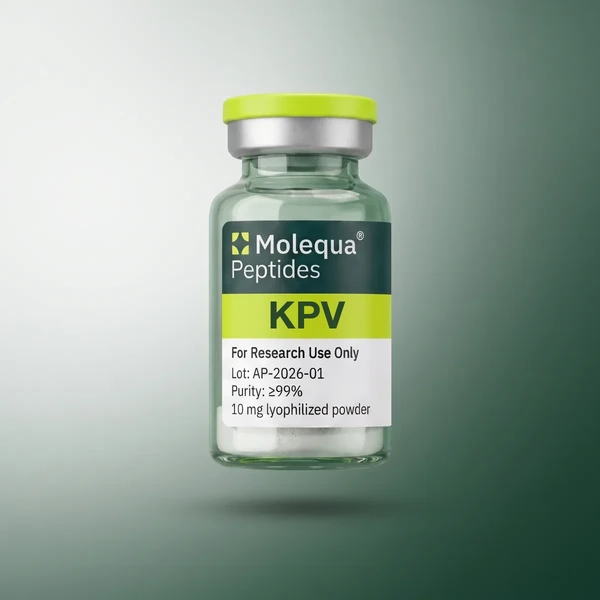
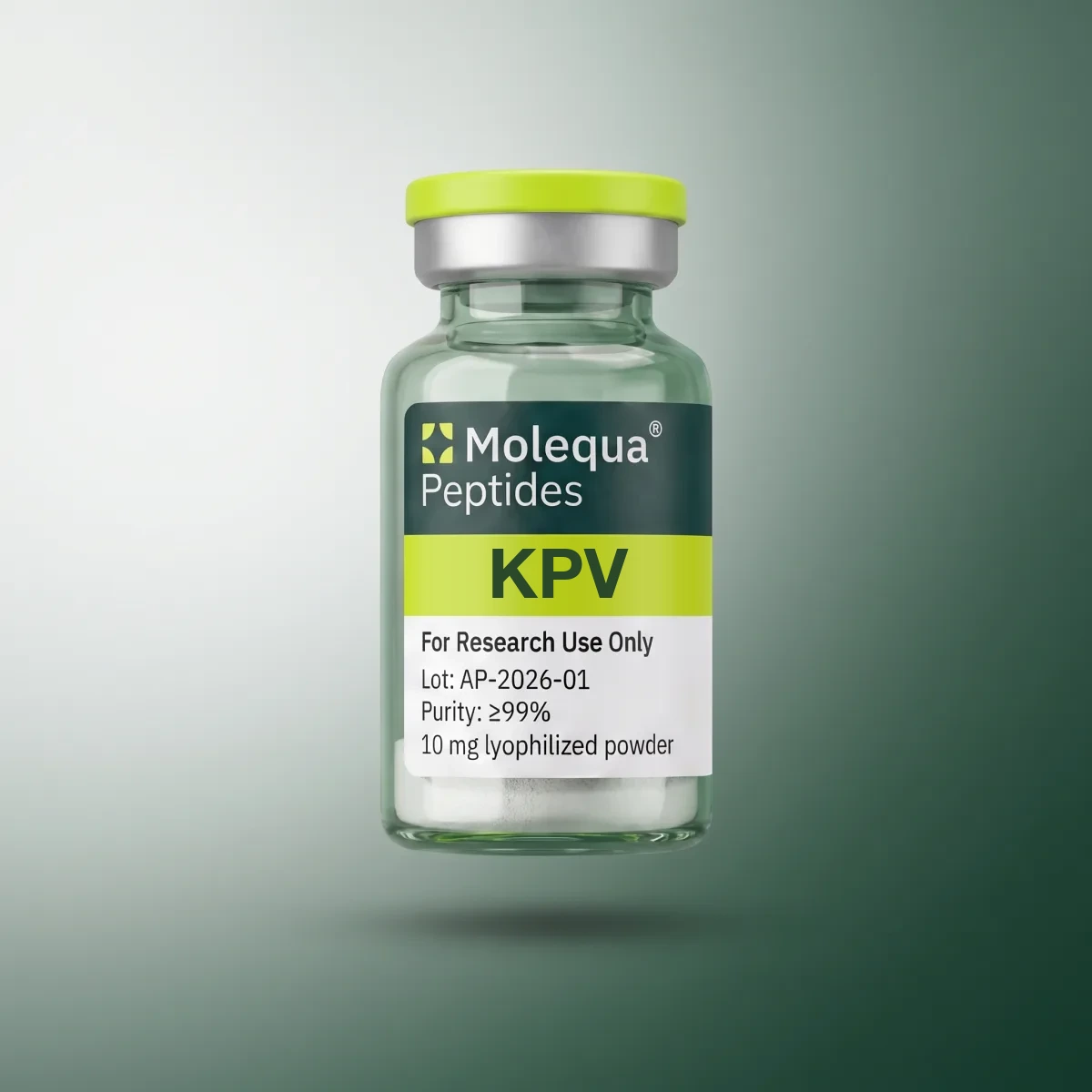
- Lyophilisate specified at ≥ 99 % HPLC purity, for laboratory research only
Read more Close
Overview
KPV, Lys-Pro-Val, alpha-MSH (11-13): the same substance
| Designation | Origin |
|---|---|
| KPV | Single-letter code of the three amino acids lysine, proline, valine |
| Lys-Pro-Val | The sequence written out, usual in publications |
| α-MSH (11-13) | Position within the parent molecule alpha-MSH |
All three names mean the same tripeptide. Throughout this text we use KPV.
Origin and reason for development
KPV is not a newly designed molecule but a naturally occurring fragment. It corresponds to the last three amino acids of alpha-melanocyte-stimulating hormone (α-MSH), an endogenous peptide of 13 amino acids.
The starting observation dates from the 1990s: α-MSH showed clear effects in inflammation models but was impractical as a research tool, because it also acts strongly on melanocortin receptors and therefore affects pigmentation. The question was whether the two properties could be separated.
The answer was the C-terminal tripeptide. Publications by Getting and colleagues showed that KPV retains activity in inflammation models, while the pigmenting component remains tied to the longer part of the molecule. A complex hormone thus became a minimally small research tool of three amino acids.
Mechanism of action in the literature
The mechanisms described differ fundamentally from those of classical receptor agonists. Two routes are chiefly discussed in the literature:
Intracellular signal modulation. KPV is small enough to be taken up into cells. Dalmasso and colleagues described in 2008 an inhibition of the NF-κB pathway, a central switch for the transcription of pro-inflammatory genes. According to the published data the effect occurs independently of melanocortin receptors.
Transport via PepT1. Uptake through the peptide transporter PepT1, which is more strongly expressed in inflamed intestinal tissue, has been described. The literature cites this as the explanation for why the effects in colitis models were particularly pronounced.
State of research in 2026
KPV is in the preclinical phase. The evidence base consists predominantly of cell-culture and animal models of inflammatory bowel disease plus dermatological models. Controlled clinical studies in humans do not exist.
Because of its small molecular size, KPV is also studied in the literature as a model substance for the question of how short a peptide can be and still show specific signalling activity.
The transporter PepT1: the decisive point
Here the evidence on KPV becomes genuinely unusual, and this is precisely the part almost always missing from commercial presentations.
PepT1 is a transporter for di- and tripeptides expressed in the gut. Its physiological task is the uptake of short fragments from protein digestion. It transports di- and tripeptides, but not longer peptides.
With its three amino acids, KPV fits that template exactly.
Dalmasso and colleagues published in Gastroenterology in 2008 that PepT1-mediated uptake of KPV reduces intestinal inflammation. Viennois and colleagues deepened this role in 2016.
The consequence is considerable and rarely spelled out: unlike almost every peptide, which digestion breaks down, KPV has an identified route of intestinal uptake. That is why a large part of the literature concerns oral administration and diseases of the digestive tract.
What the literature examines and what it does not
| Field | State of the literature |
|---|---|
| Intestinal inflammation, colitis | The dominant field, several mouse models |
| Oral delivery systems | Nanoparticles, hydrogels, targeted systems |
| Bronchial epithelium | Work on human cells, receptor MC3R |
| Antimicrobial properties | Described for the melanocortin family |
| Topical skin application | Commercially very active, literature thin |
This table deserves careful reading. KPV is often presented as a skincare peptide, whereas the focus of published research lies on the gut. The skin application is not far-fetched, since activity on human keratinocytes is described for alpha-MSH, but it is not what the main literature documents.
The question of administration
Three routes appear in the published work, and they are not equivalent.
The oral route is mechanistically the best founded, thanks to PepT1, and the more recent work on targeted carrier systems concentrates on it.
The topical route rests on the melanocortinergic activity described in keratinocytes, with a markedly thinner literature of its own.
The parenteral route is used in part of the animal models.
Regulatory placement
KPV is not authorized as a medicinal product in any jurisdiction. In the European Union medicinal-product questions fall to the EMA and the national agencies. The published work is preclinical, predominantly in mouse models and cell cultures.
Buying KPV: what to look for
When buying KPV it is not the price that decides but the verifiability of quality. A research peptide is only ever as good as its certificate of analysis. These five criteria separate serious suppliers from grey-market sellers, because from the outside lyophilized powder looks identical.
1. HPLC purity, documented rather than asserted
HPLC purity states what proportion of the powder actually is KPV and not a by-product of synthesis. Serious suppliers document the figure with a chromatogram. A purity figure without an accompanying chromatogram is an assertion, not proof.
2. Batch-specific certificate of analysis (CoA)
The most important document. A batch-specific CoA belongs to exactly the batch you receive: with batch number, date of analysis and purity value, issued by an independent laboratory. Rule of thumb: if a supplier cannot show you the CoA for the specific batch immediately, do not buy there.
3. LC-MS identity confirmation
Purity says how much of a substance is present. LC-MS says which substance it is. Via the molecular mass it confirms the correct identity and rules out the delivery of cheaper, mislabeled material.
4. Origin and EU dispatch with traceability
A supplier with a warehouse in the EU and full batch traceability has the advantage over grey imports: shorter transport routes, no customs risk, a documented path from synthesis to vial.
5. Correct supply form: lyophilizate
High-quality material is supplied as a lyophilizate, freeze-dried powder, not as a pre-mixed solution. In dry form the substance is considerably more stable and is reconstituted only immediately before use.
Legal notice: KPV is a research material and not an authorized medicinal product. It is supplied exclusively for scientific laboratory research and is not intended for human or animal consumption. It has no approved therapeutic use.
Science & studies
Key publications
Cutuli M., Cristiani S., Lipton J.M., Catania A. (2000). Antimicrobial effects of alpha-MSH peptides. J Leukoc Biol. 67(2):233 to 239. PubMed 10670585 The antimicrobial side of the melanocortin family, frequently overlooked.
Dalmasso G., Charrier-Hisamuddin L., Nguyen H.T., Yan Y., Sitaraman S., Merlin D. (2008). PepT1-mediated tripeptide KPV uptake reduces intestinal inflammation. Gastroenterology. 134(1):166 to 178. PubMed 18061177 The central paper of the whole evidence base. It documents both uptake route and effect.
Kannengiesser K., Maaser C., Heidemann J. et al. (2008). Melanocortin-derived tripeptide KPV has anti-inflammatory potential in murine models of inflammatory bowel disease. Inflamm Bowel Dis. 14(3):324 to 331. PubMed 18092346 A confirmation by an independent group in the same year.
Land S.C. (2012). Inhibition of cellular and systemic inflammation cues in human bronchial epithelial cells by melanocortin-related peptides: mechanism of KPV action and a role for MC3R agonists. Int J Physiol Pathophysiol Pharmacol. 4(2):59 to 73. PubMed 22837805 The mechanistic work on human cells, with the trail of the MC3R receptor.
Viennois E., Ingersoll S.A., Ayyadurai S. et al. (2016). Critical role of PepT1 in promoting colitis-associated cancer and therapeutic benefits of the anti-inflammatory PepT1-mediated tripeptide KPV in a murine model. Cell Mol Gastroenterol Hepatol. 2(3):340 to 357. PubMed 27458604 The deepening of the PepT1 role, eight years after the original work.
Xiao B., Xu Z., Viennois E. et al. (2017). Orally Targeted Delivery of Tripeptide KPV via Hyaluronic Acid-Functionalized Nanoparticles Efficiently Alleviates Ulcerative Colitis. Mol Ther. 25(7):1628 to 1640. PubMed 28143741 Targeted oral delivery, the direct consequence of the PepT1 mechanism.
Studies in detail
▸ Study 1: the uptake mechanism
Citation: Dalmasso G. et al. PepT1-mediated tripeptide KPV uptake reduces intestinal inflammation. Gastroenterology, 2008. PubMed 18061177
What they did: examined the transport of KPV by PepT1 in the intestinal epithelium, linking uptake to a measured effect on inflammation.
What they found: the tripeptide is taken up via this transporter, and that uptake goes together with reduced intestinal inflammation in the models used.
Why it matters: because this is exactly what sets KPV apart from other substances. An orally administered peptide is normally digested. Here the fragment size matches the template of a physiological transporter. Mechanism and route of administration fit together, which is rare in this field. On top of that, the journal is a first-rank gastroenterology title.
▸ Study 2: the independent confirmation
Citation: Kannengiesser K. et al. Melanocortin-derived tripeptide KPV has anti-inflammatory potential in murine models of inflammatory bowel disease. Inflamm Bowel Dis, 2008. PubMed 18092346
What they did: tested KPV in mouse models of chronic inflammatory bowel disease, through a group independent of Dalmasso.
What they found: an anti-inflammatory potential in those models.
Why it matters: replication by a second group, published in the same year and in a different journal, is exactly what many peptides on the market lack. The evidence on KPV does not rest on a single research group.
▸ Study 3: the mechanism in human cells
Citation: Land S.C. Inhibition of cellular and systemic inflammation cues in human bronchial epithelial cells by melanocortin-related peptides. Int J Physiol Pathophysiol Pharmacol, 2012. PubMed 22837805
What they did: examined KPV in human bronchial epithelial cells, including the signalling route via the MC3R receptor.
What they found: an inhibition of cellular inflammation signals plus indications of a role for MC3R agonists.
Why it matters: partly because these are human cells, partly because the tissue examined does not come from the gut. That argues that the mechanism is not gut-specific, even if the gut remains the best documented field.
▸ Study 4: the targeted oral delivery
Citation: Xiao B. et al. Orally Targeted Delivery of Tripeptide KPV via Hyaluronic Acid-Functionalized Nanoparticles Efficiently Alleviates Ulcerative Colitis. Mol Ther, 2017. PubMed 28143741
What they did: developed hyaluronic-acid-functionalized nanoparticles to carry KPV to the site of inflammation in the colon, tested in an ulcerative colitis model.
What they found: an attenuation of the colitis in the model used, with targeted delivery.
Why it matters: the field has left the question of whether KPV works behind it and is now concerned with pharmaceutical process engineering. That is a sign of maturity. At the same time it underlines that a plainly reconstituted powder is not the vehicle examined in this work.
Storage
Store the lyophilized powder at 2 to 8 °C protected from light, for long-term storage at −20 °C. In dry form the substance stays stable for years. After reconstitution the solution belongs in the fridge, protected from light, and according to the literature should be used within 28 days. Avoid repeated freezing and thawing, which degrades peptides measurably.
Reservation
KPV is currently available to reserve. You reserve the quantity you want without obligation and we confirm the batch and the delivery date by email. Nothing is paid at the point of reservation.
Stacking tips: frequently combined peptides
BPC-157
This is the most frequently mentioned combination. The logic follows from both peptides appearing in work on the digestive tract: BPC-157 in models of gastrointestinal damage and healing, KPV in models of intestinal inflammation.
The mechanisms described are different, however, and no publication on the combination of the two exists. The connection rests on a field analogy, not on data.
Alpha-MSH and related fragments
Comparison rather than combination. KPV is a fragment of alpha-MSH, and examining them in parallel allows exactly the determination of what the tripeptide retains from the complete hormone and what it does not. That approach is what led to the isolation of KPV in the first place.
Skin peptides
In commercial skincare KPV is frequently combined with GHK-Cu or Matrixyl. Clarity is in order here: there is no published examination of that combination, and the skin application is itself the most weakly documented part of the KPV evidence base.
Key scientific figures and citations
“PepT1-mediated uptake of the tripeptide KPV reduces intestinal inflammation.” After Dalmasso G. et al. (2008), Gastroenterology 134(1):166 to 178 PubMed 18061177
Core data from the literature
- Sequence: Lys-Pro-Val (KPV), three amino acids
- Origin: residues 11 to 13 of alpha-MSH, a hormone of thirteen amino acids
- Identified transporter: PepT1, intestinal transporter for di- and tripeptides
- Original paper: 2008, Dalmasso and colleagues, Gastroenterology
- Independent replication: 2008, Kannengiesser and colleagues, Inflamm Bowel Dis
- Receptor named in mechanistic work: MC3R
- Dominant field of the literature: intestinal inflammation
- Carrier systems examined: nanoparticles with hyaluronic acid, hydrogels
- WADA prohibited list: not affected
Figures from the cited studies
- Antimicrobial effect (Cutuli 2000, J Leukoc Biol 67(2):233 to 239): KPV corresponds to residues 11 to 13 of the thirteen-amino-acid alpha-MSH, sequence SYSMEHFRWGKPV. Activity against Staphylococcus aureus and Candida albicans was documented down to the picomolar range
- Anti-inflammatory effect in vitro (Dalmasso 2008, Gastroenterology 134(1):166 to 178): nanomolar concentrations of KPV already suppressed activation of NF-κB and MAP kinases. Entry into the cell runs through the PepT1 transporter, shown by uptake kinetics with [³H]KPV
- Two colitis models (Kannengiesser 2008, Inflamm Bowel Dis 14(3):324 to 331): DSS colitis and CD45RB^hi transfer colitis. KPV led to earlier recovery, significantly lower myeloperoxidase activity in colonic tissue and smaller inflammatory infiltrates
- Mechanistic proof through PepT1 (Viennois 2016, Cell Mol Gastroenterol Hepatol 2(3):340 to 357): in a colitis-associated cancer model (AOM/DSS), KPV prevented carcinogenesis in wild-type mice but had no effect at all in PepT1-knockout mice. The effect therefore stands or falls with the transporter
- Airways (2012, Int J Physiol Pathophysiol Pharmacol 4(2):59 to 73): in the human bronchial epithelial line 16HBE14o-, KPV produced a dose-dependent inhibition of NF-κB, of MMP-9 activity and of IL-8 and eotaxin secretion
- Targeted delivery (Xiao 2017, Mol Ther 25(7):1628 to 1640): hyaluronic-acid nanoparticles carrying KPV had a size of about 272.3 nm and a zeta potential of about −5.3 mV. Marketing authorisation: none, all data are preclinical
Reference sources (PubMed)
- Cutuli M. et al. (2000). Antimicrobial effects of alpha-MSH peptides. J Leukoc Biol 67(2):233 to 239. PubMed 10670585
- Dalmasso G. et al. (2008). PepT1-mediated tripeptide KPV uptake reduces intestinal inflammation. Gastroenterology 134(1):166 to 178. PubMed 18061177
- Kannengiesser K. et al. (2008). Melanocortin-derived tripeptide KPV has anti-inflammatory potential in murine models of inflammatory bowel disease. Inflamm Bowel Dis 14(3):324 to 331. PubMed 18092346
- Land S.C. (2012). Inhibition of cellular and systemic inflammation cues in human bronchial epithelial cells by melanocortin-related peptides. Int J Physiol Pathophysiol Pharmacol 4(2):59 to 73. PubMed 22837805
- Viennois E. et al. (2016). Critical role of PepT1 in promoting colitis-associated cancer and therapeutic benefits of the anti-inflammatory PepT1-mediated tripeptide KPV in a murine model. Cell Mol Gastroenterol Hepatol 2(3):340 to 357. PubMed 27458604
- Xiao B. et al. (2017). Orally Targeted Delivery of Tripeptide KPV via Hyaluronic Acid-Functionalized Nanoparticles Efficiently Alleviates Ulcerative Colitis. Mol Ther 25(7):1628 to 1640. PubMed 28143741
Regulatory status: KPV is not authorized as a medicinal product in any jurisdiction. The published work is preclinical, predominantly in mouse models and cell cultures. In the European Union medicinal-product questions fall to the EMA and the national agencies. The product offered here is a reagent exclusively for scientific laboratory research (RUO).
Frequently asked questions about KPV
What is KPV and what is it used for in research?
KPV is a tripeptide of lysine, proline and valine and corresponds to the last three amino acids (11 to 13) of the hormone alpha-MSH. In the preclinical literature it is examined predominantly in models of inflammatory processes, particularly in the gut and in the skin.
What does the abbreviation KPV stand for?
For the single-letter codes of the three amino acids: K for lysine, P for proline, V for valine. The full designation is Lys-Pro-Val.
How does KPV differ from alpha-MSH?
Alpha-MSH is a peptide of 13 amino acids with additional effects on pigmentation via melanocortin receptors. KPV is only its C-terminal fragment. The literature describes the fragment as showing inflammation-modulating properties without the pigmenting component.
Is KPV an authorized medicinal product?
No. KPV is not authorized and is supplied exclusively as research material for laboratory research, not for use in humans.
Does KPV derive from alpha-MSH?
Yes. It corresponds to residues 11 to 13 of alpha-MSH, that is, its C-terminal end. It retains the anti-inflammatory activity described for the hormone, without the fragment responsible for pigmentation.
What is PepT1 and why does it matter?
An intestinal transporter for di- and tripeptides whose natural task is the uptake of short fragments from digestion. With three amino acids KPV fits that template. From this follows an identified route of oral uptake, unlike most peptides.
Is KPV a skin peptide?
That is how it is usually presented commercially, but the focus of the published literature is on the gut. The skin application is not unfounded, since activity on human keratinocytes is described for alpha-MSH, but it is markedly more weakly documented.
Does the evidence rest on a single research group?
No, and that is a strength. The original paper by Dalmasso and the confirmation by Kannengiesser appeared in the same year, from independent groups, in two different journals.
Does a reconstituted solution correspond to the vehicles of the more recent studies?
No. The more recent work uses nanoparticles or hydrogels designed to reach the colon specifically. Transferring their results to a simple solution is not justified.
Is KPV on the WADA prohibited list?
No.