




Overview
What bacteriostatic water is and why it is indispensable in the laboratory
Bacteriostatic water (abbreviated BAC water) is sterile water to which a small proportion of a preservative has been added, specifically 0.9% benzyl alcohol. It is precisely this one gram of benzyl alcohol per every 100 milliliters that turns ordinary sterile water into a tool that has become the absolute standard when working with lyophilized (freeze-dried) research peptides.
To understand why it is so important, one must picture the fundamental problem of laboratory practice. Research peptides are supplied in lyophilized form, as a white or light cream powder in a glass vial sealed with a rubber stopper. In this dry form they are stable for months to years. However, in order to be used in any experiment, they must first be dissolved in a liquid, this process is called reconstitution. And this is exactly where the question arises: with which liquid?
The answer might seem simple, with water. But ordinary tap water contains minerals, chlorine, and microorganisms. Not even distilled water is sterile. And even if we use sterile water for injection (WFI, water for injection), we run into another problem: as soon as you pierce the rubber stopper of the vial with a needle and withdraw part of the solution, bacteria from the air can enter the remainder through the same opening. With repeated withdrawal over several days, the solution gradually becomes contaminated and spoiled.
Bacteriostatic water elegantly solves this problem. Benzyl alcohol acts bacteriostatically, it does not kill bacteria immediately, but reliably suppresses their growth and multiplication. Thanks to this, you can pierce the same peptide vial and withdraw from it gradually over days to weeks, without the solution spoiling. It is precisely this property that has made it an inseparable part of every laboratory that works with peptides in small, gradually withdrawn doses.
Where it comes from and how it is manufactured
Bacteriostatic water is not a modern invention, the concept of preserved sterile water with benzyl alcohol has been used in laboratory and pharmaceutical practice for decades. Benzyl alcohol itself is an organic compound naturally occurring in many plants (for example in the essential oils of jasmine or hyacinth) and has long been used in the food industry and cosmetics as a safe preservative.
The manufacture of bacteriostatic water takes place under controlled sterile conditions. Highly purified water (typically water for injection, which has undergone multiple distillation or reverse osmosis) is mixed with a precisely measured amount of benzyl alcohol so that the resulting concentration is exactly 0.9% (weight/volume). The mixture is then filtered through sterilizing filters (0.22 µm) and filled into sterile vials in an aseptic environment. Each batch undergoes sterility testing.
The result is a clear, colorless liquid without odor (or with a very faint characteristic odor of benzyl alcohol), ready to serve as a reliable solvent for sensitive peptide molecules.
Why 0.9%
The figure 0.9% is not random. This concentration represents an optimal compromise between two conflicting requirements. On one hand, you need enough benzyl alcohol to reliably suppress bacterial growth throughout the entire period of vial use. On the other hand, you do not want to increase its concentration unnecessarily, higher concentrations could interfere with sensitive peptides or affect their stability. Through decades of practice, the concentration of 0.9% has become established as a value that provides reliable bacteriostatic protection while remaining gentle to most peptide structures.
Science & use
How exactly benzyl alcohol works at the molecular level
To understand why bacteriostatic water is so effective, one must look at what benzyl alcohol does to bacteria. The distinction between the terms bactericidal (killing bacteria) and bacteriostatic (suppressing their growth) is key here.
Benzyl alcohol acts primarily by disrupting the bacterial cell membrane. The cell membrane is a thin layer that separates the interior of the cell from its surroundings and controls what enters and leaves the cell. Benzyl alcohol, as a lipophilic (fat-adhering) molecule, embeds itself into this membrane and disrupts its structure and permeability. The cell subsequently loses the ability to maintain internal equilibrium, its metabolic processes slow down, and it stops multiplying.
Importantly, at a concentration of 0.9% this effect is primarily bacteriostatic, not bactericidal. This means that benzyl alcohol does not produce immediate sterilization, but instead creates an environment hostile to bacterial growth. Thus, if a few microorganisms from the air enter during withdrawal from the vial, they have no chance to multiply to a level that would spoil the solution. This is exactly what you need for repeated withdrawal over days.
Why bacteriostatic water is the standard for peptide reconstitution
In laboratory practice, the choice of solvent is governed by several requirements at once, and bacteriostatic water meets them all:
- Neutrality toward the peptide, it has a near-neutral pH and contains no salts or ions that could react with the peptide molecule or affect its stability
- Compatibility, it works with the vast majority of common research peptides without causing precipitation, aggregation, or degradation
- Extended solution shelf life, thanks to the preservative, the reconstituted solution lasts substantially longer with proper storage than with sterile water
- Safety of repeated withdrawal, a single vial serves for multiple withdrawals over days, which is essential when working with small doses
- Availability and standardization, it is an established, well-documented solvent familiar to everyone who works with peptides
When something else is used
For completeness, it should be added that bacteriostatic water is not the only possible solvent, merely the most common. In some specific research protocols, alternatives are used:
- Sterile water for injection (WFI), when the entire contents of the vial are used at once and a preservative is not needed
- Physiological saline (0.9% NaCl), in some applications requiring an isotonic environment
- Acidic solvents (e.g. dilute acetic acid), for peptides that dissolve poorly or aggregate at neutral pH (for example, some hydrophobic sequences)
- Bacteriostatic physiological saline, a combination of preservative and isotonicity
For the vast majority of common research peptides, however, bacteriostatic water is the first choice and the recommended standard.
Storage & stability
How long it lasts, both before and after reconstitution
The stability of bacteriostatic water and the reconstituted solution depends on the phase you are in:
Unopened vial of bacteriostatic water:
- Store at room temperature, protected from direct light
- Shelf life according to the date on the packaging (typically months to years)
Peptide reconstituted with bacteriostatic water:
- Store at 2–8 °C (a standard refrigerator), protected from light
- Use within 14 to 30 days depending on the specific peptide
- More sensitive peptides (for example LL-37 or SS-31) may have shorter stability, follow the documentation for the given peptide
Peptide reconstituted with sterile water without preservative:
- Substantially shorter shelf life, typically up to 7 days, since protection against microbial growth is absent
Practical storage rules
- Let the vial warm to room temperature before opening (15–20 min). A cold vial + warm air = condensation of moisture inside.
- Do not freeze after reconstitution. Crystallization during freezing and thawing can damage the peptide structure. The reconstituted solution belongs in the refrigerator, not the freezer.
- Darkness is your ally. UV light gradually degrades peptides as well as the solution itself. Store in the original vial or in dark packaging.
- Do not decant or handle unnecessarily. Every opening and piercing is an opportunity for contamination, even despite the preservative, the principle of minimal handling applies.
Bacteriostatic water vs other solvents
To make it clear why bacteriostatic water is the preferred choice, let us compare it with the most common alternatives:
| Property | Bacteriostatic water | Sterile water (WFI) | Physiological saline (0.9% NaCl) |
|---|---|---|---|
| Preservative | 0.9% benzyl alcohol | none | none |
| Repeated withdrawal | yes, days to weeks | no, single-use | limited |
| Solution stability | 14–30 days | 1–2 days | 1–2 days |
| pH | neutral | neutral | neutral |
| Salt content | none | none | isotonic (salt) |
| Recommended for | multiple draws from a single vial | single use of the entire vial | specific isotonic protocols |
Comparison summary: if you plan to withdraw from a single peptide vial gradually over several days, which in research work with small doses is almost always the case, bacteriostatic water is the clear choice. Sterile water makes sense only when you use up the entire contents of the vial at once.
Tips & common mistakes
Even experienced users make mistakes that spoil an otherwise high-quality peptide. Here are the most common ones:
- Injecting water directly onto the lyophilizate, a strong jet can denature the peptide.
- Shaking instead of swirling, mechanical stress breaks the peptide structure.
- Reconstituting a cold vial, condensation of moisture affects the lyophilizate.
- Freezing the reconstituted solution, crystallization damages the peptide. Store in the refrigerator, not the freezer.
- Using ordinary or distilled water, it is neither sterile nor preserved, a risk of contamination and spoilage.
- Storing in light, UV degrades peptides. Keep in the dark.
- Exceeding the stability period, after 14–30 days, degradation products may accumulate. Track the reconstitution date.
Key figures & facts
- 0.9%, the concentration of benzyl alcohol, the optimal compromise between protection and gentleness toward peptides
- 14–30 days, typical stability of a peptide reconstituted with bacteriostatic water at 2–8 °C
- 7 days, typical stability when using sterile water without a preservative
- 2–8 °C, recommended storage temperature of the reconstituted solution
- 0.22 µm, pore size of the sterilizing filter during manufacturing
- 10 ml, standard vial volume, sufficient to reconstitute several peptide vials
Frequently asked questions about bacteriostatic water
What is bacteriostatic water used for?
Bacteriostatic water is the standard solvent for reconstituting lyophilized (freeze-dried) research peptides in a laboratory setting. It contains 0.9% benzyl alcohol as a preservative, thanks to which a single peptide vial can be withdrawn from gradually over days to weeks without the solution being spoiled by contamination.
What is the difference between bacteriostatic and sterile water?
The main difference is the preservative. Sterile water for injection (WFI) contains no preservative, so after the vial is pierced it lasts only 1–2 days. Bacteriostatic water contains 0.9% benzyl alcohol, which suppresses bacterial growth and extends the solution’s stability to 14–30 days, allowing repeated withdrawal from a single vial.
Why should water not be injected directly onto the lyophilizate?
A strong jet of water striking the powdered lyophilizate directly can mechanically damage (denature) the sensitive peptide structure.
How long does a peptide last after reconstitution with bacteriostatic water?
With proper storage at 2–8 °C, protected from light, most peptides last 14 to 30 days. More sensitive peptides (for example LL-37 or SS-31) may have shorter stability, always follow the documentation for the specific peptide.
Why should a peptide not be frozen after reconstitution?
Crystallization of water during freezing and subsequent thawing can mechanically damage the peptide structure. The reconstituted solution therefore belongs in the refrigerator (2–8 °C), not the freezer. Only the dry lyophilizate is stored in the freezer before reconstitution.
Can I use physiological saline instead of bacteriostatic water?
In some specific protocols, yes, but physiological saline (0.9% NaCl) contains no preservative, so it has shorter solution stability, similar to sterile water. For routine reconstitution with repeated withdrawal, bacteriostatic water is more suitable thanks to its extended shelf life.
Where to buy bacteriostatic water in the EU for research use?
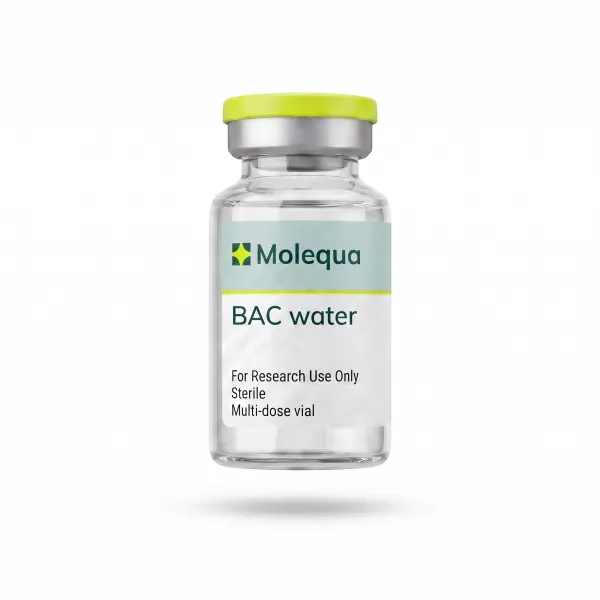
Bacteriostatic water for laboratory and analytical purposes is offered by Molequa® with delivery within the EU in 1–3 business days. The product comes from controlled sterile manufacturing with clear documentation. It is intended strictly for laboratory scientific research (RUO).
For research use only
Molequa® bacteriostatic water is intended exclusively for laboratory and analytical purposes when working with research peptides (Research Use Only, RUO). It is not a medicine, medical device, or a product intended for human or veterinary use, diagnosis, treatment, or consumption. Perform handling in accordance with applicable laboratory practice and the legislation in your jurisdiction. Before any work, study the relevant documentation.