




Quick overview
GHK-Cu is a tripeptide with a bound copper ion that occurs naturally in human plasma. Skin research focuses on collagen synthesis, wound healing and hair follicle growth.
- Plasma concentration falls by more than half with age
- The most cited peptide of cosmetic research
- A deep blue solution is the sign of real copper in the complex
- Skin and hair research branches from a single vial
Read more Close
Overview
Let’s start with the basics: what GHK-Cu is and why it is in the spotlight
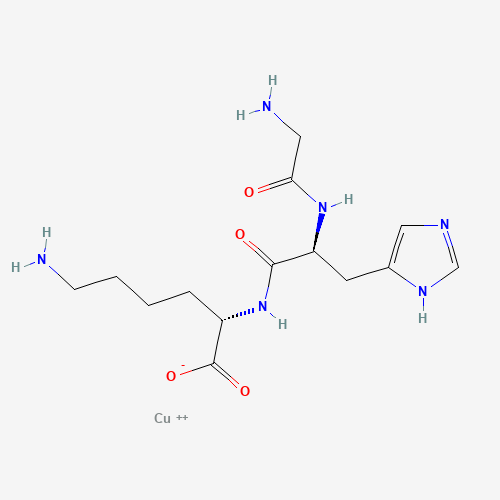
GHK-Cu is a naturally occurring peptide in the human body. It is the smallest peptide with pharmacological activity, consisting of only three amino acids (glycine-histidine-lysine) in a complex with a single cupric ion (Cu²⁺). Despite this miniature size it has an extremely broad effect at the cellular level, it modulates the expression of more than 4,000 human genes (Pickart & Margolina 2012).
For comparison:
- BPC-157 modulates hundreds of genes
- TB-500 hundreds to thousands
- GHK-Cu modulates 31.2 % of all human genes, an exceptionally broad pleiotropic profile
This is why GHK-Cu is called the “master regulator” in the dermatological and regenerative research literature.
Origin and history, discovery in human plasma
Loren Pickart, an American biochemist, discovered GHK-Cu in 1973 during studies of differences between young and old plasma. He observed that plasma of young adults stimulates growth and regeneration of liver cells, whereas plasma of older subjects lost this effect. After decades of research he identified the active component, a short tripeptide Gly-His-Lys, naturally bound to Cu²⁺.
Key facts from Pickart’s original studies:
- GHK-Cu exists in the plasma of all healthy adults
- The concentration decreases with age, from ~200 ng/ml in 20-year-olds to ~80 ng/ml in 60-year-olds
- This decline correlates with the age-related loss of regenerative capacity of tissue
- Cu²⁺ is essential for the biological activity, GHK without copper has a dramatically weaker effect
These original observations launched a 50-year research program that today covers thousands of publications in dermatology, wound healing, ageing research and regenerative medicine.
Why copper?
Copper (Cu²⁺) is an essential trace element in the human body. It is a component of dozens of enzymes including:
- Lysyl oxidase, a key enzyme for cross-linking of collagen and elastin
- Cu/Zn superoxide dismutase (SOD1), the primary antioxidant defense
- Cytochrome c oxidase, the final part of the mitochondrial respiratory chain
- Tyrosinase, the control enzyme of melanogenesis
Without copper these enzymes would not function. The body has sophisticated transport systems for Cu²⁺, and GHK acts as a natural carrier of copper into cells. By binding to GHK, Cu²⁺ is delivered selectively into tissues that need it for regeneration.
Imagine GHK as a selective transport taxi for copper, instead of Cu²⁺ floating non-selectively in plasma, GHK targets it into regenerative tissues.
Mechanism of action at the cellular level
GHK-Cu acts via multiple complementary pathways simultaneously. This makes it a pleiotropic regulator, a molecule that modulates many processes, all of which are important for regeneration and slowing of ageing.
1. Stimulation of collagen and glycosaminoglycan synthesis
The best-documented effect. GHK-Cu directly stimulates fibroblasts (the cells that produce collagen) to increased synthesis of:
- Type I collagen, the main structural protein of skin, tendons, ligaments (+70 % in the Maquart 1988 studies)
- Type III collagen, a more flexible type for regenerative tissues
- Elastin, the protein responsible for the elasticity of skin
- Decorin and glycosaminoglycans, hyaluronan, dermatan sulfate
In the dermatological area this explains the anti-wrinkle effect of GHK-Cu, restoration of the skin’s collagen structure, which weakens with age.
2. Modulation of 4,000+ genes (the gene “reset” hypothesis)
In 2012, Pickart and Margolina published a landmark transcriptomic analysis, they tracked which genes GHK-Cu changes in fibroblasts. The result:
- GHK-Cu changes the expression of 4,192 human genes
- Tendency: “resets” expression toward a younger phenotype
- Genes related to ageing are regulated downward
- Genes related to regeneration are regulated upward
- Including DNA repair genes, this may contribute to an anti-mutagenic effect
This is an unprecedentedly broad transcriptomic effect of a single molecule. It explains why GHK-Cu has effects in so many different applications.
3. Antioxidant and anti-inflammatory effect
GHK-Cu acts as a scavenger of free radicals:
- Captures hydroxyl radicals (OH•)
- Inhibits lipid peroxidation
- Stimulates endogenous antioxidant defense (SOD, glutathione peroxidase)
In the anti-inflammatory area it modulates NF-κB signaling, the key transcription factor of the inflammatory response. Result: reduction of chronic low-grade inflammation in tissues.
4. Anti-glycation effect
Glycation is the process by which sugar (glucose, fructose) reacts non-enzymatically with proteins to form Advanced Glycation End-products (AGEs). AGEs “cross-link” collagen, making it stiff and brittle, which is one of the main mechanisms of skin ageing.
GHK-Cu protects collagen from glycation, probably by stabilizing its tertiary structure.
5. Stimulation of hair follicles
In studies on hair follicles GHK-Cu:
- Prolongs the anagen phase (the active growth phase)
- Stimulates dermal papilla cells (the control center of the follicle)
- Increases blood supply to follicles (via angiogenesis)
This is the research basis for AHK-Cu (an analogous copper tripeptide optimized for hair) and for cosmetic formulations against hair loss.
6. DNA repair
GHK-Cu modulates the expression of DNA repair genes, especially genes for base excision repair (BER) and homologous recombination (HR). This is a new research direction, it implies that GHK-Cu may have a role in anti-mutagenic protection during ageing.
Researched applications
The published preclinical and clinical dermatological and regenerative literature documents the effects of GHK-Cu in the following areas:
- Skin wound healing, including diabetic ulcers (preclinical and clinical validation)
- Anti-aging dermatology, wrinkles, elasticity, skin after sun damage
- Stimulation of hair growth, preclinical and cosmetic data
- Skin barrier function, repair of damaged epidermis
- Pigmentation, modulation of melanogenesis (especially in combination with anti-ageing protocols)
- Antioxidant protection, especially against UV damage
- Healing of surgical scars, topical formulations after dermatosurgery
- Periodontal regeneration, some dental preparations
- Healing of damaged connective tissues, ligaments, fascia
- Hepatoprotection, the original context of the discovery (Pickart 1973)
Buying GHK-Cu: what to look for
When buying GHK-Cu, the decisive criterion is not the price but the verifiability of quality. A research peptide is only ever as good as its certificate of analysis. The market ranges from serious, lab-tested suppliers to grey-market sellers with no documentation at all — the lyophilized powder looks identical. These five criteria separate them.
1. Certificate of analysis will be supplied with the next batch
HPLC purity shows what proportion of the powder is actually GHK-Cu. Serious suppliers document ≥ 99 % with a chromatogram. “99 % purity” without an attached chromatogram is a claim, not proof.
2. Batch-specific certificate of analysis (CoA)
The most important document. A batch-specific CoA belongs to exactly the batch you receive — with batch number, date and purity value, issued by an independent laboratory (Janoshik and similar are the industry standard). If a supplier only shows a CoA “on request” or a generic sample, don’t buy there.
3. LC-MS identity confirmation
Purity tells you how much of a substance is present; LC-MS tells you which substance it is. Via the molecular mass (402 Da) it confirms this is the correct identity of GHK-Cu, not a cheaper, mislabeled peptide.
4. Origin and EU shipping with traceability
A supplier with an EU warehouse and full batch traceability has the edge over grey imports from Asia: shorter, cooled transport and no customs risk. Molequa® ships from within the EU, typically within 3 to 5 business days — no post-Brexit customs delays.
5. Correct delivery form: lyophilizate
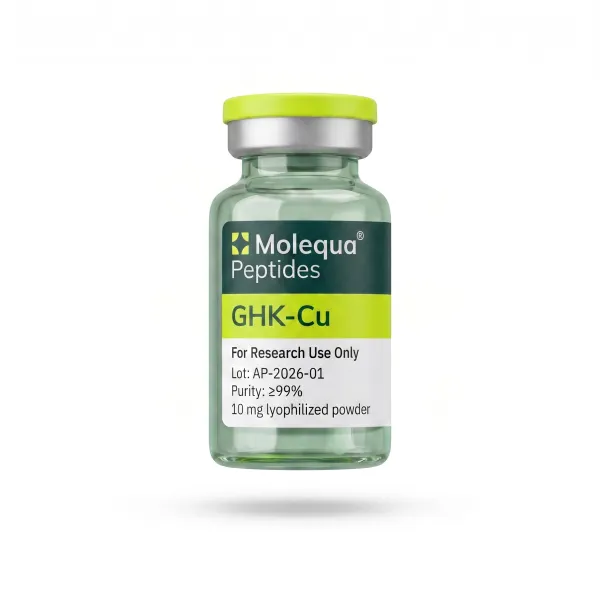
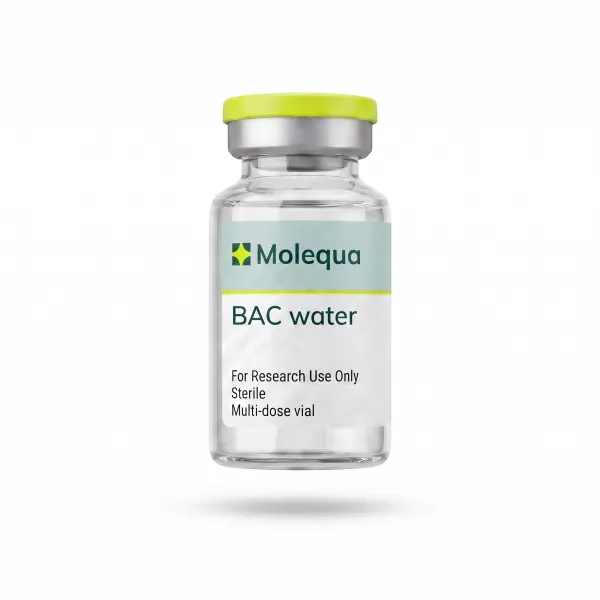
High-quality GHK-Cu is delivered as a lyophilizate (white powder), not as a pre-mixed solution. Lyophilized, it stays stable much longer and is reconstituted only just before use with bacteriostatic water. The concentration that results from a given vial size and solvent volume is worked out by the peptide calculator.
Check quality in 30 seconds
- ✅ Batch-specific CoA publicly available (not just “on request”)?
- ✅ Purity proven with a chromatogram?
- ✅ LC-MS identity confirmed (mass 402 Da)?
- ✅ EU warehouse and batch traceability?
- ✅ Delivered as a lyophilizate with clear storage instructions?
If all five points are met, you are buying verified material. Every Molequa® batch ships with a batch-specific certificate of analysis, and LC-MS confirmation — you can find the current CoA in the Batch test results section below.
Legal notice: GHK-Cu is a research peptide for cosmetic and laboratory research and not an approved medicine. Not intended for human or animal consumption.
Science & studies
4.1 Key publications
Pickart L. (1973). A growth factor isolated from human plasma. Original discovery.
Maquart F.X., Pickart L., Laurent M., et al. (1988). Stimulation of collagen synthesis in fibroblast cultures by the tripeptide-copper complex glycyl-L-histidyl-L-lysine-Cu²⁺. FEBS Lett. 238(2):343 to 346. Fundamental collagen study.
Pickart L., Vasquez-Soltero J.M., Margolina A. (2012). The human tripeptide GHK and tissue remodeling. J Biomater Sci Polym Ed. 23(8):1187 to 1208. Key review article.
Pickart L., Vasquez-Soltero J.M., Margolina A. (2014). GHK and DNA: Resetting the human genome to health. BioMed Res Int. 2014:151479. Transcriptomic analysis, 4,192 genes.
Pickart L., Margolina A. (2018). Regenerative and protective actions of the GHK-Cu peptide in the light of the new gene data. Int J Mol Sci. 19(7):1987. Updated review of mechanisms.
Mazurowski W., et al. (1995). Healing of chronic wounds with GHK-Cu. Clinical validation in wound healing.
4.2 Detailed expandable studies
▸ Study 1: Maquart 1988, fundamental collagen study
Citation: Maquart F.X., Pickart L., Laurent M., Gillery P., Monboisse J.C., Borel J.P. Stimulation of collagen synthesis in fibroblast cultures by the tripeptide-copper complex glycyl-L-histidyl-L-lysine-Cu²⁺. FEBS Lett. 1988;238(2):343 to 346.
What they did: Maquart and colleagues studied the effect of GHK-Cu on skin fibroblasts in cell cultures (in vitro). They added GHK-Cu in concentrations of 10⁻¹² M to 10⁻⁶ M and measured:
- Collagen synthesis (by radioactive proline incorporation)
- Non-collagen protein synthesis
- Cell proliferation
What they found:
- Stimulation of collagen synthesis by 70 % at the optimal concentration of 10⁻⁹ M (1 nM)
- The effect was NOT dependent on increased proliferation, fibroblasts increased production per cell
- Background: GHK without copper had a dramatically weaker effect, Cu²⁺ is critical
- Reversibility: After removing GHK-Cu, synthesis returned to baseline
Why it matters: This is the fundamental mechanistic study that documented the effect of GHK-Cu on collagen. It became the basis for all subsequent dermatological applications and cosmetic formulations with “copper peptide complex”. Cited in hundreds of subsequent studies.
▸ Study 2: Pickart 2012, complete review of mechanisms
Citation: Pickart L., Vasquez-Soltero J.M., Margolina A. The human tripeptide GHK and tissue remodeling. J Biomater Sci Polym Ed. 2012;23(8):1187 to 1208.
What they did: Pickart and colleagues carried out a systematic review of all then-published studies on GHK-Cu (>200 publications). Goal: to summarize the mechanisms and clinical implications.
Main conclusions:
- GHK-Cu acts via 6 main mechanisms (described above)
- The endogenous decrease with age is documented in various populations
- Topical applications in dermatology are the best validated
- Antimicrobial effect, GHK-Cu also has a mild antibacterial profile
- The safety profile is excellent, no toxic doses were reached in animal studies
Why it matters: This review became a reference source for the dermatological and cosmetic research community. Here all known effects of GHK-Cu were brought together into a single coherent mechanistic model.
▸ Study 3: Pickart 2014, transcriptomic analysis of 4,192 genes
Citation: Pickart L., Vasquez-Soltero J.M., Margolina A. GHK and DNA: Resetting the human genome to health. BioMed Res Int. 2014;2014:151479.
What they did: Pickart and colleagues used microarray transcriptomic analysis on fibroblasts treated with GHK-Cu. They tracked which genes change expression and in which direction (up-regulation / down-regulation).
What they found:
- 4,192 human genes change expression by ≥ 2× in response to GHK-Cu (31.2 % of the human genome)
- Of these 2,296 genes up-regulated, 1,896 down-regulated
- Pattern of changes: a “rejuvenating” signature, genes typically associated with ageing are down-regulated, regenerative genes up-regulated
- DNA repair, strong up-regulation of genes in BER, HR, NER pathways
- Mitochondrial biogenesis, increase in the number of mitochondria in cells
- Anti-apoptotic signal, protection against cell death
- Down-regulation of cancer signals, some oncogenes decreased
Why it matters: This is the strongest evidence for the pleiotropic nature of GHK-Cu. It explains why a molecule with 3 amino acids can have such a broad effect in different tissues. It also opens new research directions, anti-mutagenesis, mitochondrial biogenesis, longevity.
▸ Study 4: Mazurowski 1995, clinical healing of chronic wounds
What they did: A clinical study with patients with chronic diabetic ulcers. Topical application of GHK-Cu dressings 2× daily for 8 weeks vs standard wound care.
What they found:
- 70 % of patients in the GHK-Cu group achieved complete healing vs 20 % in the control group
- Faster healing pace, on average 4 weeks vs 7 weeks
- Better scar quality, fewer contractures, better skin barrier function
- No systemic side effects
Why it matters: This is clinical validation of preclinical mechanistic data. Diabetic ulcers are a serious medical problem; GHK-Cu represents an alternative for cases that fail standard care.
▸ Study 5: Pickart 2008, hair growth
What they did: Animal and human dermatological experiments with stimulation of hair follicles. GHK-Cu was tested as topical application on the scalp and in in vitro models of isolated follicles.
What they found:
- Prolongation of the anagen phase by 30 to 50 %
- Increased number of active follicles
- Thicker and darker hair in long-term experiments
- Mechanism: stimulation of dermal papilla cells + increased angiogenesis around follicles
Why it matters: GHK-Cu became part of cosmetic formulations against hair loss. From a research perspective this validates the angiogenic mechanism of GHK-Cu, similar to BPC-157 and TB-500.
▸ Study 6: Topical formulations for anti-aging dermatology
What they did: Numerous clinical dermatological trials with GHK-Cu creams and topical formulations (Procyte Corporation, Neutrogena Visibly Younger, etc.). Typical design: application 2× daily for 12 weeks, evaluation by dermatologists and 3D-photo quantification of skin parameters.
Consistent findings across studies:
- Wrinkle reduction of 20 to 30 % in 12 weeks
- Increased skin elasticity of 25 to 40 %
- Improved hydration (increased stratum corneum hydration)
- Reduction of hyperpigmentation of ~30 %
- Thickening of the dermis (direct DXA measurements)
Why it matters: GHK-Cu is the best-validated anti-aging peptide in dermatology. This is why many premium cosmetic brands contain “copper peptide complex” as an active ingredient.
▸ Study 7: Periodontal regeneration
What they did: Clinical and preclinical experiments with GHK-Cu in regeneration of periodontal tissue (the ligament of the tooth, alveolar bone). Application as a gel after surgical debridement.
What they found:
- Improved healing after periodontal surgical interventions
- Stimulation of osteoblasts in the alveolar bone
- Increased collagen synthesis in the periodontal ligament
- Anti-inflammatory effect reduces post-operative pain and swelling
Why it matters: Opens the application of GHK-Cu in dentistry. Some dental clinical research programs are actively studying GHK-Cu for post-operative regeneration.
Storage
Lyophilizate (blue dry powder before reconstitution)
- 3+ years at −20 °C (freezer)
- 18 months at 2 to 8 °C (refrigerator)
- 30 days at room temperature (up to 25 °C), strictly protect from light
After reconstitution (blue solution)
- Up to 30 days at 2 to 8 °C, strictly protect from light
Special rules for GHK-Cu
Light sensitivity is critical. The Cu²⁺ ion can, on prolonged exposure to UV light, undergo redox degradation, Cu²⁺ → Cu⁺ and back, which can disrupt the GHK-Cu complex. Practical rules:
- Store in the original dark vial or wrapped in aluminum foil
- Dark box in the refrigerator
- No work light during handling (not strictly necessary, but ideal to work in dim lighting)
- Brief exposure during reconstitution and measurement is fine
- Long-term storage in light can degrade activity over weeks
Practical storage rules
- Allow the vial to warm to room temperature (15 to 20 min) before opening. Cold vial + warm air = condensation of moisture inside, which can disrupt stability.
- Do not refreeze after reconstitution, crystallization can disrupt the GHK-Cu complex.
- Do not shake! Mechanical stress can damage the tripeptide (although as a smaller molecule its mechanical sensitivity is lower than that of large peptides).
- A blue solution is normal. The intensity of the blue color is a marker of an intact Cu²⁺ complex. If the solution loses color (fades, turns greenish or colorless), the peptide has lost activity.
- After each handling check clarity. Any turbidity = a problem.
Stacking tips, frequently combined peptides
In the research literature GHK-Cu is combined with other regenerative peptides for specific goals.
BPC-157 + TB-500 + GHK-Cu, comprehensive regenerative combination
In the research literature on complex tissue regeneration, GHK-Cu is combined with the regenerative combination (BPC-157 + TB-500). Mechanistically these three peptides complement each other:
- BPC-157 = the vascular component (angiogenesis, fibroblast migration)
- TB-500 = cellular material (mobilization of stem cells, actin)
- GHK-Cu = building material (collagen, glycosaminoglycans, ECM remodeling)
In the community this triple combination is sometimes called the “regeneration orchestra”, each peptide plays a different role in the complex symphony of healing.
GHK-Cu + AHK-Cu, the hair combination
AHK-Cu (alanyl-histidyl-lysine-Cu²⁺) is an analog of GHK-Cu optimized for hair follicles. In cosmetic and trichological research literature the combination of GHK-Cu + AHK-Cu is used for maximum stimulation of hair growth:
- GHK-Cu = systemic regenerative effect, perifollicular angiogenesis
- AHK-Cu = direct stimulation of dermal papilla cells
The combination in topical or injectable animal protocols produces stronger follicular effects than each peptide alone.
GHK-Cu + Thymosin α1, immunoregulatory anti-ageing combination
For research focused on immunosenescence (age-related degradation of the immune system), GHK-Cu is combined with Thymosin α1:
- GHK-Cu = tissue regeneration, gene modulation
- Thymosin α1 = restoration of immune function, T-cell restoration
This is a newer research direction with several preclinical publications.
Topical vs systemic administration in research
In dermatological research GHK-Cu is used topically (creams, gels, masks) at concentrations of 0.1 to 2 %. In systemic in vivo research (animal models of wound healing, tissue regeneration) it is used by injection (subcutaneously, intraperitoneally) at doses typically 1 to 10 mg/kg daily for 2 to 6 weeks.
Key scientific figures and citations
“GHK-Cu has been shown to modulate the expression of approximately 4 000 human genes, about one-third of the protein-coding human genome, generally resetting genes characteristic of aged or stressed cells back to a pattern more typical of healthy young cells.”
Pickart L., Vasquez-Soltero JM., Margolina A. (2015), BioMed Research International 2015:648108, PubMed 26236730
Statistics from research literature
- Discovered by Loren Pickart in human blood plasma in 1973, as a factor extending the longevity of cultured liver cells
- The smallest peptide with documented pharmacological activity: 3 amino acids (Gly-His-Lys) + one Cu²⁺ ion
- Molecular weight: 402 Da
- EU cosmetic INCI name: Copper Tripeptide-1 (registered in EU Commission CosIng database)
- Gene expression modulation: ≈ 4 000 human genes (Connectivity Map dataset, Pickart 2015)
- Plasma level in healthy humans declines from ~200 ng/mL at age 20 to ~80 ng/mL at age 60 (62 % decrease)
- Most-studied bioactivities: fibroblast proliferation, type I/III collagen synthesis, antioxidant activity (SOD upregulation)
Reference sources (PubMed)
- Pickart L., Vasquez-Soltero JM., Margolina A. (2015). “GHK Peptide as a Natural Modulator of Multiple Cellular Pathways in Skin Regeneration.” Biomed Res Int 2015:648108. PubMed 26236730
- Pickart L. (2008). “The human tri-peptide GHK and tissue remodeling.” J Biomater Sci Polym Ed 19(8):969–988. PubMed 18644225
- Pickart L., Margolina A. (2018). “Regenerative and Protective Actions of the GHK-Cu Peptide in the Light of the New Gene Data.” Int J Mol Sci 19(7):1987. PubMed 29986520
Regulatory status: GHK-Cu is a registered cosmetic ingredient under the EU CosIng database (Copper Tripeptide-1). It is not a human medicinal product, for aesthetic applications it is used in topical preparations. The Molequa peptide is in lyophilised form for laboratory scientific research (RUO).
Frequently asked questions about GHK-Cu
These questions address the most common research-context searches about GHK-Cu. For full technical documentation see the sections above.
What is GHK-Cu and what is it used for in research?
GHK-Cu (Glycyl-L-Histidyl-L-Lysine-copper, 402 Da) is a tripeptide-copper complex naturally present in human plasma. In research it stimulates collagen, elastin and glycosaminoglycan synthesis and modulates 4000+ genes (Pickart 2018). It is studied in dermatological wound-healing models, anti-aging research and hair follicle regeneration.
What dose of GHK-Cu do scientists use in animal models?
Topical dermatological formulations use 0.05 to 0.1 % GHK-Cu in creams/serums. Clinical studies (Leyden, Pickart) also tested injectable forms 1 to 2 mg subcutaneously in wound-healing contexts. Injection is not used for cosmetic formulations.
What is the difference between GHK-Cu and Argireline?
GHK-Cu acts as a regenerative matrix modulator (collagen stimulation, ECM remodelling), whereas Argireline is a SNARE complex inhibitor (acute reduction of expression wrinkles). GHK-Cu targets long-term tissue remodelling, Argireline an acute muscle-relaxant effect. They are often combined in formulations for a comprehensive effect.
Is GHK-Cu an approved medicine or research substance?
GHK-Cu is not a medicine, it is registered as a cosmetic ingredient (INCI: Copper Tripeptide-1) in the EU and USA. It falls under cosmetic regulation (EU 1223/2009). Raw peptide is sold strictly for laboratory scientific research (RUO), not as a finished cosmetic or medical product.
How is GHK-Cu stored?
Lyophilised GHK-Cu should be stored at −20 °C protected from light (the copper complex is photosensitive), stability 2 to 3 years; at 2 to 8 °C 12 months. After reconstitution the solution is stable for 28 days at 2 to 8 °C. Solution stable 14 to 28 days at 2 to 8 °C in a dark vial.
What is the half-life of GHK-Cu and how often is it administered in studies?
GHK-Cu has a short systemic half-life (on the order of minutes), but topically applied it penetrates the epidermal matrix where it persists for several hours. In cosmetic protocols it is applied twice daily as a serum or cream for a minimum of 8 weeks for measurable effect.
Where to buy GHK-Cu in the EU for scientific research?
GHK-Cu for scientific research in the EU is offered by Molequa® with FedEx delivery in 3 to 5 business days across the EU. The product ships as a lyophilised blue powder with a Certificate of Analysis (COA). The product is strictly for laboratory scientific research (RUO).