




Quick overview
Cagrilintide is a long-acting analogue of amylin, the satiety hormone of the pancreas. In metabolic research it complements the GLP-1 pathway, and combined with semaglutide (CagriSema) it is in phase 3 clinical testing.
- Amylin satiety pathway, a complement to GLP-1 molecules
- The CagriSema combination is in phase 3
- Lipidation enables weekly research protocols
- Acetate salt with a declared sequence in the technical data sheet
Read more Close
Regulatory status. Cagrilintide is in active clinical development. An investigational compound intended exclusively for research and scientific purposes.
Overview
Let’s start with the basics: what amylin is and why it is different from GLP-1
In the Semaglutide and Tirzepatide products we saw how the incretin hormones GLP-1 and GIP regulate appetite and glycemia via the enteroendocrine system (a signal from the gut). Cagrilintide acts via a completely different pathway, modulation of the amylin system.
Amylin (also known as IAPP, Islet Amyloid Polypeptide) is a 37-amino-acid peptide hormone that the β-cells of the pancreas release together with insulin during every meal. This means amylin is not a competitor of insulin, it is its partner, released at the same time and in the same contexts.
The functions of amylin are complementary to insulin and to GLP-1:
- Slows gastric emptying, similarly to GLP-1, but more strongly
- Suppresses glucagon, helps control postprandial glycemia
- Induces satiety, via the area postrema in the brainstem
- Regulates weight balance, long-term effect
In type 2 diabetes amylin secretion deteriorates in parallel with insulin secretion, as the disease progresses, the β-cells lose the ability to produce both hormones at once. This means that a T2DM diabetic has an amylin deficit as much as an insulin deficit. Supplementation of amylin could restore the lost homeostatic signaling.
The problem with native amylin, amyloid aggregation
Here comes an interesting complication. Human amylin has a strong tendency to aggregate into amyloid fibrils, similarly to amyloid β in Alzheimer’s or α-synuclein in Parkinson’s. These amyloid aggregates are toxic to β-cells and are linked to the pancreatic pathophysiology of T2DM.
For therapeutics this means: native human amylin cannot be administered as a drug, it aggregates already in the syringe and in the subcutis. The solution? Chemical modification to remove the amyloidogenic motifs.
Pramlintide, the first generation (1990s)
In the 1990s, the pharmaceutical company Amylin Pharmaceuticals developed Pramlintide, a modified amylin with three proline substitutions at positions 25, 28 and 29. Proline, with its rigid cyclic structure, disrupts the amyloid arrangement, Pramlintide does not aggregate and is therapeutically usable.
In 2005 the FDA approved Pramlintide under the brand name Symlin for type 1 and 2 diabetes. The problem: very short half-life (~50 minutes) and 3× daily injections at meals, an extremely impractical regimen. Commercially Pramlintide never achieved major success.
Cagrilintide, the second generation (2020s)
Novo Nordisk took the Pramlintide concept and applied the same half-life extension strategy that they used with Semaglutide:
- Kept the proline substitutions (anti-amyloid)
- Added a C20 fatty diacid via a γ-Glu linker to a lysine residue, albumin binding
- Additionally stabilized the N- and C-terminal positions
Result: Cagrilintide with a half-life of 6.6 days (vs 50 minutes for Pramlintide). This enables weekly dosing, the same regimen as Semaglutide, parallel clinical convenience.
The CagriSema strategy, the power of combination
The main innovation of Cagrilintide is not in stand-alone use, but in combination with Semaglutide. Novo Nordisk created CagriSema, a fixed combination of Cagrilintide + Semaglutide in a single injector (1× weekly). The mechanistic hypothesis:
- Semaglutide activates GLP-1R, appetite suppression, glycemic control
- Cagrilintide activates amylin receptors, appetite suppression via the area postrema, slowing of gastric evacuation
- Two independent mechanisms of appetite suppression → a supra-additive effect
In Phase 1b and Phase 2 trials the combination showed a stronger effect than either component alone:
- Semaglutide alone: −14.9 % (STEP-1)
- Cagrilintide alone (Phase 2): −10.8 %
- CagriSema combination (Phase 2): −15.6 %
- CagriSema Phase 3 (REDEFINE 1): −25.3 %
CagriSema thus becomes the largest body-weight signal reported in the published incretin literature to date, stronger than Tirzepatide (−22.5 % in SURMOUNT-1) and comparable to Retatrutide.
Development status, where Cagrilintide is in 2026
Cagrilintide is in Phase 3 clinical trials as part of the CagriSema combination. The main ongoing studies:
- REDEFINE 1, Phase 3 obesity without T2D (results 2024–2025, preliminarily −25.3 %)
- REDEFINE 2, Phase 3 obesity + T2D
- REDEFINE 3, Phase 3 cardiovascular outcome trial (n~7000)
Stand-alone clinical development of Cagrilintide is limited, Novo Nordisk is primarily investing in the CagriSema combination. FDA approval is expected at the earliest in 2026–2027 for CagriSema. The commercial name has not yet been revealed.
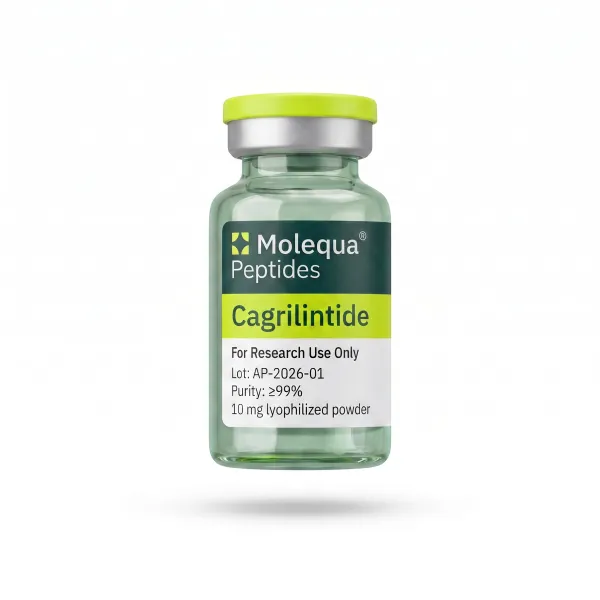
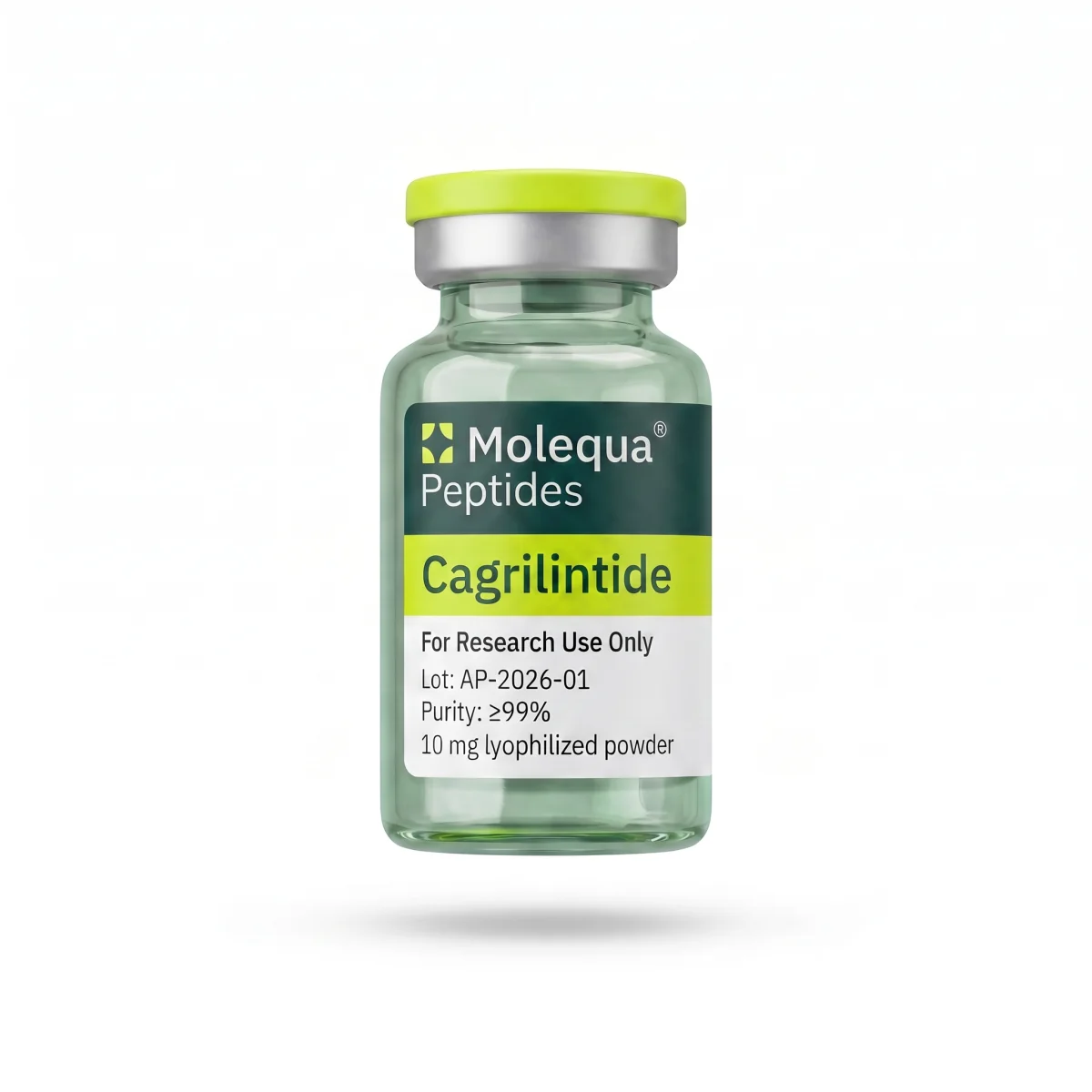
Molequa® supplies a pure lyophilized form of Cagrilintide identical to the API used in Novo Nordisk trials. For research the pure form is more flexible, it allows testing of stand-alone Cagrilintide as well as experimental combinations.
Mechanism of action, the amylin receptor complex
Cagrilintide activates amylin receptors, these are special receptor complexes composed of two components.
The amylin receptor, calcitonin receptor + RAMP
The amylin receptor is not a stand-alone molecule. It is a dimeric complex composed of:
- The calcitonin receptor (CTR), a GPCR
- The RAMP protein (Receptor Activity Modifying Protein), 1, 2 or 3
Depending on the type of RAMP, three different amylin receptors arise:
- AMY1: CTR + RAMP1, primarily in the CNS (area postrema, hypothalamus)
- AMY2: CTR + RAMP2, peripheral tissues
- AMY3: CTR + RAMP3, bone tissue, some CNS
Cagrilintide activates all three amylin receptors, but the primary therapeutic effect is via AMY1 in the area postrema (brainstem, where nausea and satiety signals are processed).
Activation in the area postrema (AP)
The area postrema is a “circumventricular organ”, a region of the brain that has no blood-brain barrier, so peptide hormones from the blood have direct access to it. Amylin and Cagrilintide activate CGRP-like neurons in the AP that project to:
- Nucleus tractus solitarius (NTS), autonomic center
- Parabrachial nucleus, integration of taste and satiety
- Hypothalamic pathways, energy balance
The result: strong central appetite suppression and stabilization of satiety between meals.
Peripheral effects
Via the AMY2 and AMY3 receptors Cagrilintide acts peripherally:
- Slowing of gastric emptying, stronger than with GLP-1
- Suppression of postprandial glucagon, helps control postprandial glycemic spikes
- Modulation of bone remodeling (via AMY3), a neutral effect, but clinically monitored
Synergy with GLP-1 (the mechanistic basis of CagriSema)
The main innovation is the complementarity with the GLP-1 pathway:
- GLP-1 suppresses appetite via the arcuate nucleus of the hypothalamus (POMC neurons, AgRP/NPY inhibition)
- Amylin suppresses appetite via the area postrema (CGRP-like neurons)
Two independent centers, two independent mechanisms. With combined activation (CagriSema) the effect does not add linearly, but supra-additively, which is why the combination has a stronger clinical result than either component alone.
Researched applications
In the published preclinical and clinical literature the effects of Cagrilintide are documented in the following areas:
- Obesity (stand-alone), Phase 2 data (Lau 2021, −10.8 % at 4.5 mg)
- Obesity + Semaglutide (CagriSema), Phase 3 REDEFINE 1 (−25.3 %)
- T2DM + obesity, Phase 3 REDEFINE 2
- Cardiovascular prevention, Phase 3 REDEFINE 3 (n ~ 7000)
- MASLD/MASH, exploratory in Phase 2
- Type 2 diabetes (monotherapy), preclinical data
- Prediabetes, exploratory plans
Science & studies
4.1 Key publications
Lau D.C.W., Erichsen L., Francisco A.M., et al. (2021). Once-weekly cagrilintide for weight management in people with overweight and obesity: a multicentre, randomised, double-blind, placebo-controlled and active-controlled, dose-finding phase 2 trial. Lancet. 398(10317):2160–2172., Pivotal Phase 2 monotherapy.
Enebo L.B., Berthelsen K.K., Kankam M., et al. (2021). Safety, tolerability, pharmacokinetics, and pharmacodynamics of concomitant administration of multiple doses of cagrilintide with semaglutide 2.4 mg for weight management: a randomised, controlled, phase 1b trial. Lancet. 397(10286):1736–1748., CagriSema Phase 1b proof-of-concept.
Frias J.P., Deenadayalan S., Erichsen L., et al. (2023). Efficacy and safety of co-administered once-weekly cagrilintide 2·4 mg with once-weekly semaglutide 2·4 mg in type 2 diabetes: a multicentre, randomised, double-blind, active-controlled, phase 2 trial. Lancet. 402(10403):720–730., Phase 2 in T2DM.
Novo Nordisk REDEFINE 1 Topline Results (2024). Phase 3 trial of CagriSema in obesity without T2DM., Phase 3 results 2024.
Hay D.L., Chen S., Lutz T.A., et al. (2015). Amylin: Pharmacology, Physiology, and Clinical Potential. Pharmacol Rev. 67(3):564–600., Review article on amylin biology.
Lutz T.A. (2010). The role of amylin in the control of energy homeostasis. Am J Physiol Regul Integr Comp Physiol. 298(6):R1475–R1484., Basic mechanism.
4.2 Detailed expandable studies
▸ Study 1: Lau 2021, pivotal Phase 2 monotherapy
Citation: Lau D.C.W., Erichsen L., Francisco A.M., et al. Once-weekly cagrilintide for weight management. Lancet. 2021;398(10317):2160–2172.
What they did: A multinational randomized controlled study. n = 706 adults with overweight/obesity (BMI ≥ 27 + comorbidity or BMI ≥ 30), without T2DM. Six arms: Cagrilintide at doses 0.3, 0.6, 1.2, 2.4, 4.5 mg/week SC vs Liraglutide 3.0 mg/day vs placebo. Duration: 26 weeks. 4-week titration. All received lifestyle intervention.
What they found:
- Cagrilintide 4.5 mg: −10.8 % weight reduction vs −3.0 % placebo (p < 0.001)
- Dose-response confirmed, higher doses = stronger effect
- Cagrilintide 4.5 mg vs Liraglutide 3.0 mg: −10.8 % vs −9.0 %, Cagrilintide numerically stronger
- 48 % of patients at 4.5 mg achieved ≥10 % reduction vs 12 % placebo
- Most frequent side effects: GI (nausea 31 %, diarrhea 21 %)
- Safety profile comparable to Liraglutide
Why it matters: The study was the first major validation of Cagrilintide as a stand-alone anti-obesity molecule. It demonstrated that amylin agonism can be clinically effective, not only as an adjuvant, but also as monotherapy. The numerically superior effect vs Liraglutide was a surprise and paved the way for the CagriSema combination program.
▸ Study 2: Enebo 2021, CagriSema Phase 1b proof-of-concept
Citation: Enebo L.B., Berthelsen K.K., Kankam M., et al. Concomitant administration of cagrilintide with semaglutide 2.4 mg. Lancet. 2021;397(10286):1736–1748.
What they did: n = 96 adults with overweight/obesity. Randomization: combination Cagrilintide (0.16–4.5 mg) + Semaglutide 2.4 mg vs Semaglutide 2.4 mg alone vs placebo. Duration: 20 weeks. Evaluation: safety, tolerability, pharmacokinetics, preliminary efficacy.
What they found:
- CagriSema combination safe and tolerated, no unexpected interactions
- Pharmacokinetics of Cagrilintide and Semaglutide in combination unchanged vs monotherapy (no drug-drug interactions)
- Preliminary efficacy: CagriSema −17.1 % vs Semaglutide alone −9.8 % in the 20-week window
- Side effects: predominantly GI (nausea, vomiting, diarrhea), relatively similar to Semaglutide monotherapy
- Continuous weight reduction until the end of the study (no plateau)
Why it matters: The study was a proof-of-concept for the CagriSema combination. It showed that:
- The combination is safe, no synergistic toxicities
- The combination is supra-additive, effect larger than the sum of components
- No pharmacokinetic interactions, the molecules do not interfere with each other’s elimination
It opened the way to the Phase 2 and Phase 3 REDEFINE program.
▸ Study 3: Frias 2023, Phase 2 in T2DM
Citation: Frias J.P., Deenadayalan S., Erichsen L., et al. Cagrilintide with semaglutide 2.4 mg in type 2 diabetes. Lancet. 2023;402(10403):720–730.
What they did: n = 92 patients with T2DM inadequately controlled on metformin (HbA1c 7.0–10.0 %). Randomization: CagriSema (Cagrilintide 2.4 mg + Semaglutide 2.4 mg) vs Semaglutide 2.4 mg vs Cagrilintide 2.4 mg vs placebo. Duration: 32 weeks. Primary endpoint: change in HbA1c.
What they found:
- HbA1c reduction: CagriSema −2.2 %, Semaglutide −1.8 %, Cagrilintide −0.7 %, placebo −0.2 %
- % of patients with HbA1c < 7.0 %: CagriSema 89 %, Semaglutide 73 %, Cagrilintide 47 %
- % of patients with HbA1c < 5.7 % (normoglycemic range): CagriSema 53 %, comparable to SURPASS-2 (Tirzepatide 46.1 %)
- Weight loss: CagriSema −15.6 %, Semaglutide −5.1 %, Cagrilintide −8.1 %
- GI side effects ~10 % higher with CagriSema vs monotherapy
Why it matters: The study validated CagriSema also in the T2DM population. Particularly interesting was:
- Weight effect 3× stronger than with Semaglutide alone in the T2DM population
- Glycemic control superior to Semaglutide alone
- % of patients achieving normoglycemia comparable to Tirzepatide in SURPASS-2
It opened the debate whether CagriSema can be a direct competitor of Tirzepatide in the T2DM + obesity indication.
▸ Study 4: REDEFINE 1 Phase 3, preliminary results
Citation: Novo Nordisk Press Release (2024). REDEFINE 1: Phase 3 trial of CagriSema in obesity without T2DM, Topline results.
What they did: n = 3,417 adults with obesity (BMI ≥ 30 or BMI ≥ 27 + comorbidity), without T2DM. Randomization: CagriSema 2.4 mg/2.4 mg vs Semaglutide 2.4 mg vs Cagrilintide 2.4 mg vs placebo. Duration: 68 weeks. Primary endpoint: percentage change in body weight.
What they found (preliminary):
- CagriSema −25.3 % vs placebo −3.0 %
- CagriSema vs Semaglutide alone: difference of ~10 percentage points in favor of CagriSema
- CagriSema vs Cagrilintide alone: ~15 percentage points in favor of CagriSema
- >40 % of patients achieved ≥25 % weight reduction, historically unprecedented
- Safety profile in line with Phase 2 data
Why it matters: REDEFINE 1 confirmed CagriSema as the largest body-weight signal reported in the published incretin literature to date. The figure −25.3 % surpasses:
- Tirzepatide SURMOUNT-1: −22.5 %
- Semaglutide STEP-1: −14.9 %
- Retatrutide Phase 2: −24.2 % (comparable, but Phase 3 results for Retatrutide are still lacking)
It raises the question whether CagriSema will be the first molecule with an effect truly comparable to bariatric surgery (typically 25–30 % reduction). FDA approval is expected in 2026.
▸ Study 5: Hay 2015, review article on amylin biology
Citation: Hay D.L., Chen S., Lutz T.A., et al. Amylin: Pharmacology, Physiology, and Clinical Potential. Pharmacol Rev. 2015;67(3):564–600.
What they did: A review article summarizing 30 years of amylin research. Covers: biochemistry of amylin, receptor biology (CTR + RAMP complex), physiological functions, clinical applications, the Pramlintide experience, perspectives for long-acting analogs.
What they found (summary):
- Amylin is a critical partner of insulin in metabolism, the loss of amylin in T2DM is as significant as the loss of insulin
- The AMY1 receptor in the area postrema is the primary target for the appetite effect
- Amyloid aggregation is the main problem with native amylin, proline substitutions (the Pramlintide strategy) are essential
- The half-life of native amylin is only 13 minutes, that is why lipidated analogs like Cagrilintide are necessary
- Perspective: amylin + GLP-1 combinations are the natural evolution of metabolic pharmacotherapy
Why it matters: This is the reference article for amylin pharmacology. Hay (Auckland) and Lutz (Zurich) are two key researchers in amylin biology. For the research context the article is key for understanding why the amylin + GLP-1 combination makes mechanistic sense.
▸ Study 6: Lutz 2010, basic mechanism
Citation: Lutz T.A. The role of amylin in the control of energy homeostasis. Am J Physiol Regul Integr Comp Physiol. 2010;298(6):R1475–R1484.
What they did: A review article by Thomas Lutz (University of Zurich), one of the main authors in amylin biology. Covers: animal models of appetite, acute vs chronic amylin effects, lesion studies of the area postrema, combined effects with leptin and CCK.
What they found (summary):
- Amylin acts primarily in the area postrema, lesioning the area postrema abolishes the anorexigenic effect of amylin
- Acute vs chronic effect: acute, suppression of feeding; chronic, maintenance of weight balance
- Synergy with leptin, amylin restores leptin sensitivity in obese models
- Synergy with CCK and GLP-1, multi-pulse pathways of appetite suppression
- No tolerance, chronic administration of amylin preserves efficacy
Why it matters: Lutz’s review article established the scientific basis for amylin pharmacotherapy of obesity. For the research context it is key for understanding why amylin analogs do not develop tolerance with chronic use (unlike many other anti-obesity molecules).
▸ Study 7: REDEFINE 3, cardiovascular outcome trial (ongoing)
Citation: NCT05669755, REDEFINE 3 Phase 3 trial. Sponsor: Novo Nordisk. Primary results expected 2026–2027.
What they did: n = ~ 7,000 adults with obesity and high CV risk. Randomization: CagriSema 2.4 mg/2.4 mg vs Semaglutide 2.4 mg vs placebo. Duration: 4–5 years. Primary endpoint: composite MACE (cardiovascular death, non-fatal myocardial infarction, non-fatal stroke).
Hypothesis: Thanks to a stronger weight loss, CagriSema should lead to a superior reduction of MACE compared to Semaglutide in SELECT (where Semaglutide reduced MACE by 20 %).
Why it matters: REDEFINE 3 will be key for regulatory and clinical adoption of CagriSema. SELECT established Semaglutide as CV-protective therapy, CagriSema must demonstrate at least equivalent CV safety for broad clinical practice. If it can demonstrate superior MACE reduction, it will shift to first line in cardiovascular prevention in obese patients.
CoA, Certificate of Analysis
Quality specification (CoA with the first batch)
The values below are the release specification the first batch is tested against. The signed CoA is added as soon as it is issued.
- Purity: ≥ 99.1 % (HPLC-UV at 220 nm)
- Identity: confirmed by mass spectrometry (MS, ESI+, MW 3,924.38 Da)
- Endotoxins: < 0.5 EU/mg (LAL test, measurement of contamination by bacterial toxins)
- Microbial contamination: meets USP <61>
- Residual solvents: meets ICH Q3C
- TFA residues: < 1.0 %
- Profile of related impurities: deamidated forms, oxidized forms, des-amino versions < 0.5 % each
- Amyloid aggregation screening (HPLC SEC), < 1 % aggregated form
[Download CoA (PDF)] · [Download SDS (PDF)]
Independent analytical laboratory (3rd party verification). Original manufacturing CoA available on request for B2B partners.
Note on amyloid aggregation: Cagrilintide has proline substitutions at positions 25, 28, 29, which dramatically reduce the amyloidogenic potential. Despite this, with improper storage the molecule can undergo gradual aggregation. For every batch we perform size exclusion chromatography (SEC) to monitor aggregates. Molequa® guarantees < 1 % aggregated form in the lyophilizate.
Storage
Lyophilizate (dry powder before reconstitution)
- 2 years at −20 °C (freezer)
- 12 months at 2–8 °C (refrigerator)
- Only short-term (up to 14 days) at room temperature, Cagrilintide is more sensitive to aggregation at higher temperatures
- Protect from light and moisture
After reconstitution (peptide in solution with bacteriostatic water)
- Up to 21 days at 2–8 °C, protected from light
- Cagrilintide has slightly shorter shelf life than Semaglutide because of its amyloid tendency
Practical storage rules
- Allow the vial to warm to room temperature (15–20 min) before opening.
- Do not refreeze after reconstitution, freezing/thawing accelerates the amyloid aggregation of Cagrilintide.
- Darkness is your friend, UV light can catalyze conformational changes.
- Do not shake! Mechanical stress promotes amyloid nucleation, with amylin analogs this is particularly critical.
- The solution should remain clear. A turbid or viscous solution is a sign of aggregation, do not use.
Stacking tips, frequently combined peptides
In the research literature Cagrilintide is primarily positioned as a combination component, especially with Semaglutide.
Semaglutide, the primary combination partner (CagriSema)
The most extensively studied combination for Cagrilintide. CagriSema is the canonical combination that in Phase 3 REDEFINE 1 reported −25.3 % body-weight reduction, among the largest values published in the incretin literature to date.
Clinical CagriSema protocol:
- Cagrilintide 2.4 mg + Semaglutide 2.4 mg
- Weekly SC, fixed combination in a single injector
- 16-week titration from 0.25/0.25 mg to 2.4/2.4 mg
For research replication: Molequa® offers both peptides separately, you can reconstitute and administer them individually. Clinical data support administration on the same day or in the same injection (if mixed), no proven pharmacokinetic interactions.
Tirzepatide or Retatrutide, an alternative, NOT a combination
Tirzepatide and Retatrutide are competing multi-receptor molecules. The combination with Cagrilintide is not studied in the literature and theoretically:
- Cagrilintide + Tirzepatide would lead to a three-way appetite suppression (GIP + GLP-1 + amylin), potentially supra-additive, but with the risk of strong nausea and loss of muscle mass
- Cagrilintide + Retatrutide would be a four-way activation, highly speculative
For research it is an alternative, not a combination, choose one strategy.
AOD-9604 / HGH Fragment 176-191, complementary lipolytic profile
CagriSema markedly reduces appetite and weight. AOD-9604 or HGH Fragment 176-191 add peripheral lipolysis via β3-AR. In the research context for separating the effect on central satiety vs peripheral lipolysis. Hypothetical research combination.
MOTS-c, mitochondrial support
With the rapid weight reduction caused by CagriSema, mitochondrial function in muscle tissue also decreases. MOTS-c can compensate for this decline and support muscle endurance during the reduction phase.
BPC-157 and TB-500, anti-catabolic complement
CagriSema causes the strongest weight reduction of all incretin regimens, the risk of sarcopenia is proportionally the highest. BPC-157 and TB-500 in combination with resistance training can reduce the loss of muscle mass.
Ipamorelin + CJC-1295, anabolic counterweight
For the same reason (muscle catabolism during rapid reduction), in research a combination with the GH combination is described, anabolic signaling pathways in opposition to the catabolic pressure from caloric deficit.
Key scientific figures and citations
“Cagrilintide is a long-acting amylin analogue that, when combined with semaglutide, produced clinically meaningful and dose-dependent weight loss in adults with overweight or obesity.”
Enebo LB. et al. (2021), Lancet 397(10286), PubMed 33894838
Statistics from preclinical literature
- Cagrilintide (development code AM833), a long-acting amylin analogue, 32 amino acids, molecular weight 3.795 kDa
- Developed at Novo Nordisk (Denmark) as part of the CagriSema combination program (cagrilintide + semaglutide)
- Target: amylin receptors (AMY1, AMY2, AMY3) + secondarily the calcitonin receptor, extended half-life via a C16 fatty acid linker
- Standard dose in clinical trials: 0.16–4.5 mg/week subcutaneously (Phase 1b/2)
- Phase 2 (Enebo 2021, n=96): 17.1 % reduction in body weight with CagriSema 2.4 mg + 2.4 mg over 20 weeks vs 9.8 % with semaglutide alone
- REDEFINE 1 Phase 3 (2024, preliminary data): 22.7 % weight reduction with CagriSema 2.4 mg/2.4 mg over 68 weeks
- Status: Phase 3 completed 2024–2025, FDA filing expected 2025–2026
- Approximately 25+ peer-reviewed publications in PubMed (2018–2024)
Reference sources (PubMed)
- Enebo LB. et al. (2021). “Safety, tolerability, pharmacokinetics, and pharmacodynamics of concomitant administration of multiple doses of cagrilintide with semaglutide 2·4 mg for weight management: a randomised, controlled, phase 1b trial.” Lancet 397(10286):1736–1748. PubMed 33894838
- Lau DCW. et al. (2021). “Once-weekly cagrilintide for weight management in people with overweight and obesity: a multicentre, randomised, double-blind, placebo-controlled and active-controlled, dose-finding phase 2 trial.” Lancet 398(10317):2160–2172. PubMed 34798060
- Frias JP. et al. (2023). “Efficacy and safety of co-administered once-weekly cagrilintide 2·4 mg with once-weekly semaglutide 2·4 mg in type 2 diabetes.” Lancet 402(10403):720–730. PubMed 37364590
Regulatory status: Cagrilintide is not an approved human medicinal product in any regulatory zone (FDA, EMA, or any national medicines agency) as of the publication date. The Phase 3 REDEFINE program is ongoing; FDA filing is expected 2025–2026. Existing data come from clinical trials. The product is sold strictly for laboratory scientific research (RUO).
Frequently asked questions about Cagrilintide
These questions address the most common research-context searches about Cagrilintide. For full technical documentation see the sections above.
What is Cagrilintide and what is it used for in research?
Cagrilintide is a long-acting amylin analogue (acylated 37-amino-acid peptide, 3924 Da) studied for appetite control and weight reduction. It activates amylin and calcitonin receptors in the hypothalamus. In Novo Nordisk clinical trials it is being tested in combination with semaglutide (CagriSema) in Phase 3 obesity trials.
What dose of Cagrilintide do scientists use in animal models?
Clinical trials test 0.16 to 4.5 mg subcutaneously once weekly (Lau 2021, Lancet). In combination with semaglutide (CagriSema 2.4/2.4 mg) Phase 2 demonstrated weight reduction up to −15.6 % over 32 weeks.
What is the difference between Cagrilintide and Retatrutide?
Cagrilintide acts via amylin/calcitonin receptors (satiety, delayed gastric emptying), whereas Retatrutide is a triple GLP-1/GIP/glucagon agonist. The CagriSema amylin+GLP-1 combination achieves effects comparable to Retatrutide monotherapy, but Retatrutide has a stronger standalone effect (−24 % in Phase 2).
Is Cagrilintide an approved medicine or research substance?
Cagrilintide is not approved as a standalone medicine. The CagriSema combination is in Phase 3 trials (REDEFINE program) in the EU/USA, with approval expected 2027–2028. The product is sold strictly for laboratory scientific research (RUO), not for human consumption.
How is Cagrilintide stored?
Lyophilised Cagrilintide should be stored at −20 °C protected from light, stability 2 to 3 years; at 2 to 8 °C about 12 months. After reconstitution the solution is stable for 28 days at 2 to 8 °C. For acylated peptides, avoid freezing after reconstitution.
What is the half-life of Cagrilintide and how often is it administered in studies?
Cagrilintide has a plasma half-life of approximately 159 hours (~7 days) thanks to the acylated C20 fatty acid binding to albumin, which enables once-weekly dosing. In clinical protocols it is titrated stepwise (escalation every 4 weeks) to minimise GI side effects.
Where to buy Cagrilintide in the EU for scientific research?
Cagrilintide for scientific research in the EU is offered by Molequa® with FedEx delivery in 3 to 5 business days across the EU. The product ships lyophilised with a Certificate of Analysis (COA). The product is strictly for laboratory scientific research (RUO).