




Quick overview
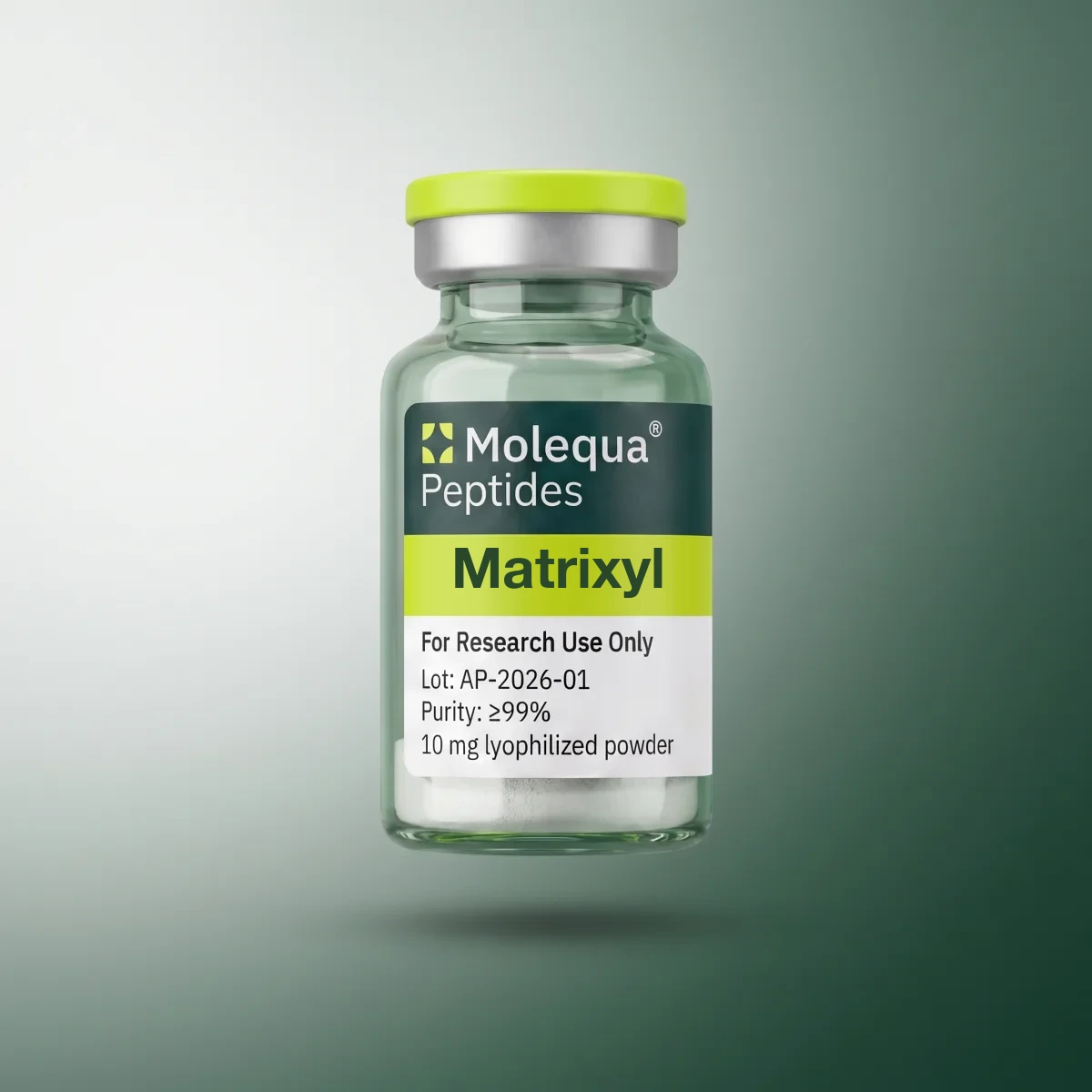
Matrixyl is the palmitoylated pentapeptide KTTKS, a fragment of the type I collagen propeptide. Fibroblast models describe stimulation of extracellular matrix production at nanomolar concentrations.
- Sequence Lys-Thr-Thr-Lys-Ser, N-terminally palmitoylated, 802.1 Da
- Pentapeptide activity identified in 1993 (Katayama et al., JBC)
- Proteins measured: collagen I, collagen III and fibronectin
- INCI name Palmitoyl Pentapeptide-4, for laboratory research only
Read more Close
Overview
Matrixyl, palmitoyl pentapeptide-4, pal-KTTKS: the same substance
| Name | Origin |
|---|---|
| Matrixyl | Brand name of the manufacturer Sederma |
| Palmitoyl pentapeptide-4 | INCI name |
| pal-KTTKS | Short form usual in publications |
| Palmitoyl pentapeptide-3 | Older INCI name for the same substance |
Not to be confused with Matrixyl 3000, a different composition of palmitoyl tripeptide-1 and palmitoyl tetrapeptide-7.
Origin and why it was developed
The starting point was a 1993 paper by Katayama. The question was which signals prompt fibroblasts to synthesize collagen. It turned out that a short fragment from the propeptide of type I collagen acts as a signal in its own right: the sequence KTTKS.
The mechanism behind it is a kind of feedback. When collagen is broken down, fragments are produced. Their presence signals to the tissue that repair is needed. KTTKS is one of those signal fragments.
For practical use one problem remained: the pentapeptide is strongly hydrophilic and barely crosses the stratum corneum. The solution was to couple it to palmitic acid, a saturated C16 fatty acid. That turned a water-soluble signal fragment into a lipophilic molecule described in the dermatological literature as able to penetrate.
Mechanism of action in the literature
Stimulation of matrix synthesis. The published cell-culture work describes increased production of type I and III collagen, fibronectin and glycosaminoglycans in dermal fibroblasts.
A signal fragment, not a building block. Important for understanding: pal-KTTKS is not described in the literature as building material but as a signal. The amount is far too small to contribute to the matrix itself; the described effect lies in triggering the cell’s own synthetic activity.
Research status 2026
For a peptide of this category the evidence base is comparatively good. There is a double-blind, placebo-controlled study by Robinson and colleagues from 2005 with 93 participants over twelve weeks.
Matrixyl is therefore among the few dermatologically studied peptides with controlled human data. The material offered here is supplied exclusively as a research reagent, not as a cosmetic and not for use on humans.
What a matrikine is and why that makes the difference
The concept of matrikines is central here and belongs stated plainly, because it explains why Matrixyl works differently from a synthetic peptide designed from scratch.
The extracellular matrix of the dermis is not an inert scaffold. It is continuously broken down and rebuilt. When a collagen fibre is cleaved by a matrix metalloproteinase, fragments are produced. Maquart and his group described in the 2000s that some of these fragments are not mere waste products: they carry information and bind to cellular receptors. Those are matrikines.
KTTKS is one of them. It comes from the C-terminal domain of the propeptide of type I collagen. Its release signals to the fibroblast that degradation has taken place, and the literature describes a synthetic response following on from that.
The principle is a feedback loop: the breakdown of the matrix itself triggers the signal to rebuild it. That is exactly what separates a signal peptide from a classical active ingredient, which imposes an effect from outside.
Palmitic acid: why the molecule does not end at the pentapeptide
Bare KTTKS raises a practical problem that cosmetic research spent years solving.
The skin barrier, more precisely the stratum corneum, is built to hold back hydrophilic molecules. KTTKS, made of lysine, threonine, threonine, lysine and serine, is markedly hydrophilic: two positively charged lysines and three hydroxylated residues. It crosses the barrier poorly.
The solution chosen was to attach a palmitic acid, a saturated fatty acid with 16 carbon atoms, to the N-terminal end. That chain alone accounts for close to a third of the 802.1 Da of the final molecule and changes its behavior fundamentally: pal-KTTKS becomes lipophilic enough to associate with the intercorneocyte lipids.
Lintner and Peschard described this principle of the lipidated peptide in 2000, in an article that became the reference for the acylation strategy in cosmetics.
The three proteins the literature measures
The publications on pal-KTTKS do not measure an anti-wrinkle effect, which would not be a scientific criterion. They measure three precisely named matrix proteins.
| Protein | Role in the dermis | What the papers report |
|---|---|---|
| Type I collagen | Tensile strength, dominant protein of the dermis | Increased synthesis in fibroblast culture |
| Type III collagen | Suppleness, predominant in young skin and repair tissue | Increased synthesis, altered III to I ratio |
| Fibronectin | Cell adhesion, organization of the matrix | Increased production |
The ratio of type III to type I collagen is a marker followed in dermatology: it is high in young skin and falls with age. It is among the parameters reported in the KTTKS papers.
Fields of application studied
The field of publications is narrower than the market suggests.
- Photoageing of the skin. The best documented field of application, with measurements of surface roughness and wrinkle depth by profilometry.
- Wound healing. The role of a matrikine in tissue repair is described, but work carried out specifically on it is scarce.
- Basic matrix research. KTTKS serves as a model for studying signalling by matrix fragments, independently of any cosmetic application.
Buying Matrixyl: what to look for
When buying Matrixyl it is not the price that decides but the verifiability of the quality. A research peptide is only ever as good as its certificate of analysis. These five criteria separate serious suppliers from grey-market sellers, because from the outside lyophilized powder looks identical.
1. HPLC purity, documented rather than claimed
HPLC purity states what proportion of the powder is actually Matrixyl and not a by-product of the synthesis. Serious suppliers document the value with a chromatogram. A purity figure without an attached chromatogram is a claim, not evidence.
2. Batch-specific certificate of analysis (CoA)
The most important document. A batch-specific CoA belongs to exactly the batch you receive: with batch number, date of analysis and purity value, issued by an independent laboratory. Rule of thumb: if a supplier cannot show you the CoA for the specific batch immediately, do not buy there.
3. LC-MS identity confirmation
Purity tells you how much of a substance is present. LC-MS tells you which substance it is. It confirms the correct identity via the molecular mass and rules out that a cheaper, mislabeled material has been shipped.
4. Origin and EU shipping with traceability
A supplier with a warehouse in the EU and full batch traceability has the advantage over grey imports: shorter transport routes, no customs risk, a documented path from synthesis to vial.
5. Correct delivery form: lyophilizate
High-quality material is delivered as a lyophilizate, freeze-dried powder, not as a premixed solution. In dry form the substance is stable for considerably longer and is reconstituted only immediately before use.
Legal notice: Matrixyl is a research material and not an approved medicine. It is supplied exclusively for scientific laboratory research and is not intended for human or animal consumption. It has no approved therapeutic use.
Science & studies
Key publications
Katayama K., Armendariz-Borunda J., Raghow R., Kang A.H., Seyer J.M. (1993). A pentapeptide from type I procollagen promotes extracellular matrix production. J Biol Chem. 268(14):9941–9944. PubMed 8486721 The founding paper. Here the sequence KTTKS is identified as the active fragment of type I procollagen, before any cosmetic application.
Lintner K., Peschard O. (2000). Biologically active peptides: from a laboratory bench curiosity to a functional skin care product. Int J Cosmet Sci. 22(3):207–218. PubMed 18503476 The article that established the acylation strategy: why attaching a fatty chain to a hydrophilic peptide changes its ability to cross the stratum corneum.
Robinson L.R., Fitzgerald N.C., Doughty D.G., Dawes N.C., Berge C.A., Bissett D.L. (2005). Topical palmitoyl pentapeptide provides improvement in photoaged human facial skin. Int J Cosmet Sci. 27(3):155–160. PubMed 18492182 The most cited cosmetic study on pal-KTTKS, with instrumental criteria.
Maquart F.X., Pasco S., Ramont L., Hornebeck W., Monboisse J.C. (2004). An introduction to matrikines: extracellular matrix-derived peptides which regulate cell activity. Implication in tumor invasion. Crit Rev Oncol Hematol. 49(3):199–202. PubMed 15036260 The conceptual framework of matrikines, indispensable for understanding the mechanism.
Choi Y.L., Park E.J., Kim E., Na D.H., Shin Y.H. (2014). Dermal Stability and In Vitro Skin Permeation of Collagen Pentapeptides (KTTKS and palmitoyl-KTTKS). Biomol Ther (Seoul). 22(4):321–327. PubMed 25143811 The direct comparison of bare and palmitoylated peptide with respect to stability and permeation. The experimental support for Lintner’s argument.
Detailed studies
▸ Study 1: identifying KTTKS as the active fragment
Citation: Katayama K. et al. A pentapeptide from type I procollagen promotes extracellular matrix production. J Biol Chem, 1993. PubMed 8486721
What they did: the group worked on the propeptides of type I collagen, the ends cleaved off as the molecule matures. Synthetic fragments of these domains were tested on fibroblast cultures, with measurement of matrix production.
What they found: the pentapeptide of lysine, threonine, threonine, lysine and serine increased the production of collagen and fibronectin in the cultures. The effect appeared at very low, nanomolar concentrations, which argues for a signalling effect and not for an effect of quantity.
Why it counts: it is the paper everything else is built on. Without it there would be no Matrixyl. It shows that a breakdown product of collagen acts as a signal to rebuild, which at the time ran against intuition.
▸ Study 2: why the bare peptide is not enough
Citation: Choi Y.L. et al. Dermal Stability and In Vitro Skin Permeation of Collagen Pentapeptides. Biomol Ther, 2014. PubMed 25143811
What they did: a direct comparison of KTTKS and pal-KTTKS with respect to two quantities: stability in a skin homogenate and permeation through skin in the diffusion cell.
What they found: the bare peptide is rapidly degraded by dermal peptidases and crosses the skin poorly. The palmitoylated form shows markedly higher stability and measurable permeation.
Why it counts: it is the experimental confirmation of a formulation decision taken fourteen years earlier. It also explains why buying cheaper, non-palmitoylated KTTKS does not give you the same product.
▸ Study 3: the cosmetic reference study
Citation: Robinson L.R. et al. Topical palmitoyl pentapeptide provides improvement in photoaged human facial skin. Int J Cosmet Sci, 2005. PubMed 18492182
What they did: a study on photoaged facial skin with topical application of a preparation containing pal-KTTKS, plus instrumental measurement of surface roughness and wrinkle depth by profilometry, alongside clinical assessment.
What they found: an improvement in the measured instrumental parameters over the vehicle alone across the study period.
Why it counts and where the limits are: it is a cosmetic study, not a medical one. The criteria are roughness and wrinkle depth, not a clinical health endpoint. The sample size is small, as in almost all work in this field. That belongs said openly: a study of this kind shows a measurable improvement in surface parameters, not a treatment.
▸ Study 4: the framework of matrikines
Citation: Maquart F.X. et al. An introduction to matrikines. Crit Rev Oncol Hematol, 2004. PubMed 15036260
What they did: a summarizing paper gathering those fragments of the extracellular matrix for which a biological activity of their own had been described, and proposing the term and conceptual framework of matrikines.
What they found: a coherent group of fragments from collagen, elastin and laminin that bind to cellular receptors and influence proliferation, migration and matrix synthesis.
Why it counts: it places KTTKS within a family rather than leaving it standing as an isolated curiosity. The mechanism is not particular to this one peptide but to a whole class of signals.
Storage
Store lyophilized powder at 2–8 °C protected from light; for long-term storage −20 °C. In dry form the substance is stable this way for years. After reconstitution the solution belongs in the fridge, protected from light, and according to the literature should be used within 28 days. Avoid repeated freezing and thawing, which degrades peptides measurably.
Reservation
Matrixyl is currently available for reservation. You reserve the quantity you want without obligation, and we confirm the batch and the delivery date by email. No payment is taken at reservation.
Stacking tips: frequently combined peptides
In the dermatological literature pal-KTTKS is rarely studied on its own. Three combinations recur, with different logic behind them.
GHK-Cu (copper peptide)
This is the mechanistically best documented combination. Both are signal peptides, but their reach differs considerably: GHK-Cu influences several thousand genes of the matrix, Matrixyl targets collagen synthesis more narrowly.
One technical point deserves attention: GHK-Cu carries a copper ion, and interactions between metal ions and peptides in a preparation are not without consequence. The available work on this exact combination is limited.
Argireline (acetyl hexapeptide-8)
A combination of complementary, not redundant mechanisms. Argireline is a neuromuscular peptide for which interference with the SNARE complex is described, while Matrixyl acts on the build-up of the matrix. One concerns contraction, the other structure.
This is the logic behind most cosmetic preparations that combine several peptides.
SNAP-8 (acetyl octapeptide-3)
A longer analogue of argireline with the same described mechanism. To be combined with Matrixyl on the same logic as argireline, without expecting any additional effect over it, since both concern the same signalling pathway.
Key scientific figures and citations
“The pentapeptide KTTKS, derived from the C-terminal propeptide of type I collagen, stimulates extracellular matrix production in fibroblasts at nanomolar concentrations.” After Katayama K. et al. (1993), Journal of Biological Chemistry 268(14):9941–9944 PubMed 8486721
Key data from the literature
- Sequence: Lys-Thr-Thr-Lys-Ser (KTTKS), N-terminally palmitoylated
- Molecular weight of pal-KTTKS: 802.1 Da, of which about 238 Da is the palmitic chain alone
- Origin: C-terminal domain of the propeptide of type I collagen
- Identification of the pentapeptide’s activity: 1993, Katayama and colleagues
- Establishment of the acylation strategy: 2000, Lintner and Peschard
- INCI name: Palmitoyl Pentapeptide-4, formerly Palmitoyl Pentapeptide-3
- Concentrations described in cosmetic preparations: about 3 to 8 ppm of active peptide
- Proteins measured in the papers: collagen I, collagen III, fibronectin
- WADA prohibited list: not affected
Figures from the cited studies
- The reference cosmetic study (Robinson 2005, Int J Cosmet Sci 27(3):155–160): n = 93 women aged 35 to 55, 12 weeks, double-blind, placebo-controlled split-face design with left-right randomisation
- A moisturiser was compared with the same moisturiser containing 3 ppm pal-KTTKS, that is 0.0003 % active. The difference in wrinkle and fine-line reduction was significant both by quantitative image analysis and by expert graders
- Skin permeation (Choi 2014, Biomol Ther 22(4):321–327): in hairless mouse skin pal-KTTKS was found in every layer, 4.2 ± 0.7 µg/cm² in the stratum corneum, 2.8 ± 0.5 µg/cm² in the epidermis and 0.3 ± 0.1 µg/cm² in the dermis
- In the same work unmodified KTTKS was detected in no layer at all, and neither compound crossed the skin into the receptor solution. Palmitoylation therefore changes distribution, not systemic penetration
- Origin of the sequence (Katayama 1993, J Biol Chem 268(14):9941–9944): KTTKS corresponds to residues 212 to 216 of the type I collagen C-propeptide, inside the larger fragment 197 to 241. It is the shortest sequence that still stimulates collagen and fibronectin production
- Cosmetic use: topical, not injected. Marketing authorisation: none, the substance is an INCI ingredient
Reference sources (PubMed)
- Katayama K. et al. (1993). A pentapeptide from type I procollagen promotes extracellular matrix production. J Biol Chem 268(14):9941–9944. PubMed 8486721
- Lintner K., Peschard O. (2000). Biologically active peptides: from a laboratory bench curiosity to a functional skin care product. Int J Cosmet Sci 22(3):207–218. PubMed 18503476
- Robinson L.R. et al. (2005). Topical palmitoyl pentapeptide provides improvement in photoaged human facial skin. Int J Cosmet Sci 27(3):155–160. PubMed 18492182
- Maquart F.X. et al. (2004). An introduction to matrikines: extracellular matrix-derived peptides which regulate cell activity. Implication in tumor invasion. Crit Rev Oncol Hematol 49(3):199–202. PubMed 15036260
- Choi Y.L. et al. (2014). Dermal Stability and In Vitro Skin Permeation of Collagen Pentapeptides (KTTKS and palmitoyl-KTTKS). Biomol Ther 22(4):321–327. PubMed 25143811
Regulatory status: Matrixyl is not an approved medicine in any jurisdiction. It is listed as a cosmetic ingredient under the INCI name Palmitoyl Pentapeptide-4. The lyophilized form offered here is a reagent exclusively for scientific laboratory research (RUO).
Frequently asked questions about Matrixyl
What is Matrixyl?
Matrixyl is a brand name for palmitoyl pentapeptide-4, a five-amino-acid peptide with the sequence Lys-Thr-Thr-Lys-Ser coupled to a palmitic acid. In the literature it usually appears as pal-KTTKS.
What does KTTKS stand for?
It is the one-letter code of the five amino acids: lysine, threonine, threonine, lysine, serine. That sequence is a fragment from the propeptide of type I collagen.
What is the palmitic acid for?
Pure KTTKS pentapeptide is hydrophilic and barely penetrates the stratum corneum. The attached palmitic acid raises lipophilicity considerably. In the dermatological literature this is described as the decisive modification for penetration.
Is Matrixyl the same as Matrixyl 3000?
No. Matrixyl 3000 is a different composition of two peptides, palmitoyl tripeptide-1 and palmitoyl tetrapeptide-7. The material offered here is palmitoyl pentapeptide-4.
How do KTTKS and pal-KTTKS differ?
KTTKS is the bare pentapeptide. Pal-KTTKS additionally carries a palmitic acid chain of 16 carbon atoms at the N-terminal end. The work of Choi and colleagues shows that this difference changes dermal stability and permeation.
At what concentrations is Matrixyl studied?
The founding papers report activity at nanomolar concentrations in fibroblast culture. In cosmetic preparations the described concentrations are around 3 to 8 ppm of active peptide.
Is Matrixyl on the WADA prohibited list?
No. Unlike several research peptides, pal-KTTKS is not affected by it.
Why does the powder dissolve slowly?
The palmitic chain makes the molecule considerably harder to dissolve in an aqueous medium than non-acylated peptides. That is to be expected. Leave the vial standing at room temperature and roll it gently instead of shaking.
What do the published studies actually measure?
Three matrix proteins, type I collagen, type III collagen and fibronectin, plus instrumental surface parameters such as roughness and wrinkle depth. Those are cosmetic, not medical, criteria.