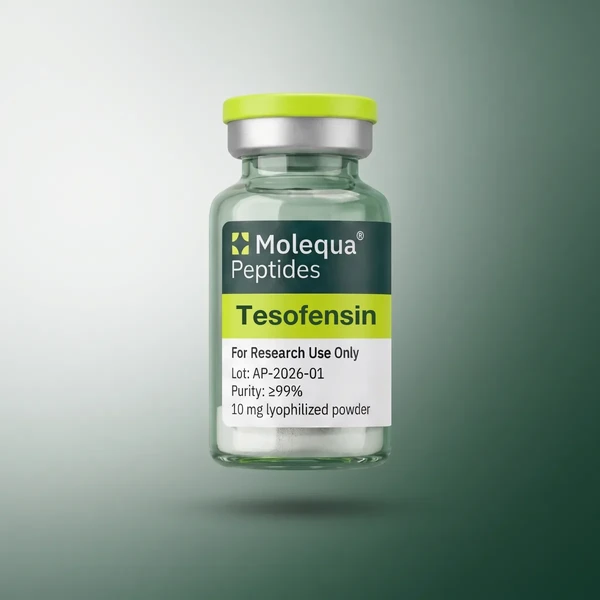

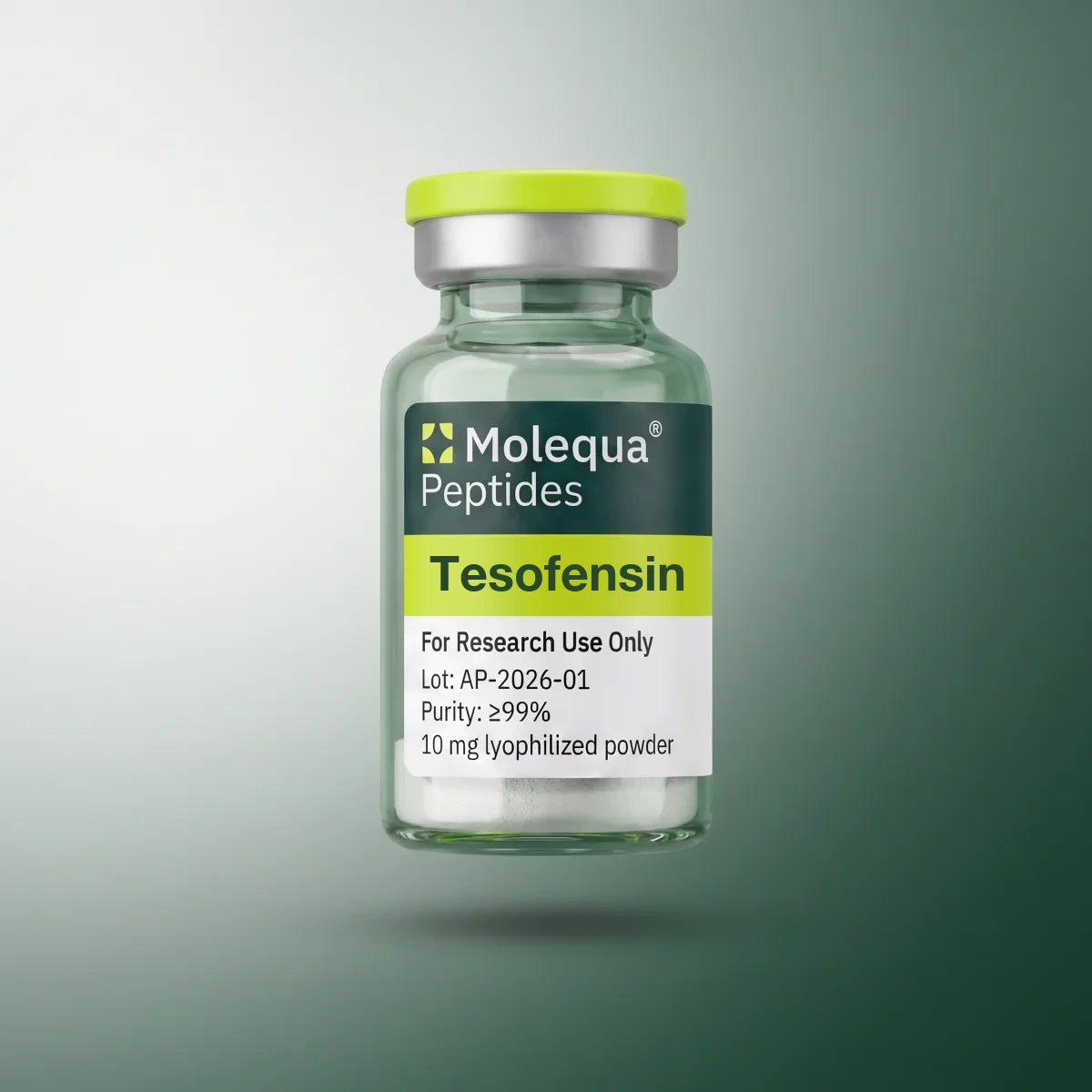




Quick overview
Tesofensine is not a peptide but a small synthetic molecule, an inhibitor of dopamine, noradrenaline and serotonin reuptake. It was originally developed by the Danish company NeuroSearch for Alzheimer and Parkinson disease.
- Small synthetic molecule, not a peptide, originally developed by NeuroSearch
- Dopamine, noradrenaline and serotonin transporters, alpha-1 and D1 pathways
- A class precedent worth knowing, sibutramine was withdrawn from the market in 2010
- No approval in the EU or the USA, for laboratory research only
Read more Close
Overview
Tesofensine, NS2330: the same substance
| Name | Origin |
|---|---|
| Tesofensine | International non-proprietary name (INN) |
| Tesofensin | Alternative spelling |
| NS2330 | NeuroSearch development code |
Tesofensine is not a peptide. It is a tropane derivative, chemically related to substances such as cocaine and methylphenidate, which places it in a different class from the rest of the catalogue.
Origin and why it was developed
Tesofensine is an example of a substance that changed its indication. The Danish company NeuroSearch originally developed NS2330 for neurological indications, and it was studied in programs for Parkinson’s disease and Alzheimer’s disease.
In those trials the hoped-for neurological benefit did not materialize. What stood out instead was a side finding: participants lost weight. NeuroSearch redirected the program accordingly.
The decisive publication appeared in the Lancet in 2008. Astrup and colleagues reported weight reduction from a 24-week phase 2 trial that was well above what the substances available at the time achieved. That paper made tesofensine internationally known.
Mechanism of action in the literature
Triple reuptake inhibition. The literature describes inhibition of the transporters for noradrenaline, dopamine and serotonin. All three systems are involved in the central regulation of appetite and satiety.
Central action. The point of attack is in the central nervous system, not in the gastrointestinal tract or at peripheral receptors. This is what fundamentally separates tesofensine from incretin analogues such as semaglutide or retatrutide.
Cardiovascular effects. The literature consistently reports increases in heart rate and blood pressure. This point is considered a substantial reason why the program was never carried through to EU authorization.
Research status 2026
Controlled human data from phase 2 exist, published in a high-ranking journal. A complete phase 3 program to EMA standard was never finished. A national authorization exists in Mexico under a trade name; in the EU it does not.
The material offered here is supplied exclusively as a research reagent.
A substance from a failed therapeutic program
Tesofensine was not designed for weight reduction. Almost no commercial description mentions this point, and it illuminates everything that follows.
The substance was developed by NeuroSearch, a Danish company, as a candidate against Alzheimer’s disease and Parkinson’s disease. The reasoning was neurological: a reuptake inhibitor acting on dopamine might be of interest in dopaminergic disorders.
The trials in those indications did not meet their endpoints. The investigators did, however, notice a consistent and marked side effect: patients lost weight. Astrup and colleagues published an analysis of that weight loss in patients with Parkinson’s or Alzheimer’s disease in 2008. The program was switched to obesity.
It is worth seeing what this means methodologically. The weight loss was initially an observation in a non-representative population, not a tested hypothesis.
What triple reuptake inhibitor means
Tesofensine is not a peptide. It is a small synthetic molecule, which sets it apart from most of the range and changes its handling properties.
The described mechanism is inhibition of the reuptake of three neurotransmitters.
| Neurotransmitter | Consequence described in the literature |
|---|---|
| Dopamine | Reward system, motivation to eat |
| Noradrenaline | Alertness, energy expenditure, sympathetic tone |
| Serotonin | Satiety, mood |
The principle is simple: the transporter that pulls the neurotransmitter back into the presynaptic neuron is blocked, so the molecule stays longer in the synaptic cleft and its signal is prolonged.
It is the same general principle as SSRI antidepressants, only at three targets instead of one. That kinship explains a large part of the described profile.
What the literature says about the satiety mechanism
The preclinical work asked through what the appetite suppression runs, and the answer is not the expected one.
Axel and colleagues showed in 2010, in the diet-induced obese rat, that appetite suppression runs through indirect stimulation of the alpha-1 adrenoceptor and dopamine D1 receptor pathways. Hansen and colleagues described in 2013 a weight loss that went together with restoration of lowered prefrontal dopamine levels in the obese animal.
More recent work from 2024 describes an effect on GABAergic hypothalamic neurons.
What due care requires us to mention
In 2013 a correspondence by Astrup and colleagues appeared in the Lancet on the under-reporting of adverse effects of tesofensine. A 2010 study in people who use stimulants had additionally examined its subjective effects, that is, the abuse potential.
Neither reference appears on any sales page. They are nonetheless a fixed part of the literature, and a page that claims to document a substance without mentioning them is not documenting it.
Tesofensine has no authorization in the European Union or the United States.
Buying Tesofensine: what to look for
When buying tesofensine it is not the price that decides but the verifiability of the quality. A research compound is only ever as good as its certificate of analysis. These five criteria separate serious suppliers from grey-market sellers, because from the outside lyophilized powder looks identical.
1. HPLC purity ≥ 99 % – documented, not just claimed
HPLC purity states what proportion of the powder is actually tesofensine and not a by-product of the synthesis. Serious suppliers document the value with a chromatogram. A purity figure without an attached chromatogram is a claim, not evidence.
2. Batch-specific certificate of analysis (CoA)
The most important document. A batch-specific CoA belongs to exactly the batch you receive: with batch number, date of analysis and purity value, issued by an independent laboratory. Rule of thumb: if a supplier cannot show you the CoA for the specific batch immediately, do not buy there.
3. LC-MS identity confirmation
Purity tells you how much of a substance is present. LC-MS tells you which substance it is. It confirms the correct identity via the molecular mass and rules out that a cheaper, mislabeled material has been shipped.
4. Origin and EU shipping with traceability
A supplier with a warehouse in the EU and full batch traceability has the advantage over grey imports: shorter transport routes, no customs risk, a documented path from synthesis to vial.
5. Correct delivery form: lyophilizate
High-quality material is delivered as a lyophilizate, freeze-dried powder, not as a premixed solution. In dry form the substance is stable for considerably longer and is reconstituted only immediately before use.
Legal notice: Tesofensine is a research material and not an approved medicine. It is supplied exclusively for scientific laboratory research and is not intended for human or animal consumption. It has no approved therapeutic use.
Science & studies
Key publications
Astrup A., Meier D.H., Mikkelsen B.O., Villumsen J.S., Larsen T.M. (2008). Weight loss produced by tesofensine in patients with Parkinson’s or Alzheimer’s disease. Obesity (Silver Spring). 16(6):1363–1369. PubMed 18356831 The starting observation, in the neurological population the substance had been designed for.
Bello N.T., Zahner M.R. (2009). Tesofensine, a monoamine reuptake inhibitor for the treatment of obesity. Curr Opin Investig Drugs. 10(10):1105–1116. PubMed 19777399 The reference review on the substance being redirected towards obesity.
Axel A.M., Mikkelsen J.D., Hansen H.H. (2010). Tesofensine, a novel triple monoamine reuptake inhibitor, induces appetite suppression by indirect stimulation of alpha1 adrenoceptor and dopamine D1 receptor pathways in the diet-induced obese rat. Neuropsychopharmacology. 35(7):1464–1476. PubMed 20200509 The central mechanistic paper: which pathways the appetite suppression actually runs through.
van de Giessen E., de Bruin K., la Fleur S.E. et al. (2012). Triple monoamine inhibitor tesofensine decreases food intake, body weight, and striatal dopamine D2/D3 receptor availability in diet-induced obese rats. Eur Neuropsychopharmacol. 22(4):290–299. PubMed 21889317 An imaging approach to the receptors that complements the preceding work.
Schoedel K.A., Meier D., Chakraborty B. et al. (2010). Subjective and objective effects of the novel triple reuptake inhibitor tesofensine in recreational stimulant users. Clin Pharmacol Ther. 88(1):69–78. PubMed 20520602 The assessment of abuse potential. Rarely cited, methodologically necessary.
Astrup A., Madsbad S., Breum L. et al. (2013). Under-reporting of adverse effects of tesofensine. Lancet. 382(9887):127. PubMed 23849924 A correspondence on the recording of adverse effects. Part of the state of knowledge.
Detailed studies
▸ Study 1: the starting observation
Citation: Astrup A. et al. Weight loss produced by tesofensine in patients with Parkinson’s or Alzheimer’s disease. Obesity, 2008. PubMed 18356831
What they did: analysed the weight loss in patients who received tesofensine within trials for neurological indications.
What they found: a consistent weight loss, pronounced enough to justify redirecting development towards obesity.
Why it counts and where the limits are: it is the birth certificate of tesofensine as an obesity candidate. It is, however, a side observation in a population of neurological patients, that is, a starting point for forming a hypothesis, not proof.
▸ Study 2: what the appetite suppression runs through
Citation: Axel A.M. et al. Tesofensine induces appetite suppression by indirect stimulation of alpha1 adrenoceptor and dopamine D1 receptor pathways in the diet-induced obese rat. Neuropsychopharmacology, 2010. PubMed 20200509
What they did: a pharmacological study in the diet-induced obese rat, using antagonists to selectively block individual pathways in order to determine which ones are necessary for the effect.
What they found: the appetite suppression depended on the alpha-1 adrenoceptor and dopamine D1 receptor pathways, through indirect stimulation.
Why it counts: because it contradicts the simplified reading according to which blocking the reuptake of three monoamines simply dampens appetite. The mechanism runs through named pathways, two of which carry the essential part of the effect.
▸ Study 3: the receptors in imaging
Citation: van de Giessen E. et al. Triple monoamine inhibitor tesofensine decreases food intake, body weight, and striatal dopamine D2/D3 receptor availability in diet-induced obese rats. Eur Neuropsychopharmacol, 2012. PubMed 21889317
What they did: imaging measurement of the availability of dopamine D2 and D3 receptors in the striatum, in parallel with food intake and body weight.
What they found: reduced food intake and lower weight, accompanied by an altered availability of striatal D2 and D3 receptors.
Why it counts: the striatum is a structure of the reward system. This work links the weight effect to a measurable change in the dopaminergic system and not to a peripheral metabolic effect.
▸ Study 4: the abuse potential
Citation: Schoedel K.A. et al. Subjective and objective effects of the novel triple reuptake inhibitor tesofensine in recreational stimulant users. Clin Pharmacol Ther, 2010. PubMed 20520602
What they did: an investigation in people who use stimulants, the standard population for this question, recording subjective effects in the sense of liking the substance.
What they found: data characterizing the profile with respect to abuse potential, of the kind required for any substance acting on dopamine reuptake.
Why it counts: every substance that raises synaptic dopamine raises this question. The mere existence of this study is part of the overall picture, and leaving it out would give a false impression of the literature.
Storage
Store lyophilized powder at 2–8 °C protected from light; for long-term storage −20 °C. In dry form the substance is stable this way for years. After reconstitution the solution belongs in the fridge, protected from light, and according to the literature should be used within 28 days. Avoid repeated freezing and thawing, which degrades peptides measurably.
Reservation
Tesofensine is currently available for reservation. You reserve the quantity you want without obligation, and we confirm the batch and the delivery date by email. No payment is taken at reservation.
Comparison notes: frequently compared substances
Tesofensine belongs to the field of obesity substances, where published comparisons are more common than combinations.
Versus GLP-1 receptor agonists
This is the most relevant comparison today, and it is instructive because the mechanisms have nothing in common. Semaglutide, tirzepatide and survodutide act at receptors of incretin hormones, peripherally and in the brainstem. Tesofensine acts at monoamine transporters in the central nervous system.
The difference in regulatory status is just as clear: several GLP-1 agonists are approved, tesofensine is approved nowhere.
Versus other reuptake inhibitors
Sibutramine, a reuptake inhibitor for serotonin and noradrenaline, was withdrawn from the market in the European Union and the United States in 2010 for cardiovascular reasons. It is the immediately relevant precedent for classifying a substance of this class and should be known to anyone working in this field.
A methodological warning
Combining tesofensine with another substance acting on monoamines, including an antidepressant, concerns a pharmacology that the available literature does not cover.
Key scientific figures and citations
“Tesofensine induces appetite suppression by indirect stimulation of the alpha-1 adrenoceptor and dopamine D1 receptor pathways in the diet-induced obese rat.” After Axel A.M. et al. (2010), Neuropsychopharmacology 35(7):1464–1476 PubMed 20200509
Key data from the literature
- Substance class: small synthetic molecule, not a peptide
- Original developer: NeuroSearch, Denmark
- Initially targeted indications: Alzheimer’s and Parkinson’s disease
- Described targets: transporters for dopamine, noradrenaline and serotonin
- Pathways identified as necessary: alpha-1 adrenergic and dopamine D1
- First publication on weight loss: 2008, Astrup and colleagues
- Authorization: none, neither in the European Union nor in the United States
- Correspondence on the recording of adverse effects: 2013, Lancet 382(9887):127
- Precedent of the class worth knowing: market withdrawal of sibutramine in 2010
Figures from the cited studies
- Meta-analysis of four randomised trials (Astrup 2008, Obesity 16(6):1363–1369): tesofensine n = 740, placebo n = 228, 14 weeks, orally once daily, with no weight-loss programme at all
- Weight change after 14 weeks in the full cohort: +0.5 % placebo, −0.5 % (0.125 mg), −0.9 % (0.25 mg), −1.8 % (0.5 mg), −2.8 % (1.0 mg); P = 0.015 for the dose effect
- In the obese subgroup: −0.2 %, −1.7 %, −1.6 %, −1.5 %, −3.7 %. At least 5 % weight loss was reached by 2.1 %, 8.2 %, 14.1 %, 20.9 % and 32.1 % of obese patients
- Heart-rate change: −0.4, +2.1, +4.2, +6.0 and +6.8 bpm. No effect on blood pressure was observed
- The placebo-subtracted difference was roughly 4 % of body weight over more than 14 weeks, without diet or lifestyle therapy
- Abuse potential (Schoedel 2010, Clin Pharmacol Ther 88(1):69–78): N = 52 recreational stimulant users, crossover design, 48 h of assessment. Tesofensine did not differ from placebo and was lower than D-amphetamine 30 mg
- Preclinical data: diet-induced obese rats, 2.0 mg/kg s.c., hypophagia with an ED50 of 1.3 mg/kg across a 0.5 to 3.0 mg/kg range; the effect was reversed by prazosin 1.0 mg/kg (Neuropsychopharmacology 2010). A second paper used four groups of 15 rats over 28 days (Eur Neuropsychopharmacol 2012)
- Published criticism: Lancet 2013;382(9887):127 describes under-reporting of adverse effects of tesofensine. Marketing authorisation: none
Reference sources (PubMed)
- Astrup A. et al. (2008). Weight loss produced by tesofensine in patients with Parkinson’s or Alzheimer’s disease. Obesity 16(6):1363–1369. PubMed 18356831
- Bello N.T., Zahner M.R. (2009). Tesofensine, a monoamine reuptake inhibitor for the treatment of obesity. Curr Opin Investig Drugs 10(10):1105–1116. PubMed 19777399
- Axel A.M. et al. (2010). Tesofensine induces appetite suppression by indirect stimulation of alpha1 adrenoceptor and dopamine D1 receptor pathways. Neuropsychopharmacology 35(7):1464–1476. PubMed 20200509
- Schoedel K.A. et al. (2010). Subjective and objective effects of tesofensine in recreational stimulant users. Clin Pharmacol Ther 88(1):69–78. PubMed 20520602
- van de Giessen E. et al. (2012). Triple monoamine inhibitor tesofensine decreases food intake, body weight, and striatal dopamine D2/D3 receptor availability. Eur Neuropsychopharmacol 22(4):290–299. PubMed 21889317
- Astrup A. et al. (2013). Under-reporting of adverse effects of tesofensine. Lancet 382(9887):127. PubMed 23849924
Regulatory status: Tesofensine has received authorization neither in the European Union nor in the United States. Clinical development in obesity did not lead to an authorization. The product offered here is a reagent exclusively for scientific laboratory research (RUO).
Frequently asked questions about Tesofensine
What is tesofensine?
Tesofensine is not a peptide but a tropane derivative and therefore a small-molecule substance. In the literature it inhibits the reuptake of noradrenaline, dopamine and serotonin, which is why it is described as a triple monoamine reuptake inhibitor.
What was tesofensine originally developed for?
For neurological indications. The company NeuroSearch first studied NS2330 in Parkinson’s and Alzheimer’s disease. In those trials weight loss stood out as an unexpected finding, which led to the program being reoriented.
Is tesofensine approved?
No, neither in the European Union nor in the United States. The phase 3 program was never carried through to an authorization in either. A national authorization exists in Mexico under a trade name. The material offered here is research material.
Why was development not continued?
The literature names effects on heart rate and blood pressure, together with the regulatory environment following experience with earlier centrally acting weight-reduction substances, as the reasons.
Is tesofensine a peptide?
No. It is a small synthetic molecule, which sets it apart from most of the range and changes both handling and getting it into solution.
Why was it developed against Alzheimer’s and Parkinson’s?
Because its mechanism is dopaminergic and those diseases affect the dopaminergic system. Weight loss was observed as a side effect in those trials and subsequently became the direction of development.
How does it differ from semaglutide or survodutide?
The mechanisms have nothing in common. The latter act at receptors of incretin hormones, tesofensine at monoamine transporters in the central nervous system. The regulatory status also differs fundamentally.
Are there data on adverse effects?
Yes, and they are part of the overall picture. A correspondence published in the Lancet in 2013 deals specifically with their under-reporting, and a 2010 study examined the subjective effects in people who use stimulants.
Can a reconstitution table be given?
Not a universally valid one, unlike for a lyophilized peptide. Solubility depends on the salt form and the solvent chosen in the protocol.