



Quick overview
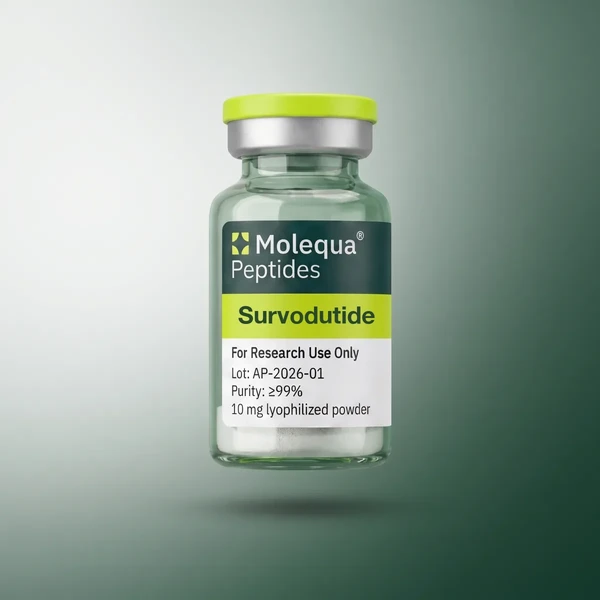
Survodutide is a dual agonist of the glucagon and GLP-1 receptors, developed by Boehringer Ingelheim under the code BI 456906. The glucagon arm targets energy expenditure, the GLP-1 arm satiety and slowed gastric emptying.
- Two receptors at once, glucagon and GLP-1, mechanistically closest to mazdutide
- Phase 2 in obesity in 2024 (Lancet Diabetes Endocrinol)
- Phase 2 in MASH and fibrosis 2024, phase 3 in obesity 2026 (NEJM)
- No approval as of the date of this page, for laboratory research only
Read more Close
Overview
Survodutide, BI 456906: the same substance
| Designation | Origin |
|---|---|
| Survodutide | International non-proprietary name (INN) |
| BI 456906 | Boehringer Ingelheim development code |
| Glucagon/GLP-1 dual agonist | Functional description |
Throughout this text we use survodutide.
Origin and reason for development
Survodutide comes out of a collaboration between Boehringer Ingelheim and the Danish company Zealand Pharma. It belongs to the same development wave as tirzepatide and retatrutide but pursues a different combination.
The idea behind it can be described as an equation with two terms. GLP-1 lowers energy intake via satiety and delayed gastric emptying. Glucagon raises energy expenditure via lipolysis and thermogenesis in the liver. Together they act on both sides of the energy balance.
The technical difficulty is the same as with retatrutide: excessive glucagon activation leads to hyperglycaemia, because the liver releases sugar. The molecule has to be tuned so that the GLP-1 component compensates for that effect. Survodutide solves it with its own activity ratio between the two receptors.
Modification. Like the other members of the class, survodutide carries a fatty acid chain for albumin binding. In the published data this gives a half-life that allows weekly administration.
Mechanism of action in the literature
GLP-1 receptor. Glucose-dependent insulin secretion, delayed gastric emptying and centrally mediated satiety are described.
Glucagon receptor. Strongly expressed in the liver. Increased lipolysis, raised thermogenesis and a rise in resting energy expenditure are described.
Liver fat. The most striking finding in the literature concerns the liver. The phase 2 work on MASH published by Sanyal and colleagues in 2024 reported clear reductions in liver fat content. That matches what is expected of a substance with a glucagon component, since the receptor is predominantly hepatically expressed.
State of research in 2026
Survodutide is in the phase 3 program (SYNCHRONIZE) for obesity as well as in programs on MASH. Phase 2 data were published in 2024 in Lancet Diabetes & Endocrinology and in the New England Journal of Medicine.
No authorization exists in any country. The material offered here is pure research material.
Note on the substance class. Like semaglutide, tirzepatide and retatrutide, survodutide belongs to the group of incretin analogues. A considerable proportion of searches for these names come from people looking for a prescription medicine. This material is expressly not a medicinal product, is not intended for use in humans and is supplied exclusively for scientific laboratory research.
The best-evidenced substance in the range
This belongs at the front, because it changes how the rest reads: survodutide is by some way the substance in this range with the most robust evidence base.
Where most research peptides rest on mouse models and cell cultures, survodutide has published clinical trials of phases 2 and 3, appearing in Lancet Diabetes and Endocrinology and in the New England Journal of Medicine.
That does not mean authorization, a point we return to below. It means the available level of evidence is not comparable with that of a substance like dihexa or noopept.
The development code BI 456906 appears in older publications and in trial registers. Knowing it helps in finding the whole evidence base.
Dual agonism: what exactly that means
Survodutide is a dual agonist of the glucagon and GLP-1 receptors. That formulation deserves unpacking, because the combination can seem contradictory.
Glucagon is conventionally regarded as the hormone that raises blood sugar, that is, as the counterpart of insulin. Activating its receptor to treat obesity looks paradoxical.
The logic lies elsewhere: glucagon also raises energy expenditure. That is the effect being sought, not the blood-sugar-raising one.
GLP-1 is an incretin hormone whose activation slows gastric emptying, increases satiety and stimulates insulin secretion in a glucose-dependent manner.
The combination therefore targets two separate levers: less intake via the GLP-1 arm, more expenditure via the glucagon arm. The blood-sugar-raising effect of glucagon is offset by the GLP-1 part of the substance.
Placement within the generation of substances
This is the most practically useful question, and a table answers it better than a paragraph.
| Substance | Receptors addressed | Status |
|---|---|---|
| Semaglutide | GLP-1 | Authorized |
| Tirzepatide | GIP + GLP-1 | Authorized |
| Survodutide | Glucagon + GLP-1 | In clinical development |
| Retatrutide | GIP + GLP-1 + glucagon | In clinical development |
| Mazdutide | Glucagon + GLP-1 | In clinical development |
Survodutide and mazdutide share the same receptor combination. Retatrutide adds GIP to those same two targets and is thus a triple agonist.
MASH: a field separate from obesity
A point that presentations narrowed down to weight loss regularly pass over.
Survodutide has been studied in MASH, metabolic dysfunction-associated steatohepatitis, formerly called NASH. This is a liver disease with inflammation and fibrosis, to be distinguished from obesity even though it frequently accompanies it.
Sanyal and colleagues published a randomized phase 2 trial in MASH and fibrosis in the New England Journal of Medicine in 2024.
The glucagon arm has an independent significance here: the liver is the principal target organ of glucagon, which gives this dual agonism a hepatic interest that a pure GLP-1 agonist does not have.
The status, without evasion
Survodutide is being developed by Boehringer Ingelheim. At the time this page was written there is no authorization, neither in the European Union nor in the United States. In the European Union medicinal-product questions fall to the EMA and the national agencies.
Published phase 3 trials indicate advanced development. They do not amount to an authorization, and the product offered here remains a research reagent.
Buying survodutide: what to look for
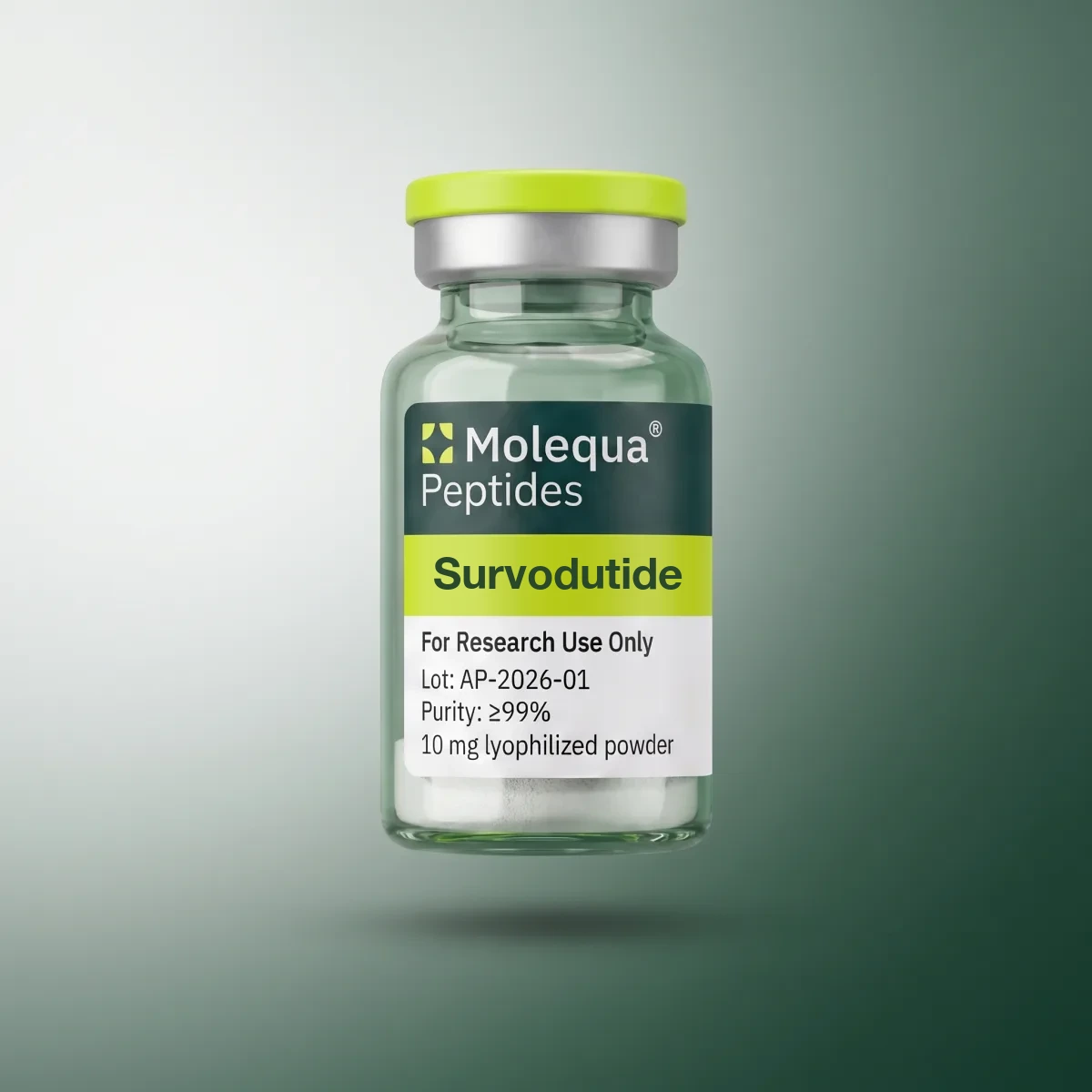
When buying survodutide it is not the price that decides but the verifiability of quality. A research peptide is only ever as good as its certificate of analysis. These five criteria separate serious suppliers from grey-market sellers, because from the outside lyophilized powder looks identical.
1. HPLC purity, documented rather than asserted
HPLC purity states what proportion of the powder actually is survodutide and not a by-product of synthesis. Serious suppliers document the figure with a chromatogram. A purity figure without an accompanying chromatogram is an assertion, not proof.
2. Batch-specific certificate of analysis (CoA)
The most important document. A batch-specific CoA belongs to exactly the batch you receive: with batch number, date of analysis and purity value, issued by an independent laboratory. Rule of thumb: if a supplier cannot show you the CoA for the specific batch immediately, do not buy there.
3. LC-MS identity confirmation
Purity says how much of a substance is present. LC-MS says which substance it is. Via the molecular mass it confirms the correct identity and rules out the delivery of cheaper, mislabeled material.
4. Origin and EU dispatch with traceability
A supplier with a warehouse in the EU and full batch traceability has the advantage over grey imports: shorter transport routes, no customs risk, a documented path from synthesis to vial.
5. Correct supply form: lyophilizate
High-quality material is supplied as a lyophilizate, freeze-dried powder, not as a pre-mixed solution. In dry form the substance is considerably more stable and is reconstituted only immediately before use.
Legal notice: Survodutide is a research material and not an authorized medicinal product. It is supplied exclusively for scientific laboratory research and is not intended for human or animal consumption. It has no approved therapeutic use.
Science & studies
Key publications
le Roux C.W., Steen O., Lucas K.J. et al. (2024). Glucagon and GLP-1 receptor dual agonist survodutide for obesity: a randomised, double-blind, placebo-controlled, dose-finding phase 2 trial. Lancet Diabetes Endocrinol. 12(3):162 to 173. PubMed 38330987 The phase 2 trial in obesity with dose finding. The central reference.
Sanyal A.J., Bedossa P., Fraessdorf M. et al. (2024). A Phase 2 Randomized Trial of Survodutide in MASH and Fibrosis. N Engl J Med. 391(4):311 to 319. PubMed 38847460 The hepatic arm of the program, in a first-rank journal.
le Roux C.W., Wharton S., Startseva E. et al. (2026). Survodutide Once Weekly for the Treatment of Adults with Obesity. N Engl J Med. 395(8):776 to 787. PubMed 42253238 The phase 3 data in obesity, published in August 2026.
Drucker D.J. (2024). Efficacy and Safety of GLP-1 Medicines for Type 2 Diabetes and Obesity. Diabetes Care. 47(11):1873 to 1888. PubMed 38843460 A review of the whole substance class by one of its leading figures, useful for placing it against the competitors.
Studies in detail
▸ Study 1: the phase 2 in obesity
Citation: le Roux C.W. et al. Glucagon and GLP-1 receptor dual agonist survodutide for obesity: a randomised, double-blind, placebo-controlled, dose-finding phase 2 trial. Lancet Diabetes Endocrinol, 2024. PubMed 38330987
What they did: a randomized, double-blind, placebo-controlled dose-finding trial. This is the methodological reference, and each of those terms counts: randomization limits selection bias, blinding limits assessment bias, the placebo control supplies the necessary comparison.
What they found: efficacy and tolerability data across several dose levels, serving to select the dosing for the later phases.
Why it matters: it is the kind of evidence almost no other substance in this range has. Comparing such a trial with a cell-culture or mouse-model paper makes no sense: they are two different levels of evidence.
▸ Study 2: the hepatic arm
Citation: Sanyal A.J. et al. A Phase 2 Randomized Trial of Survodutide in MASH and Fibrosis. N Engl J Med, 2024. PubMed 38847460
What they did: a randomized phase 2 trial in patients with MASH, metabolic dysfunction-associated steatohepatitis, with assessment of fibrosis.
What they found: results on resolution of MASH and on fibrosis, published in the New England Journal of Medicine.
Why it matters: because it is not a weight-loss trial. MASH is a liver disease whose assessment rests on histological criteria, not on the scales. It is at the same time the field in which the glucagon arm has its own logic, since the liver is the principal target organ of that hormone.
▸ Study 3: the phase 3 data
Citation: le Roux C.W. et al. Survodutide Once Weekly for the Treatment of Adults with Obesity. N Engl J Med, 2026. PubMed 42253238
What they did: tested survodutide given once weekly in adults with obesity in phase 3, that is, in a large sample and with the dosing derived from phase 2.
What they found: the efficacy and tolerability results of that stage, published in August 2026.
Why it matters: phase 3 is the stage immediately before an application for authorization. Its publication marks advanced development, but does not constitute an authorization.
▸ Study 4: the substance class as a whole
Citation: Drucker D.J. Efficacy and Safety of GLP-1 Medicines for Type 2 Diabetes and Obesity. Diabetes Care, 2024. PubMed 38843460
What they did: a review of the efficacy and tolerability of medicines acting on GLP-1, written by a leading author in the field.
What they found: a comparative picture of the substance class including the characteristic gastrointestinal adverse effects and the open questions.
Why it matters: it allows survodutide to be placed against semaglutide and tirzepatide rather than viewed in isolation. The gastrointestinal adverse-effect profile is a feature of the class, not a peculiarity of one substance.
Storage
Store the lyophilized powder at 2 to 8 °C protected from light, for long-term storage at −20 °C. In dry form the substance stays stable for years. After reconstitution the solution belongs in the fridge, protected from light, and according to the literature should be used within 28 days. Avoid repeated freezing and thawing, which degrades peptides measurably.
Reservation
Survodutide is currently available to reserve. You reserve the quantity you want without obligation and we confirm the batch and the delivery date by email. Nothing is paid at the point of reservation.
Stacking tips: substances from the same class
A methodological preliminary is indispensable here. In the field of incretin receptor agonists, substances are compared, not combined. Administering two substances with the same receptor targets together makes the result uninterpretable and adds up the class-typical adverse effects.
Retatrutide
The most instructive comparison. Retatrutide addresses the same receptors as survodutide, glucagon and GLP-1, and adds GIP to them. The difference between a dual and a triple agonist with partly shared targets is exactly what the clinical programs are trying to quantify.
Semaglutide and tirzepatide
Semaglutide acts on the GLP-1 receptor alone, tirzepatide on GIP and GLP-1. Neither substance activates the glucagon receptor. The decisive difference from survodutide therefore concerns the energy expenditure arm, which both lack.
Equally clear is the difference in authorization status: both are authorized, survodutide is not.
Mazdutide
The same receptor combination as survodutide, glucagon and GLP-1, developed in China. It is the mechanistically most immediate comparator.
Key scientific figures and citations
“Survodutide, a dual agonist of the glucagon and GLP-1 receptors, was tested in a randomised, double-blind, placebo-controlled, dose-finding phase 2 trial in people with obesity.” After le Roux C.W. et al. (2024), Lancet Diabetes and Endocrinology 12(3):162 to 173 PubMed 38330987
Core data from the literature
- Development code: BI 456906
- Company: Boehringer Ingelheim
- Receptors addressed: glucagon and GLP-1
- Logic of the glucagon arm: raising energy expenditure
- Logic of the GLP-1 arm: satiety and slowed gastric emptying
- Phase 2 in obesity: 2024, Lancet Diabetes Endocrinol
- Phase 2 in MASH and fibrosis: 2024, New England Journal of Medicine
- Phase 3 in obesity: 2026, New England Journal of Medicine
- Mechanistically closest substance: mazdutide
- Authorization: none, as at the date of this page
Figures from the cited studies
- Phase 2, obesity (le Roux 2024, Lancet Diabetes Endocrinol): n = 387 randomised, 386 treated, 43 centres across 12 countries, 46 weeks
- Body-weight change at week 46: −6.2 % (0.6 mg), −12.5 % (2.4 mg), −13.2 % (3.6 mg), −14.9 % (4.8 mg) versus −2.8 % on placebo
- 233 of 386 participants completed the trial (60.4 %). Adverse events 91 % versus 75 % on placebo, gastrointestinal ones 75 % versus 42 %
- Phase 2, MASH and fibrosis (Sanyal 2024, NEJM): n = 293, 48 weeks, doses of 2.4, 4.8 and 6.0 mg. MASH improvement without worsening of fibrosis in 47 %, 62 % and 43 % versus 14 % on placebo
- Same trial: liver fat content down by ≥ 30 % in 63 %, 67 % and 57 % versus 14 %; fibrosis improved by at least one stage in 34 %, 36 % and 34 % versus 22 %
- Phase 3 SYNCHRONIZE-1 (le Roux 2026, NEJM): n = 725, 76 weeks, mean BMI 37.9, mean body weight 108.8 kg. Body-weight change −12.2 % (3.6 mg) and −13.0 % (6.0 mg) versus −5.4 % on placebo
- At least 5 % weight reduction was reached by 72.6 % and 71.9 % of participants versus 46.3 % on placebo
- Dosing in the trials: once weekly subcutaneously. Marketing authorisation: none
Reference sources (PubMed)
- le Roux C.W. et al. (2024). Glucagon and GLP-1 receptor dual agonist survodutide for obesity: a randomised, double-blind, placebo-controlled, dose-finding phase 2 trial. Lancet Diabetes Endocrinol 12(3):162 to 173. PubMed 38330987
- Sanyal A.J. et al. (2024). A Phase 2 Randomized Trial of Survodutide in MASH and Fibrosis. N Engl J Med 391(4):311 to 319. PubMed 38847460
- Drucker D.J. (2024). Efficacy and Safety of GLP-1 Medicines for Type 2 Diabetes and Obesity. Diabetes Care 47(11):1873 to 1888. PubMed 38843460
- le Roux C.W. et al. (2026). Survodutide Once Weekly for the Treatment of Adults with Obesity. N Engl J Med 395(8):776 to 787. PubMed 42253238
Regulatory status: Survodutide is in clinical development at Boehringer Ingelheim. To date there is no authorization, neither in the European Union nor in the United States. Published phase 3 trials evidence advanced development, not an authorization. In the European Union medicinal-product questions fall to the EMA and the national agencies. The product offered here is a reagent exclusively for scientific laboratory research (RUO).
Frequently asked questions about survodutide
What is survodutide?
Survodutide is an acylated peptide of 29 amino acids that acts on two receptors: GLP-1 and glucagon. It is being developed by Boehringer Ingelheim together with Zealand Pharma and carries the code BI 456906.
How does survodutide differ from retatrutide?
Both act at the GLP-1 and glucagon receptors and use the glucagon component to raise energy expenditure. Survodutide is a dual agonist, while retatrutide additionally activates the GIP receptor, which makes it a triple agonist.
How does survodutide differ from semaglutide?
Semaglutide is a selective GLP-1 agonist without a glucagon arm, and therefore without the energy expenditure component. Survodutide adds the glucagon component, which the literature links to raised energy expenditure and a marked effect on liver fat content. The regulatory status also differs: semaglutide is authorized, survodutide is not.
Is survodutide authorized?
No. Survodutide is in phase 3 trials and is not authorized in any country. The material offered here is research material only and is not intended for use in humans.
What does BI 456906 mean?
It is the Boehringer Ingelheim development code for survodutide. It appears in older publications and in clinical trial registers.
Why activate the glucagon receptor if glucagon raises blood sugar?
Because that is not the effect being sought. Glucagon also raises energy expenditure, and that is the lever intended. The blood-sugar-raising effect is offset by the GLP-1 arm of the substance.
What is MASH?
Metabolic dysfunction-associated steatohepatitis, formerly called NASH. A liver disease with inflammation and fibrosis, to be distinguished from obesity even though often connected with it. It was the subject of a separate phase 2 trial.
Why must the vial not be shaken?
Because this is a long peptide with secondary structure. Vigorous shaking creates an air-liquid interface that promotes aggregation and denaturation.