




Quick overview
Tirzepatide is a dual GIP and GLP-1 receptor agonist, the first molecule to combine two incretin pathways at once. In the SURMOUNT-1 trial it achieved an average weight reduction of 20.9% over 72 weeks, outperforming semaglutide.
- −20.9% body weight over 72 weeks (SURMOUNT-1, n=2,539)
- Two receptors at once: GIP + GLP-1 in a single molecule
- Clinically validated active substance, offered here as research reference material
- Lyophilizate ≥ 99% HPLC with batch CoA
Read more Close
Overview
Let’s start with the basics: why two receptors?
To understand why Tirzepatide is so powerful, you first need to understand the difference between one and two incretin hormones.
The first generation of metabolic peptides (Semaglutide) activates one receptor, GLP-1. It works excellently, but it has a ceiling, one mechanism, one limit. Tirzepatide adds a second hormone: GIP (glucose-dependent insulinotropic polypeptide).
GIP and GLP-1 are both incretins, hormones released from the gut after a meal that amplify the insulin response. But they do not do exactly the same thing. GLP-1 suppresses appetite and slows the stomach. GIP amplifies insulin secretion and, interestingly, directly affects adipose tissue, its insulin sensitivity and the way adipocytes store and release fat. Tirzepatide is the first molecule to combine these two signals into one.
Recognition, you know the same molecule under different names
This is important for orientation: Tirzepatide is exactly the same molecule as the drugs Mounjaro and Zepbound. Eli Lilly developed it (code name LY3298176) and sells it under these brand names, Mounjaro for type 2 diabetes, Zepbound for obesity.
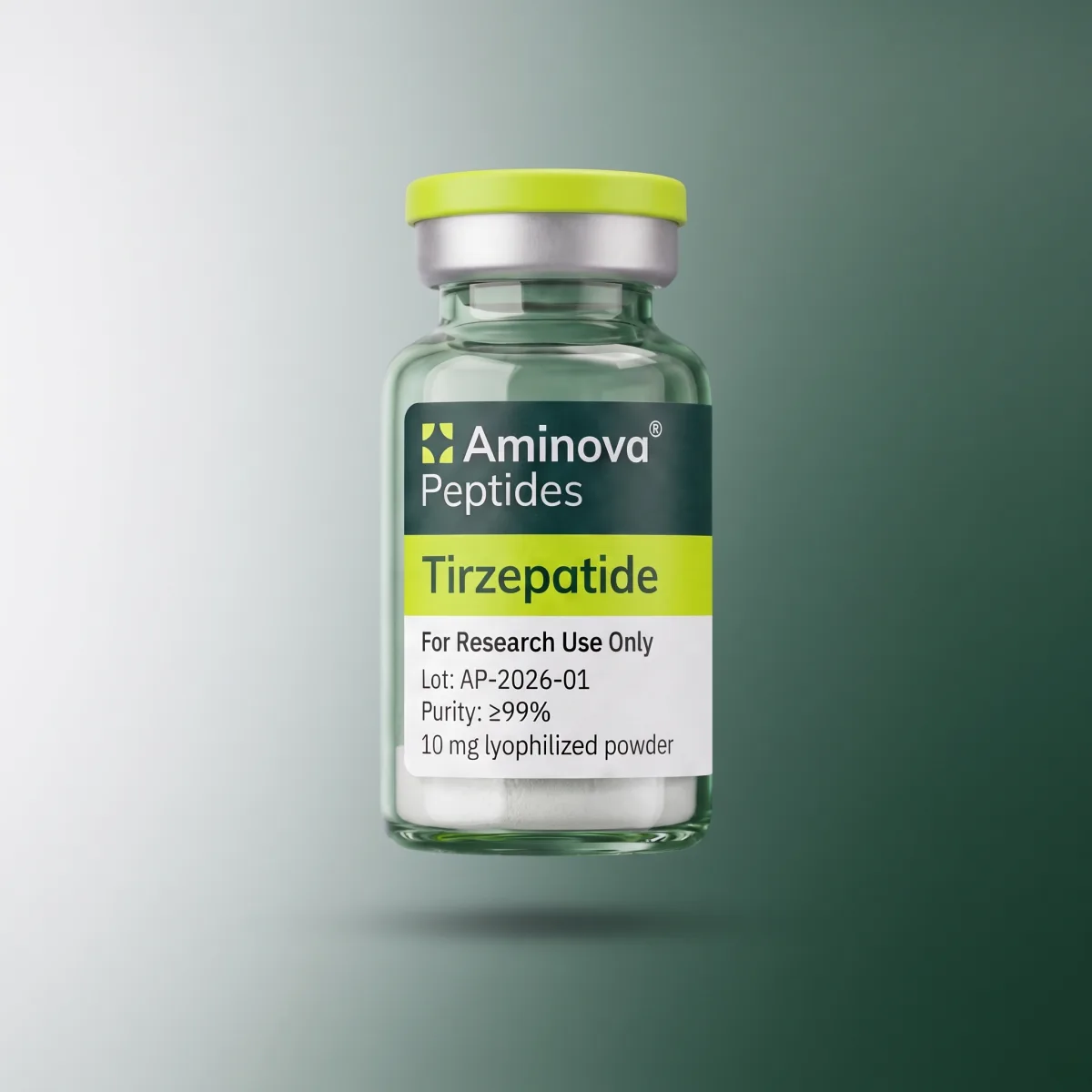
Tirzepatide is the first dual GIP + GLP-1 receptor agonist on the market and has become one of the most sought-after metabolic peptides of all. Molequa® supplies it exclusively as a research compound (RUO), pure lyophilized Tirzepatide identical to the API used in clinical studies, not as an approved medicine. We list the brand names only for molecule recognition, not as a health claim.
Tirzepatide, a chemically engineered dual agonist
Tirzepatide is a 39-amino-acid linear peptide, a dual GIP/GLP-1 receptor agonist with a molecular weight of ~4813.5 Da (CAS 2023788-19-2). An interesting fact: its backbone is derived from GIP, not GLP-1, but it is modified to activate both receptors. Eli Lilly designed it with three key changes:
Modification 1, Aib at position 2. Aminoisobutyric acid at position 2 blocks DPP-4 degradation, the same solution as in Semaglutide and Retatrutide.
Modification 2, attached C20 fatty diacid. Via the lysine at position 20. This fatty acid binds Tirzepatide to albumin in the blood, which extends the half-life to ~5 days.
Modification 3, balanced affinity. The molecule is tuned to have full activity at the GIP receptor and slightly reduced (but still strong) activity at the GLP-1 receptor, an imbalanced dual agonism that proved optimal in studies.
Result: half-life ~5 days, weekly subcutaneous dosing and efficacy that outperformed Semaglutide in a head-to-head comparison.
Development status, where is Tirzepatide in 2026
Tirzepatide is a fully approved molecule (in human medicine under the names Mounjaro for T2DM since 2022, Zepbound for obesity since 2023). The clinical program was extensive: SURPASS (diabetes, SURPASS-1 to 5) and SURMOUNT (obesity, SURMOUNT-1 to 4). It was precisely these trials that established Tirzepatide as the most effective metabolic molecule of its time, until Retatrutide came along.
For research, Tirzepatide is the key second-generation comparator, a bridge between the mono-agonist (Semaglutide) and the triple agonist (Retatrutide). Molequa® supplies a pure lyophilized form intended exclusively for laboratory research.
Mechanism of action, what it does at the cellular level
Tirzepatide activates two receptors (GIP-R and GLP-1R) in different tissues. Imagine two instruments playing together, correctly tuned they produce a harmony that a single instrument cannot achieve on its own.
Pancreatic β-cells, supra-additive insulin stimulation
Activation of both GLP-1R and GIPR leads to glucose-dependent insulin secretion. The key word is “supra-additive”, GIP and GLP-1 together stimulate insulin more strongly than a simple sum of their effects would predict. At the same time the GLP-1 component suppresses glucagon. The result is strong glycemic control at a low hypoglycemia risk (the effect is glucose-dependent).
In the SURPASS program Tirzepatide reduced HbA1c by 1.9 to 2.6 percentage points, at the time the strongest effect among all antidiabetics.
Adipose tissue, the unique GIP effect
Here is the main difference from Semaglutide. The GIP receptor is strongly expressed in adipocytes. GIPR activation in adipose tissue improves insulin sensitivity, regulates the storage and release of fatty acids and improves lipid processing. It is precisely this direct effect on adipose tissue that explains why Tirzepatide achieves stronger weight loss than a mono-GLP-1 agonist.
Stomach and central nervous system, appetite suppression
The GLP-1 component slows gastric emptying (a longer feeling of fullness) and in the brain activates GLP-1R in the hypothalamus and area postrema, thereby suppressing hunger. GIP receptors are also present in the CNS and contribute to the regulation of food intake and reduction of nausea. The combined central effect of both receptors produces strong appetite suppression, which in the SURMOUNT-1 trial led to weight loss of up to −20.9 %.
Why the dual combination is stronger than a mono-agonist
The answer lies in complementarity. GLP-1 dominates in appetite suppression and gastric slowing. GIP adds metabolic signaling through adipose tissue that GLP-1 alone does not have. Together they cover more metabolic pathways, which in the SURPASS-2 trial led to the superiority of Tirzepatide over Semaglutide at higher doses.
Investigated applications
In the published clinical literature, the effects of Tirzepatide are documented in the following areas:
- Type 2 diabetes mellitus, SURPASS program (approved 2022)
- Obesity, SURMOUNT program, SURMOUNT-1 showed −20.9 % over 72 weeks (Jastreboff et al., NEJM 2022)
- MASLD/MASH, SYNERGY-NASH trial, liver-fat reduction ~50 to 60 %
- Sleep apnea (OSA), the SURMOUNT-OSA program showed a significant reduction in severity
- Heart failure with preserved ejection fraction (HFpEF), SUMMIT
- Cardiovascular outcomes, SURPASS-CVOT (ongoing)
Buying Tirzepatide: what to look for
When buying Tirzepatide, the decisive criterion is not the price but the verifiability of quality. A research peptide is only ever as good as its certificate of analysis. Because Tirzepatide is one of the most sought-after metabolic peptides, it is also a frequent target of counterfeiting, the market ranges from serious, lab-tested suppliers to grey-market sellers with no documentation at all, the lyophilized powder looks identical. These five criteria separate them.
1. HPLC purity ≥ 99 % – documented, not just claimed
HPLC purity shows what proportion of the powder is actually Tirzepatide. Serious suppliers document ≥ 99 % with a chromatogram. “99 % purity” without an attached chromatogram is a claim, not proof.
2. Batch-specific certificate of analysis (CoA)
The most important document. A batch-specific CoA belongs to exactly the batch you receive, with batch number, date and purity value, issued by an independent laboratory. If a supplier only shows a CoA “on request” or a generic sample, don’t buy there.
3. LC-MS identity confirmation
Purity tells you how much of a substance is present, LC-MS tells you which substance it is. Via the molecular mass (4813.5 Da) it confirms this is the correct identity of Tirzepatide, not a cheaper, mislabeled peptide or a different GLP-1 analog.
4. Origin and EU shipping with traceability
A supplier with an EU warehouse and full batch traceability has the edge over grey imports from Asia: shorter cooled transport, no customs risk. Molequa® ships from within the EU, typically within 3 to 5 business days.
5. Correct form: lyophilizate
High-quality Tirzepatide is delivered as a lyophilizate (white powder), not as a pre-mixed solution. Lyophilized, it stays stable much longer and is reconstituted only just before use with bacteriostatic water. The concentration that results from a given vial size and solvent volume is worked out by the peptide calculator.
Check quality in 30 seconds
- ✅ CoA for the batch publicly available (not just “on request”)?
- ✅ HPLC purity ≥ 99 % proven with a chromatogram?
- ✅ LC-MS identity confirmed (mass 4813.5 Da)?
- ✅ EU warehouse and batch traceability?
- ✅ Delivered as a lyophilizate with clear storage instructions?
If all five points are met, you are buying verified material. Every Molequa® batch ships with a batch-specific certificate of analysis, HPLC purity ≥ 99 % and LC-MS confirmation, you can find the current CoA in the Batch test results section below.
Legal notice: This research Tirzepatide is sold exclusively for scientific laboratory research and is not intended for human or animal consumption. It is not an approved medicine and in this form has no approved therapeutic use. The brand names Mounjaro and Zepbound are listed only for molecule recognition.
Science & studies
4.1 Key publications
Jastreboff A.M., Aronne L.J., Ahmad N.N., et al. (2022). Tirzepatide Once Weekly for the Treatment of Obesity. N Engl J Med. 387(3):205 to 216. Registrational SURMOUNT-1 trial for obesity.
Frías J.P., Davies M.J., Rosenstock J., et al. (2021). Tirzepatide versus Semaglutide Once Weekly in Patients with Type 2 Diabetes. N Engl J Med. 385(6):503 to 515. Head-to-head SURPASS-2 vs Semaglutide.
Coskun T., Sloop K.W., Loghin C., et al. (2018). LY3298176, a novel dual GIP and GLP-1 receptor agonist for the treatment of type 2 diabetes mellitus: From discovery to clinical proof of concept. Mol Metab. 18:3 to 14. Original preclinical data and mechanism.
Rosenstock J., Wysham C., Frías J.P., et al. (2021). Efficacy and safety of a novel dual GIP and GLP-1 receptor agonist tirzepatide in patients with type 2 diabetes (SURPASS-1). Lancet. 398(10295):143 to 155. First registrational monotherapy trial.
Malhotra A., Grunstein R.R., Fietze I., et al. (2024). Tirzepatide for the Treatment of Obstructive Sleep Apnea and Obesity (SURMOUNT-OSA). N Engl J Med. 390(13):1193 to 1205. OSA indication.
4.2 Detailed expandable studies
▸ Study 1: SURMOUNT-1 (Phase 3 obesity)
Citation: Jastreboff A.M., Aronne L.J., Ahmad N.N., et al. Tirzepatide Once Weekly for the Treatment of Obesity. N Engl J Med. 2022;387(3):205 to 216.
What they did: Multinational randomized controlled trial. n = 2,539 adults with obesity (BMI ≥ 30 or BMI ≥ 27 + comorbidity), without T2DM. Randomization: Tirzepatide 5, 10 or 15 mg/week subcutaneously vs placebo. Duration: 72 weeks.
What they found:
- Mean weight loss: −15.0 % (5 mg), −19.5 % (10 mg), −20.9 % (15 mg) vs −3.1 % placebo (p < 0.001)
- In the 15 mg arm 91 % of patients lost ≥ 5 %, 78 % lost ≥ 10 %, 57 % lost ≥ 15 %, 36 % lost ≥ 20 %
- Improvement in cardiometabolic risk factors
- Adverse effects: predominantly GI (nausea, diarrhea, constipation), mild to moderate, during titration
Why it matters: SURMOUNT-1 moved the bar set by Semaglutide (−14.9 % in STEP 1) to −20.9 %. Tirzepatide became the most effective approved molecule of its time and showed that dual agonism surpasses mono-agonism in weight reduction. This result was in turn later surpassed by Retatrutide (−24.2 %), which illustrates the logic of the evolution of this class.
▸ Study 2: SURPASS-2 (head-to-head vs Semaglutide)
Citation: Frías J.P., Davies M.J., Rosenstock J., et al. Tirzepatide versus Semaglutide Once Weekly in Patients with Type 2 Diabetes. N Engl J Med. 2021;385(6):503 to 515.
What they did: n = 1,879 patients with T2DM inadequately controlled with metformin. Direct comparison: Tirzepatide 5, 10 or 15 mg vs Semaglutide 1.0 mg (active comparator). Duration: 40 weeks. Primary endpoint: change in HbA1c.
What they found:
- HbA1c: −2.01 % (5 mg), −2.24 % (10 mg), −2.30 % (15 mg) Tirzepatide vs −1.86 % Semaglutide
- Weight loss: −7.6 kg (5 mg) to −11.2 kg (15 mg) Tirzepatide vs −5.7 kg Semaglutide
- All Tirzepatide doses were superior to Semaglutide in both HbA1c and weight
- Safety profile comparable, predominantly GI side effects
Why it matters: SURPASS-2 is one of the most important head-to-head trials in metabolic medicine. It directly proved that a dual agonist (Tirzepatide) is more effective than a mono-GLP-1 agonist (Semaglutide) in a direct comparison. This was the definitive proof of concept that adding the GIP receptor has a real benefit, it is not just theory.
▸ Study 3: Mechanism of action (preclinical paper)
Citation: Coskun T., Sloop K.W., Loghin C., et al. LY3298176, a novel dual GIP and GLP-1 receptor agonist for the treatment of type 2 diabetes mellitus. Mol Metab. 2018;18:3 to 14.
What they did: The original preclinical characterization of the molecule (Eli Lilly). It describes binding to both receptors, pharmacology, effects on glycemia and weight in animal models and the first proof of concept in humans.
What they found (key points):
- Tirzepatide has full agonist activity at the GIP receptor and slightly reduced (imbalanced) activity at the GLP-1 receptor
- Aib at position 2 provides resistance to DPP-4
- C20 fatty diacid ensures albumin binding and a ~5 day half-life
- In animal models, dual agonism outperformed an equimolar GLP-1 mono-agonist in weight loss
Why it matters: This is the founding paper of the whole concept of dual agonism. It explains why Tirzepatide is derived from a GIP backbone and how the imbalanced affinity (stronger GIP, slightly weaker GLP-1) leads to an optimal metabolic effect. Without this paper there would be no Retatrutide either.
▸ Study 4: SURPASS-1 (monotherapy)
Citation: Rosenstock J., Wysham C., Frías J.P., et al. Efficacy and safety of tirzepatide in patients with type 2 diabetes (SURPASS-1). Lancet. 2021;398(10295):143 to 155.
What they did: n = 478 patients with T2DM inadequately controlled with diet and exercise. Randomization: Tirzepatide 5, 10 or 15 mg vs placebo (monotherapy). Duration: 40 weeks.
What they found:
- HbA1c: −1.87 % (5 mg) to −2.07 % (15 mg) vs +0.04 % placebo
- % of patients with HbA1c < 7.0 %: 87 to 92 %
- % of patients with HbA1c < 5.7 % (normoglycemic range): 31 to 52 %
- Weight loss −7.0 to −9.5 kg
- No serious hypoglycemia
Why it matters: SURPASS-1 showed the power of Tirzepatide already in monotherapy, without the addition of other antidiabetics. A high proportion of patients reached the normoglycemic range of HbA1c, which is exceptional for monotherapy. It confirmed the robustness of the molecule as a cornerstone of metabolic treatment.
▸ Study 5: SURMOUNT-OSA (sleep apnea)
Citation: Malhotra A., Grunstein R.R., Fietze I., et al. Tirzepatide for the Treatment of Obstructive Sleep Apnea and Obesity. N Engl J Med. 2024;390(13):1193 to 1205.
What they did: n = 469 patients with obesity and moderate to severe obstructive sleep apnea (OSA). Randomization: Tirzepatide 10 or 15 mg vs placebo. Duration: 52 weeks. Primary endpoint: change in AHI (apnea-hypopnea index).
What they found:
- AHI reduction of −25 to −29 events/hour vs −5 placebo
- A significant proportion of patients reached a state where CPAP therapy might become unnecessary
- Concurrent weight loss and improvement in inflammatory markers
Why it matters: SURMOUNT-OSA showed that the metabolic effect of Tirzepatide translates into clinically significant organ improvements beyond weight alone. OSA is a common comorbidity of obesity and this was the first evidence that an incretin molecule can directly affect it. It expanded the potential indication spectrum of the class.
Storage
Lyophilizate (dry powder before reconstitution)
- 2 years at −20 °C (freezer)
- 12 to 18 months at 2 to 8 °C (refrigerator)
- Up to 30 days at room temperature (up to 25 °C), protect from light and moisture
After reconstitution (peptide in solution with bacteriostatic water)
- Up to 28 days at 2 to 8 °C, protected from light
- Commercial clinical formulations of Tirzepatide are stable for a similar period, which confirms the robustness of the molecule in solution
Practical storage rules
- Let the vial warm to room temperature (15 to 20 min) before opening. A cold vial + warm air = condensation inside the vial, which disrupts the peptide.
- Do not freeze after reconstitution, Tirzepatide is sensitive to freezing due to the fatty diacid on the molecule, which can aggregate during freezing.
- Darkness is your friend, UV light progressively degrades the peptide, especially via oxidation of tryptophan and methionine residues.
- Do not shake! Mechanical stress can cause aggregation of the albumin-binding portion of the molecule. Gentle circular movements are enough.
- The solution should remain clear. Any cloudiness or aggregates mean the molecule is breaking down, the peptide is no longer functionally active.
Stacking tips, Frequently combined peptides
In the research literature and the community around metabolic peptides, Tirzepatide is combined with several molecules for specific goals.
Retatrutide or Semaglutide, alternative metabolic peptides
For research that compares dual agonism with mono-GLP-1 (Semaglutide) or triple (Retatrutide) agonism, these molecules are direct comparators. They are not combined simultaneously, they are mutually exclusive alternatives within a single protocol. Combining Tirzepatide + Retatrutide would lead to duplicate GLP-1R/GIPR activation without additive benefit.
Cagrilintide, amylin synergy
Cagrilintide is an amylin analog acting through a different receptor (amylin). In research, combination with incretin agonists is explored, because the amylin satiety pathway is complementary to the GLP-1/GIP pathways. Cagrilintide adds another, independent mechanism of appetite suppression.
AOD-9604, complementary lipolytic profile
AOD-9604 is a modified hGH fragment with a clean lipolytic effect without influence on insulin or IGF-1. In research it is combined with Tirzepatide to separate the effect of appetite suppression and metabolic signaling (Tirzepatide) from direct lipolysis (AOD-9604).
BPC-157 and TB-500, against muscle catabolism
During strong weight reduction (SURMOUNT-1 up to −20.9 %) there is a risk of muscle mass loss. Research protocols explore whether regenerative peptides (BPC-157, TB-500) combined with resistance training can mitigate this effect. This is more relevant with Tirzepatide than with Semaglutide (larger total weight loss).
Ipamorelin + CJC-1295, anabolic counterweight
For the same reason (muscle catabolism during rapid reduction), the literature describes combinations with a GH stack, anabolic signaling pathways in opposition to the catabolic pressure of caloric deficit.
Key scientific figures and citations
“In this trial in adults with obesity, once-weekly tirzepatide provided substantial and sustained reductions in body weight. The mean percentage change in body weight at 72 weeks was −20.9% with the 15-mg dose.”
Jastreboff AM. et al. (2022), New England Journal of Medicine 387(3), DOI 10.1056/NEJMoa2206038
Statistics from clinical literature
- Developer: Eli Lilly and Company, code name LY3298176
- Mechanism: dual agonist acting at the GIP and GLP-1 receptor, the first molecule of its kind
- SURMOUNT-1 (NEJM 2022) obesity, n=2,539, Tirzepatide 15 mg/week:
- −20.9 % mean reduction in body weight over 72 weeks
- 57 % of patients lost ≥ 15 % of weight
- SURPASS-2 (NEJM 2021): superior to Semaglutide (−2.30 % vs −1.86 % HbA1c)
- Plasma half-life: ~5 days (~120 hours, enables weekly subcutaneous dosing)
- Molecular weight: 4813.5 Da, CAS 2023788-19-2
Reference sources (PubMed / DOI)
- Jastreboff AM. et al. (2022). “Tirzepatide Once Weekly for the Treatment of Obesity.” N Engl J Med 387(3):205–216. PubMed 35658024 · DOI 10.1056/NEJMoa2206038
- Frías JP. et al. (2021). “Tirzepatide versus Semaglutide Once Weekly in Patients with Type 2 Diabetes.” N Engl J Med 385(6):503–515. PubMed 34170647
- Coskun T. et al. (2018). “LY3298176, a novel dual GIP and GLP-1 receptor agonist.” Mol Metab 18:3–14. PubMed 30473097
Registration status: Tirzepatide is an approved medicinal product in human medicine (Mounjaro, Zepbound), but the research form supplied by Molequa® is not an approved medicine and is sold exclusively for laboratory scientific research (RUO). It is not intended for human or animal consumption and in this form has no approved therapeutic use.
Frequently asked questions about Tirzepatide
These questions address the most common research-context searches about Tirzepatide. For full technical documentation see the sections above.
What is Tirzepatide and what is it used for in research?
Tirzepatide (LY3298176, ~4813.5 Da, CAS 2023788-19-2) is a dual GIP/GLP-1 receptor agonist developed by Eli Lilly. It is the same molecule as the drugs Mounjaro and Zepbound. In research it serves as the key second-generation comparator, a bridge between mono-GLP-1 (Semaglutide) and the triple agonist (Retatrutide).
Is Tirzepatide the same as Mounjaro and Zepbound?
Yes, chemically it is the same molecule. Mounjaro (approved for T2DM) and Zepbound (approved for obesity) contain tirzepatide as the active ingredient. The research form supplied by Molequa® is, however, strictly for laboratory research (RUO), not an approved medicine.
What is the difference between Tirzepatide and Semaglutide?
Tirzepatide is a dual agonist (GLP-1R + GIPR), whereas Semaglutide is a mono-agonist (only GLP-1R). In the head-to-head SURPASS-2 trial Tirzepatide achieved stronger reductions in both HbA1c and weight at higher doses. The GIP component adds direct signaling through adipose tissue.
What is the half-life of Tirzepatide and how often is it administered in studies?
Tirzepatide has a plasma half-life of ~5 days (~120 hours) thanks to the acylated C20 fatty acid binding to albumin, which enables once-weekly dosing. In clinical protocols it is titrated stepwise (2.5 → 15 mg) to minimize GI side effects.
Is Tirzepatide an approved medicine or a research substance?
Tirzepatide is an approved medicinal product (Mounjaro, Zepbound), but the form supplied by Molequa® is a research compound (RUO), not an approved medicine and not intended for human consumption. It is sold strictly for laboratory scientific research.
How is Tirzepatide stored?
Store lyophilized Tirzepatide at −20 °C protected from light, stability 2 to 3 years; at 2 to 8 °C 12 to 18 months. After reconstitution the solution is stable for 28 days at 2 to 8 °C. For acylated peptides, avoid freezing after reconstitution.
Where to buy Tirzepatide in the EU for scientific research?
Tirzepatide for scientific research in the EU is offered by Molequa® with FedEx delivery in 3 to 5 business days across the EU. The product ships lyophilized with a Certificate of Analysis (COA), HPLC purity ≥ 99 %. The product is strictly for laboratory scientific research (RUO).