




Quick overview
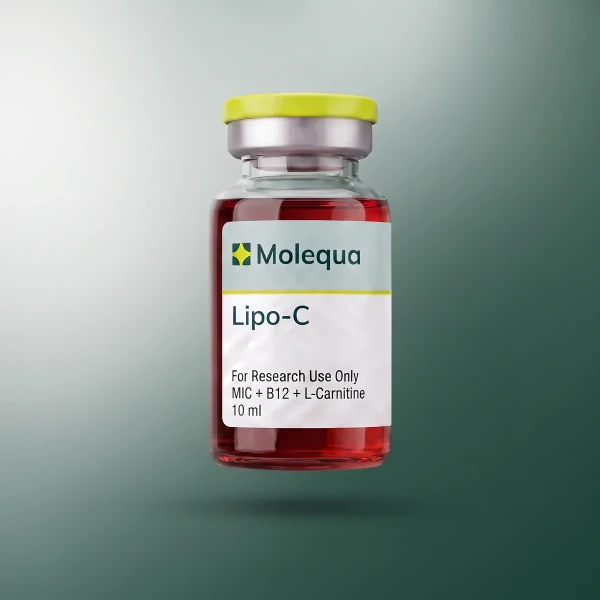
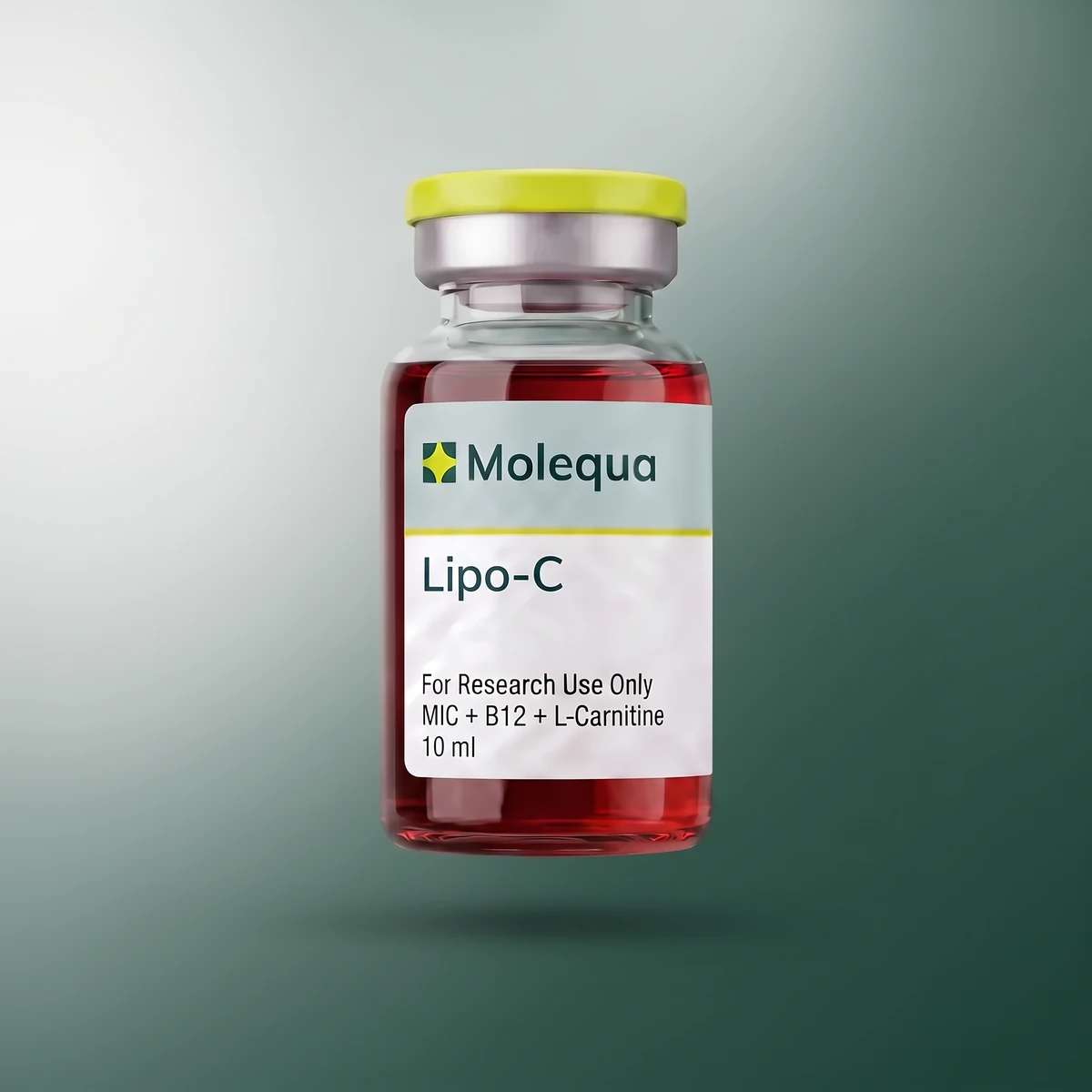
Lipo-C is a sterile solution of five lipotropic components: methionine, inositol and choline (MIC) supplemented with vitamin B12 and L-carnitine, 176 mg per millilitre in total. As a combination it has no clinical study of its own; evidence exists only for the individual components.
- Five components in one vial: 25 + 50 + 50 + 50 + 1 mg/ml
- Ready-made sterile solution, not a lyophilizate, nothing is reconstituted
- Batch composition confirmed by the certificate of analysis, not a catalogue
- No studies of the combination, literature only on the individual components
Read more Close
Overview
Lipo-C is the market name for a sterile solution of five substances: L-methionine, myo-inositol and choline (the trio known as MIC), vitamin B12 as cyanocobalamin, and L-carnitine. Molequa® supplies it as a 10 ml vial with 176 mg of components per millilitre, exclusively for laboratory research into fat metabolism and methylation. As a combination, Lipo-C has no peer-reviewed clinical study; evidence exists only for the individual components, and this page says so openly.
What “lipotropic” means and where MIC comes from
Lipotropic is a term from liver biochemistry, not marketing. Historically it covers substances involved in fat metabolism in the liver: choline, methionine and inositol, whose initials gave the abbreviation MIC. Per Zeisel and da Costa 2009, choline is an essential nutrient and a precursor of phosphatidylcholine and acetylcholine, and when it is lacking, fat accumulates in the liver.
Picture the liver as a warehouse that receives fat, repacks it and ships it on. Choline and methionine are the packaging and the tape; when they run out, goods pile up on the dock. Lipotropic says nothing about body weight, only whether the liver has something to pack with. The market added vitamin B12, cofactor of the enzyme closing the methylation cycle, and L-carnitine, which carries fatty acids into mitochondria.
Five components, one vial
The composition below is the market standard. The Molequa® batch will be confirmed by its certificate of analysis once stocked; nothing unmeasured is presented as fact.
| Component | Per 1 ml | Role in research | Source |
|---|---|---|---|
| L-methionine | 25 mg | essential amino acid, precursor of S-adenosylmethionine (SAM), the main methyl donor; lipotropic link in an old rat model | Noda 1980 |
| myo-inositol | 50 mg | precursor of phosphoinositides and the second messenger IP3; metabolic models | Croze and Soulage 2013 |
| choline chloride | 50 mg | essential nutrient, precursor of phosphatidylcholine and acetylcholine, methyl donor via betaine | Zeisel and da Costa 2009 |
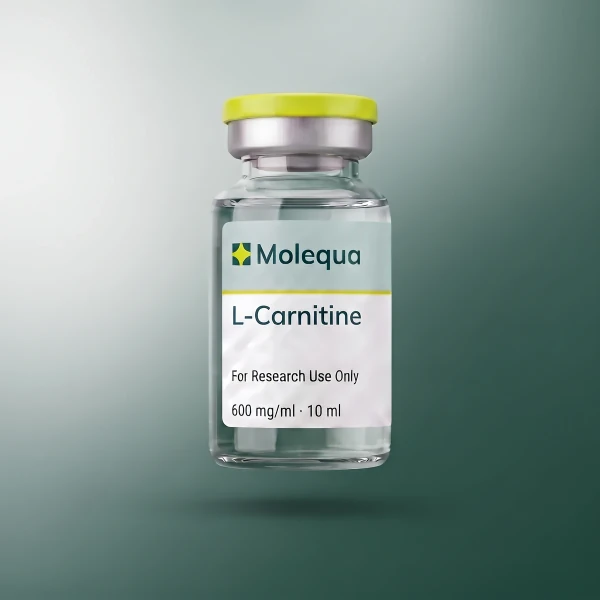
| L-carnitine | 50 mg | carries long-chain fatty acids into mitochondria for β-oxidation | Talenezhad 2020 |
| cyanocobalamin (B12) | 1 mg | cofactor of methionine synthase and methylmalonyl-CoA mutase; stable synthetic form, red, light-sensitive | Green 2017 |
In total 176 mg per 1 ml, 1,760 mg per vial. Cyanocobalamin gives the red colour; the other four are colourless in solution.
What Molequa® Lipo-C is and is not
- It is a sterile aqueous solution in a septum vial, not a lyophilizate. Nothing is reconstituted.
- It is a blend in a fixed ratio you cannot change, see the comparison below.
- It is not a medicine or a food supplement, but material for laboratory research (Research Use Only).
- It is not in stock yet. Until the first batch arrives it is a reservation without payment; the certificate of analysis follows on stocking.
Science & use
There is no direct evidence for the Lipo-C blend. As of November 2026 no peer-reviewed clinical study has examined this five-component combination as a whole. What exists is per-component literature: reviews on choline, inositol and B12, an old animal model with methionine, and a meta-analysis of 37 randomised trials of L-carnitine in humans. Below: the evidence by component, then the open questions.
Choline: methylation and fat export from the liver
Per Zeisel and da Costa 2009, choline has three roles: precursor of phosphatidylcholine, the main membrane phospholipid; precursor of acetylcholine, a neurotransmitter; and, via betaine, a methyl donor for the cycle that turns homocysteine back into methionine. Without choline the liver cannot build the coat for the fat it wants to ship, so fat accumulates. Choline deficiency is therefore a classic laboratory way to induce fat accumulation in liver cells, and the choline in Lipo-C is one variable in that set-up.
Methionine and B12: two links of one chain
L-methionine is an essential amino acid and the precursor of S-adenosylmethionine (SAM), the cell’s main methyl donor. Once SAM gives up its methyl group, homocysteine forms and methionine synthase recycles it to methionine. Here B12 enters: cobalamin is the cofactor of methionine synthase and methylmalonyl-CoA mutase (Green 2017). The two therefore sit on the same loop. Cyanocobalamin is the stable synthetic form of B12, red and light-sensitive.
An old animal model showed that disproportionately added methionine on a low-protein soybean diet induced fatty liver in rats, while phosphatides acted lipotropically (Noda 1980). A 46-year-old rat study is no evidence about humans, let alone the blend. Its lesson for Lipo-C: the ratio of components matters more than the list.
Myo-inositol: the signalling precursor
Myo-inositol is the precursor of phosphoinositides, membrane lipids that release the second messenger inositol-1,4,5-trisphosphate (IP3). Croze and Soulage 2013 summarise why it is studied in metabolic models: it sits at the start of hormonal signalling pathways. In Lipo-C it shares the highest content (50 mg/ml) with choline and L-carnitine, yet it is the only component outside the methylation cycle.
L-carnitine: the fatty acid carrier
L-carnitine carries long-chain fatty acids across the inner mitochondrial membrane to β-oxidation. It has the largest body of human data: a 2020 meta-analysis of 37 randomised controlled trials reports, for L-carnitine supplementation, a mean difference in body weight of −1.21 kg and in BMI of −0.24 kg/m² versus control (Talenezhad 2020). A literature fact about supplementation in humans, not a promise or a guide; for a researcher, a reference effect size for one component alone.
Open questions that make the blend a research topic
- Interactions in solution. Five chemically different molecules (amino acid, cyclitol, quaternary ammonium salt, zwitterion, corrinoid complex) in one aqueous phase; how they interact over 28 days, nobody has published.
- Analytics. A rewarding model for HPLC and LC-MS method development: very different polarity and detectability in one run.
- The ratio. Why 25 : 50 : 50 : 50 : 1? A market convention without a published rationale; nobody has optimised it.
Storage & stability
Store Lipo-C at 2–8 °C, in the dark and never in the freezer. An unopened vial keeps until the expiry date on the label; an opened vial keeps 28 days from the first puncture of the septum. The most sensitive component is cyanocobalamin: light breaks it down, and fading of the red colour is the first visible sign that the solution is no longer in order; clarity is the second.
Why the refrigerator and why the dark
Lipo-C is an aqueous solution, not a dry powder, so reactions between components run from day one and cold only slows them. Cyanocobalamin is the stable synthetic form of B12 (Green 2017), but like all cobalamins it is light-sensitive; clear glass does not protect it, so keep the vial in its box in the refrigerator. B12 also doubles as an indicator: while the solution is deep red and clear, the most sensitive component is in place.
Unopened vial
- 2–8 °C, an ordinary refrigerator, protected from light, until the date on the batch label.
- Do not freeze. Ice strains the closure and the components concentrate unevenly; after thawing you cannot be sure the ratio holds in every millilitre.
Opened vial
- From the first puncture of the septum allow 28 days at 2–8 °C.
- Write the date of first withdrawal on the label.
- Use sterile technique; there is no preservative to forgive handling errors.
- Before each withdrawal check colour (deep red, not faded or brownish), clarity (no turbidity, flakes or sediment) and the septum.
Lipo-C vs its individual components
The blend gives you one vial with five components in a fixed ratio, ready-made sterility, less preparation and one certificate of analysis. It does not let you attribute an effect to one component, change the ratio, or lean on clinical literature for the combination itself. If your research question is about one molecule, buy that molecule. If it is about the combination as sold on the market, Lipo-C is its standardised form.
| Aspect | Lipo-C (blend) | Individual components |
|---|---|---|
| Vials | 1 | 5 |
| Ratio of components | fixed 25 : 50 : 50 : 50 : 1 | your choice |
| Attributing an effect to a component | no, you see only the sum | yes |
| Peer-reviewed evidence | 0 studies for the combination | reviews and meta-analyses per component |
| Sterility | ready-made sterile solution | each component dissolved and sterile-filtered |
| Visual check | B12 colours everything red, turbidity harder to see | colourless, turbidity visible at once |
| Certificate of analysis | one for the blend | one per component |
| Stability after opening | 28 days at 2–8 °C for the whole | differs by component, B12 shortest |
The blend fits when you study the commercial combination as a whole, need a standardised stock solution with one certificate, or work on the analytics of multi-component solutions. Individual components fit whenever you want to know which of the five is behind an observation. An honest experiment with the blend includes the individual components as controls.
Tips & common mistakes
The most common mistake with Lipo-C is comparing price without comparing composition. In the EU, 10 ml sells for 75 to 89 €, but the L-carnitine content varies between sellers from 20 to 100 mg/ml, so two vials at the same price can differ fivefold in one component. Always recalculate the price per milligram of each component and ask for the batch certificate of analysis, not a catalogue figure.
- Price per vial instead of per composition. Molequa® charges 71.90 € for 10 ml with 176 mg/ml, 7.19 € per millilitre. A 79 € vial with 20 mg of L-carnitine per millilitre is not a tenth dearer; it has 2.5 times less of that component.
- Treating “Lipo-C” as a standard. It is not a pharmacopoeial name or a fixed recipe but a market label for solutions with varying ratios and numbers of components. Only the batch certificate of analysis is binding.
- Taking component literature as evidence for the blend. The 37-trial L-carnitine meta-analysis (Talenezhad 2020) covers L-carnitine alone in humans, not the five-component combination.
- Drawing from a vial that has changed colour. Fading or browning is information, not a cosmetic flaw.
- Confusing lipotropic with a claim about body weight. Lipotropic is a term about fat metabolism in the liver. Molequa® claims nothing else.
Key figures & facts
Molequa® Lipo-C 10 ml contains 176 mg of components per millilitre in the ratio methionine 25, inositol 50, choline chloride 50, L-carnitine 50 and cyanocobalamin 1 mg. It is stored at 2–8 °C in the dark, 28 days after opening. The price of 71.90 € sits below the market range of 75 to 89 €. Peer-reviewed studies of the combination: zero; every figure below belongs to an individual component.
| Figure | Value | Note / source |
|---|---|---|
| Components per 1 ml | 176 mg | 25 + 50 + 50 + 50 + 1 mg, market standard, confirmed by certificate |
| Cyanocobalamin | 1 mg/ml | red colour, light-sensitive (Green 2017) |
| Storage | 2–8 °C, dark, do not freeze | 28 days after first withdrawal |
| Peer-reviewed studies of the combination | 0 | as of November 2026 |
| L-carnitine in humans, meta-analysis | 37 RCTs, −1.21 kg, BMI −0.24 kg/m² | Talenezhad 2020, literature fact, not a promise |
| Spread of L-carnitine on the EU market | 20 to 100 mg/ml | fivefold difference at a similar price |
| Market price of 10 ml in the EU | 75 to 89 € | meaningless without composition |
| Molequa® price | 71.90 € (7.19 €/ml) | reservation without payment until stocked |
Reference sources (PubMed)
- Zeisel SH, da Costa KA (2009). “Choline: an essential nutrient for public health.” Nutr Rev. PubMed 19906248
- Croze ML, Soulage CO (2013). “Potential role and therapeutic interests of myo-inositol in metabolic diseases.” Biochimie. PubMed 23764390
- Noda K (1980). “Fatty liver due to disproportionally added methionine to a low soybean diet and lipotropic action of phosphatides in rats.” J Nutr Sci Vitaminol. PubMed 6987342
- Green R et al. (2017). “Vitamin B12 deficiency.” Nat Rev Dis Primers. PubMed 28660890
- Talenezhad N et al. (2020). Systematic review and meta-analysis of 37 randomised controlled trials of L-carnitine supplementation. Clin Nutr ESPEN. PubMed 32359762
Frequently asked questions about Lipo-C
Seven answers to what is most often looked up about Lipo-C: what the blend contains, why it is red, how it is stored, why comparing price without composition makes no sense, and why no clinical study of it exists. Technical data and sources are in the sections above.
What is Lipo-C and what does MIC stand for?
Lipo-C is the market name for a sterile solution of five lipotropic substances. MIC stands for methionine, inositol and choline, historically the liver’s lipotropic trio; the market added vitamin B12 as cyanocobalamin and L-carnitine. Molequa® supplies the blend as a 10 ml vial with 176 mg of components per millilitre, for laboratory research only.
Are there studies directly on the Lipo-C blend?
No. As of November 2026 no peer-reviewed clinical study has examined the five-component combination as a whole. Evidence exists only for the individual components: reviews on choline, inositol and B12, an old animal model with methionine, and a 37-trial L-carnitine meta-analysis. Molequa® does not pass off component literature as evidence for the blend.
What is the composition of Molequa® Lipo-C 10 ml?
The market standard we start from is, per 1 ml: L-methionine 25 mg, myo-inositol 50 mg, choline chloride 50 mg, L-carnitine 50 mg and cyanocobalamin 1 mg, 176 mg in total. The exact batch composition is confirmed by the certificate of analysis, published when the first batch is stocked. Until then the product is a reservation without payment.
Why is the solution red and why must it be protected from light?
The red comes from cyanocobalamin, the stable synthetic form of vitamin B12. Cobalamins are light-sensitive, so the vial belongs in the dark. The colour doubles as a check point: while the solution is deep red and clear, the most sensitive component is in place. Fading or browning means breakdown.
How is Lipo-C stored and how long does it keep after opening?
Keep the unopened vial at 2–8 °C, protected from light, until the expiry date on the label. Never freeze: ice damages the closure and the components concentrate unevenly. After the first puncture of the septum allow 28 days at 2–8 °C and write the date of first withdrawal on the label.
How do I compare Lipo-C prices between sellers?
Never by price per vial alone. In the EU, 10 ml of Lipo-C sells for 75 to 89 €, but the L-carnitine content varies between sellers from 20 to 100 mg/ml, a fivefold difference. Recalculate the price per milligram of each component from the batch certificate of analysis, not the catalogue. Molequa® charges 71.90 € for 10 ml with 176 mg per millilitre.
Where to buy Lipo-C in the EU for research use?
Molequa® offers Lipo-C 10 ml for laboratory research as a sterile solution with a batch certificate of analysis. The first batch is not yet stocked; until then the product is a reservation without payment. Delivery within the EU by Packeta or courier. Research use only (RUO).
For research use only
Molequa® Lipo-C is intended exclusively for laboratory and analytical purposes (Research Use Only, RUO). It is not a medicine, food supplement, medical device or a product for human or veterinary use, diagnosis, treatment or consumption. The information on the individual components summarises the peer-reviewed literature and is not a claim about the effects of the blend. Handle it in accordance with applicable laboratory practice and the legislation in your jurisdiction, and study the batch certificate of analysis before any work.