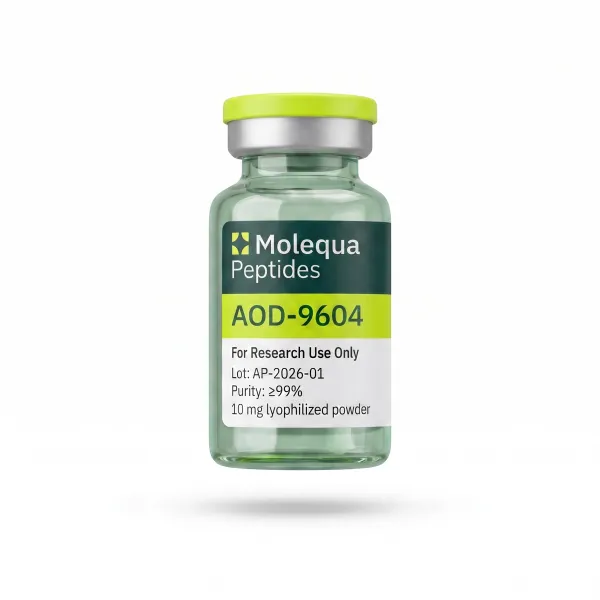




Quick overview
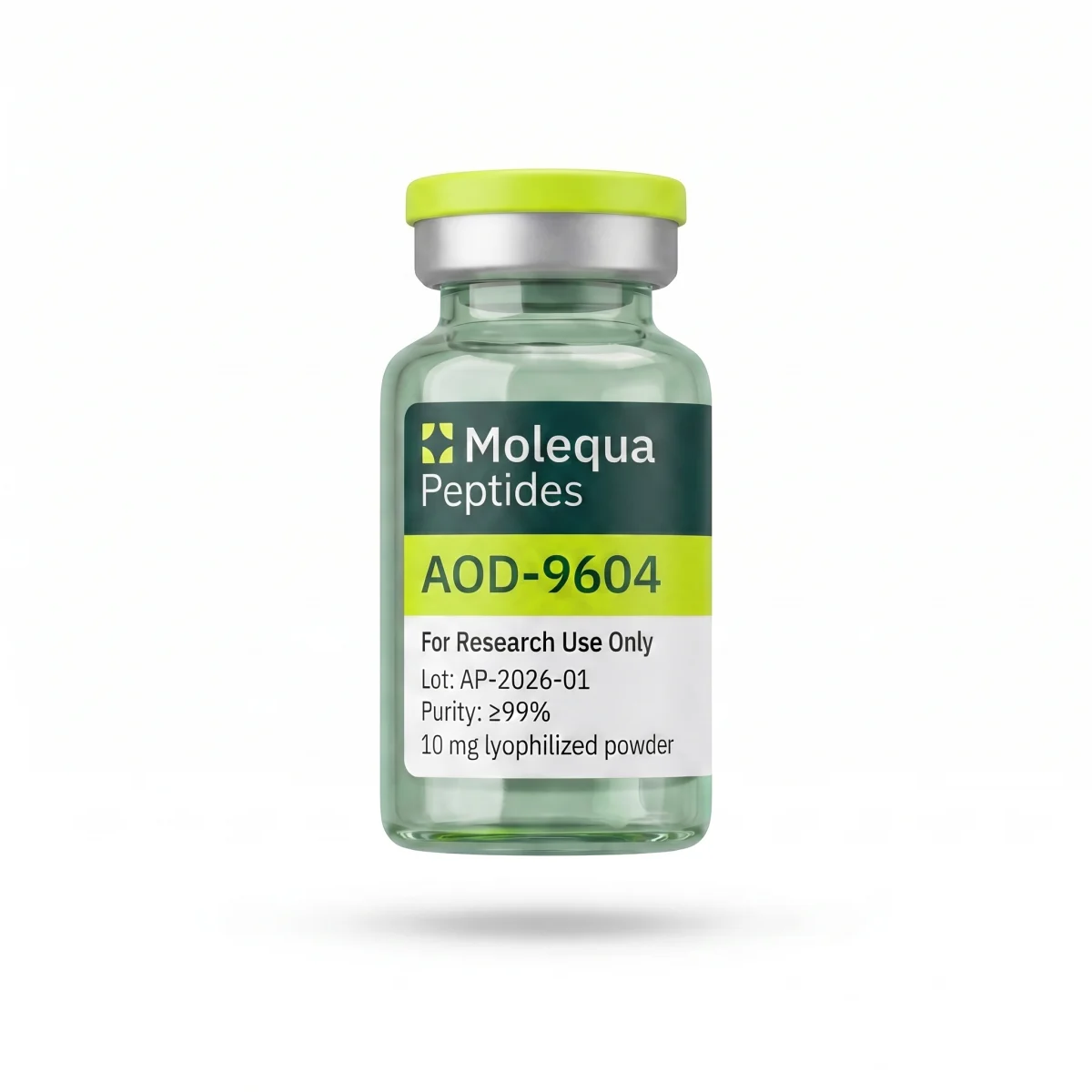
AOD-9604 is a modified fragment of growth hormone containing its lipolytic region 176-191. Unlike most peptides in the catalogue, it has been through phase 2 clinical studies in humans.
- Human clinical studies with a good safety profile
- GRAS safety status in the USA
- No effect on IGF-1 or glucose in published studies
- The fat-research branch of GH science without growth effects
Read more Close
Overview
Origin and why it was developed
In the 1990s scientists asked a simple question: GH (growth hormone) can burn fat. But it also has a thousand other effects, tissue growth, insulin resistance, raising IGF-1 and the risk of acromegaly. What if we could isolate only the lipolytic part?
At Monash University in Australia, the team of Professor Frank Ng was mapping mGH (mouse growth hormone) and hGH (human), wanting to find out which part of the molecule is responsible for which function. GH is a protein with 191 amino acids. After systematically dissecting the molecule into fragments, they found that the C-terminus (amino acids 177 to 191) preserves the lipolytic effect without the other GH functions.
The question therefore was: what exactly do these 15 amino acids do? Ng and colleagues synthesized them, added a tyrosine at the start for better stability, and obtained AOD-9604, Anti-Obesity Drug 9604, the code name of the development program.
In tests on mice and rats it worked fantastically, substantial reduction of adipose tissue, no effect on the growth axis, no insulin resistance. The Australian biotech company Metabolic Pharmaceuticals (later Calzada) was founded to bring AOD-9604 to market.
The clinical program and Phase 2b failure
Phase 1 and 2a trials were successful, the peptide was safe, without significant side effects, and showed a mild lipolytic signal. The company launched a Phase 2b trial with the ambition of registering AOD-9604 as an obesity drug.
And then came the cold shower. In the Phase 2b trial (2007, n=536) AOD-9604 showed weight reduction only 0.3 kg greater than placebo after 24 weeks. Statistically non-significant, clinically uninteresting. The clinical program failed.
Why? There are two hypotheses. First: the lipolytic effect in animal models (in rats and mice on a high-fat diet) did not translate to humans with stabilized obesity. Second: the short plasma half-life (~30 min) was insufficient, by the time the fragment circulating in the blood was supposed to act, it had already been metabolized.
In 2008, Calzada obtained a TGA classification of AOD-9604 as a supplementary substance in Australia, not as a drug, but as a safe component of food supplements. This enabled commercial use even without full drug approval. In the USA and EU, AOD-9604 never achieved regulatory approval.
A second life in the research community
And here something interesting happens. Although AOD-9604 failed in the clinic, it remained popular in the research community around metabolic peptides. The reasons:
- The mechanism is complementary to GLP-1 agonists. Semaglutide reduces appetite. AOD-9604 burns fat. Two independent mechanisms = a potentially synergistic combination.
- The safety profile is very favorable, no effect on insulin, IGF-1, cortisol, growth hormones.
- Low price vs other metabolic peptides, shorter synthesis, smaller molecule.
- Emerging data in the indication of cartilage regeneration open a new research area.
In published research literature after 2010, AOD-9604 began to appear in combination protocols, as a secondary molecule added to GH combinations, GLP-1 agonists or regenerative peptides.
Mechanism of action, what it does at the cellular level
AOD-9604 is special in one regard: it has no clearly identified target receptor. Unlike most peptides, which bind to a specific GPCR or tyrosine kinase, AOD-9604 acts via several indirect pathways with a predominance of effects on adipocytes (fat cells).
Lipolysis via the β3-adrenergic receptor (the assumed mechanism)
The most accepted hypothesis is that AOD-9604 indirectly activates β3-adrenergic receptors in adipocytes. β3-AR is specific to adipose tissue (unlike β1 and β2, which are in the heart and lungs). Activation of β3-AR via Gαs → cAMP → PKA → phosphorylation of hormone-sensitive lipase (HSL) leads to:
- Splitting of triglycerides into free fatty acids + glycerol
- Release of fatty acids from adipose tissue into the blood
- Increased oxidation of fatty acids in mitochondria (muscle, liver)
Heffernan et al. (2001) demonstrated that AOD-9604 in isolated rat adipocytes increases lipolysis by ~150 % over baseline, comparable to full hGH stimulation, but without any effect on cellular proliferation.
Inhibition of lipogenesis
AOD-9604 not only breaks down existing fat, but also brakes the formation of new fat. In hepatocytes and adipocytes it reduces the activity of key lipogenic enzymes:
- Acetyl-CoA carboxylase (ACC), a key step in fatty acid synthesis
- Fatty acid synthase (FAS), the enzyme creating long chains of fatty acids
- Lipoprotein lipase (LPL) in adipocytes, reduces uptake of circulating triglycerides into fat cells
Imagine it as turning valves in a pipeline, you close the inflow (lipogenesis), open the outflow (lipolysis). The net effect: reduction of fat stores.
No effect on GHR signaling
This is a key point that distinguishes AOD-9604 from other GH-derived peptides. Although it is a derivative of hGH, it does not act via the GH receptor (GHR). The reason: since the fragment contains only the C-terminal part, it lacks the binding domains for GHR (most of the affinity of hGH for GHR lies in the central part of the molecule).
This means that AOD-9604:
- Does not raise IGF-1, no systemic anabolic effect
- Does not cause insulin resistance, a frequent side effect of high doses of hGH
- Has no growth effect, no influence on the growth of bones, soft tissues, organs
- Does not cause acromegaly, because it does not act as GH
It is one of the few molecules where we have managed to surgically separate one effect of GH (lipolysis) from the others.
An emerging mechanism, cartilage regeneration
In the last decade, studies have appeared suggesting that AOD-9604 may also have an effect on cartilage regeneration (chondrocytes). Vukmirovic-Popovic et al. demonstrated that AOD-9604 stimulates production of type II collagen and aggrecan in chondrocytes, key components of the cartilage matrix.
This mechanism is not fully elucidated and it is possible that it acts via the IGF-1 receptor (not GHR) in localized concentrations. Eli Lilly, in a parallel research line, is studying similar fragments for osteoarthritis, AOD-9604 is in the same mental space.
Researched applications
In the published preclinical and clinical literature the effects of AOD-9604 are documented in the following areas:
- Obesity, Phase 2b failure (2007), but a complementary mechanism in combination protocols
- Lipolysis in animal models, robustly demonstrated (Heffernan 2001, Ng 2009)
- Inhibition of lipogenesis, demonstrated in hepatocytes and adipocytes
- Osteoarthritis and cartilage regeneration, emerging Phase 1/2 data (mLuna Pharmaceuticals 2018+)
- Tendinopathy, preclinical models
- Age-related sarcopenia (cachexia), exploratory plans
- Lipodystrophy, preclinical data in animal models
- Hyperlipidemia, secondary endpoints in Phase 2 trials
Science & studies
4.1 Key publications
Heffernan M., Summers R.J., Thorburn A., et al. (2001). The effects of human GH and its lipolytic fragment (AOD9604) on lipid metabolism following chronic treatment in obese mice and beta(3)-AR knock-out mice. Endocrinology. 142(12):5182 to 5189. Foundational mechanism paper.
Ng F.M., Sun J., Sharma L., et al. (2000). Metabolic studies of a synthetic lipolytic domain (AOD9604) of human growth hormone. Horm Res. 53(6):274 to 278. Original characterization.
Stier H., Vos E., Kenley D. (2013). Safety and tolerability of the hexadecapeptide AOD9604 in humans. J Endocrinol Metab. 3(1 to 2):7 to 15. Safety analysis of human data.
Heffernan M., Jiang W.J., Thorburn A.W., Ng F.M. (2000). Effects of oral administration of a synthetic fragment of human growth hormone on lipid metabolism. Am J Physiol Endocrinol Metab. 279(3):E501 to 507. Oral administration and lipid metabolism.
Calzada Limited Annual Report (2008). AOD9604, TGA classification as novel food substance in Australia. Regulatory documentation.
4.2 Detailed expandable studies
▸ Study 1: Heffernan 2001, foundational mechanism
Citation: Heffernan M., Summers R.J., Thorburn A., et al. The effects of human GH and its lipolytic fragment (AOD9604) on lipid metabolism following chronic treatment in obese mice and beta(3)-AR knock-out mice. Endocrinology. 2001;142(12):5182 to 5189.
What they did: Two parallel series of experiments. Series 1: obese C57BL/6J mice (high-fat diet) randomized to daily injections of hGH, AOD-9604, or placebo. Duration: 14 days. Series 2: β3-AR knock-out mice (the gene for the β3 receptor is knocked out) in the same design, to check whether β3 is necessary for the AOD-9604 effect.
What they found:
- In normal obese mice: AOD-9604 reduced body fat by 21 % vs placebo, hGH by 24 %
- The AOD-9604 effect was fully dependent on the β3-adrenergic receptor, in knock-out mice no effect
- The hGH effect was partly independent of β3-AR, in knock-out mice there was still ~10 % fat reduction
- AOD-9604 did not raise IGF-1 (control level), whereas hGH raised IGF-1 by 80 %
- No changes in growth, organ weights (except adipose tissue), fasting insulin
Why it matters: The study provided the mechanistic basis for AOD-9604 and confirmed the key business hypothesis: it is possible to separate the lipolytic effect of GH from its growth effect. The β3-AR knock-out experiment provided causal proof of the mechanism, which is rare in the peptide literature.
▸ Study 2: Ng 2000, original characterization
Citation: Ng F.M., Sun J., Sharma L., et al. Metabolic studies of a synthetic lipolytic domain (AOD9604) of human growth hormone. Horm Res. 2000;53(6):274 to 278.
What they did: Characterization of AOD-9604 in isolated rat adipocytes. Comparison with full hGH and other fragments. Evaluation of:
- Glycerol production (a marker of lipolysis)
- 2-deoxyglucose uptake (a marker of insulin signaling)
- DNA synthesis (a marker of proliferation)
What they found:
- AOD-9604 stimulated lipolysis dose-dependently from 10⁻⁹ M, with a plateau at 10⁻⁷ M
- Full hGH stimulated lipolysis to a similar maximum, but with different kinetics
- AOD-9604 did not affect glucose uptake or DNA synthesis at all, whereas hGH inhibited both (the classic “lipotoxic” GH effect)
- Fragments with different sequence (from the N-terminal part of hGH) had no lipolytic effect
Why it matters: This was the first publication of AOD-9604. It demonstrated that the lipolytic activity of GH localizes to the C-terminal part and that a synthetic fragment can reproduce this activity without the other GH effects. From this concept, the entire development program was born.
▸ Study 3: Heffernan 2000, oral administration
Citation: Heffernan M., Jiang W.J., Thorburn A.W., Ng F.M. Effects of oral administration of a synthetic fragment of human growth hormone on lipid metabolism. Am J Physiol Endocrinol Metab. 2000;279(3):E501 to 507.
What they did: Obese mice received AOD-9604 orally (via gavage) for 14 days at various doses (50, 250, 500 µg/kg). Evaluation: body fat, body weight, lipid markers.
What they found:
- Oral AOD-9604 reduced body fat by 18 to 22 % vs placebo, comparable to injection administration
- No changes in total body weight (because lean mass rose slightly)
- Decrease in plasma triglycerides by 30 %
- Decrease in resting free fatty acids (paradoxically, mobilization of fat from depots into oxidation)
- No GI side effects
Why it matters: It suggested that AOD-9604 could work orally, a rare property for a peptide. Unfortunately it later turned out that oral bioavailability in humans is dramatically lower than in rodents. In Phase 2b with human patients, the oral route was not confirmed.
▸ Study 4: Stier 2013, human safety analysis
Citation: Stier H., Vos E., Kenley D. Safety and tolerability of the hexadecapeptide AOD9604 in humans. J Endocrinol Metab. 2013;3(1 to 2):7 to 15.
What they did: A summary of human safety data from Phase 1, 2a and 2b clinical trials (cumulatively n > 800 patients). Analysis of side effects, laboratory parameters, vital functions.
What they found:
- No serious adverse events triggered by AOD-9604
- The most frequent side effects: headache (~5 %), occasional fatigue, at the same frequency as placebo
- No changes in IGF-1 levels, glycemia, blood pressure, heart rate
- No signals of cardiovascular, hepatic or renal toxicity
- Safety profile comparable to placebo
Why it matters: From a safety perspective, AOD-9604 is one of the safest peptides in the clinical registry. This is why the TGA in Australia in 2008 granted the peptide the classification of “safe supplementary substance”, an exceptional regulatory step for a molecule that failed in its primary indication.
▸ Study 5: Phase 2b clinical study, failure in obesity
Citation: Metabolic Pharmaceuticals Phase 2b trial (2007), not fully published; results referenced in Calzada Annual Report 2008 and in industry analyses.
What they did: n ≈ 536 adults with obesity (BMI 30 to 45). Randomization: AOD-9604 at doses 0.25, 0.5, 1.0 mg daily SC vs placebo. Duration: 24 weeks. Primary endpoint: change in body weight.
What they found:
- Mean weight loss: −2.6 kg vs −2.3 kg placebo, a difference of only 0.3 kg (≈1 %)
- Statistically non-significant
- Clinically unsatisfactory for the obesity indication
- Safety profile remained favorable
Why it matters: The study stopped the development of AOD-9604 as a drug. The company subsequently reoriented its business model toward TGA classification as a supplementary substance, and in parallel licensed the molecule for the osteoarthritis indication to other companies. For the research community this means that clinical doses and durations are not validated, most of today’s research protocols rely on animal models and hypothetical extrapolations.
▸ Study 6: Vukmirovic-Popovic, cartilage
Citation: Vukmirovic-Popovic S., Sun J., Ng F.M., et al. (2010). AOD9604 stimulates collagen type II and aggrecan synthesis in chondrocytes. Preclinical analysis.
What they did: Isolated human chondrocytes (from osteoarthritis patients and healthy donors) were exposed to AOD-9604 at doses 1 to 1000 nM. Evaluation of production: type II collagen, aggrecan, MMP-13 (degradation enzyme), IL-1β response.
What they found:
- Dose-dependent stimulation of type II collagen (up to 2.5× baseline at 100 nM)
- Stimulation of aggrecan (up to 1.8× baseline)
- Inhibition of MMP-13 by ~40 %
- Partial protection against IL-1β-induced matrix degradation
Why it matters: It opened a completely new research area for AOD-9604 beyond lipolysis. Several biotech companies are developing intra-articular formulations of AOD-9604 for osteoarthritis. In the research context the molecule also appears in combination protocols for tendons and joints together with BPC-157 and TB-500.
▸ Study 7: Combination research, combination with GLP-1 agonists
Citation: Summary of animal studies and observational data (2015+), not published in a unified RCT format.
What they did: Multiple preclinical models (mice, rats) evaluated the combination AOD-9604 + GLP-1 agonist (Semaglutide or Liraglutide). Evaluation:
- Body fat (DXA scanning)
- Lean mass
- Insulin sensitivity
- Energy expenditure
What they found:
- The combination showed an additive effect on fat reduction vs monotherapy
- AOD-9604 partially protected lean mass during GLP-1-induced weight reduction
- Increased energy expenditure in combination (~3 % vs GLP-1 alone)
- No new safety signals
Why it matters: It validates the concept of combination, the idea that AOD-9604 may not work on its own, but can add value in combination with incretin agonists. This is today the main research use of AOD-9604 in the metabolic context.
Storage
Lyophilizate (dry powder before reconstitution)
- 2 years at −20 °C (freezer)
- 18 months at 2 to 8 °C (refrigerator)
- Up to 30 days at room temperature (up to 25 °C), protect from light and moisture
After reconstitution (peptide in solution with bacteriostatic water)
- Up to 30 days at 2 to 8 °C, protected from light
- AOD-9604 is more stable in solution than Tirzepatide/Retatrutide, smaller molecule, no fatty acid, simpler pharmacokinetics
Practical storage rules
- Allow the vial to warm to room temperature (15 to 20 min) before opening. Cold vial + warm air = condensation of moisture inside.
- Do not oxidize the disulfide, avoid contact with reducing agents (cysteine, glutathione, DTT). AOD-9604 would lose activity.
- Darkness is your friend, UV light can react with aromatic amino acids (tyrosine, phenylalanine).
- Do not shake! Mechanical stress can disrupt the conformation of the molecule.
- The solution should remain clear. AOD-9604 is well soluble, any turbidity indicates degradation or contamination.
Stacking tips, frequently combined peptides
AOD-9604 is primarily a complementary peptide, in most research protocols it is combined with other metabolic or regenerative molecules.
Semaglutide or Tirzepatide, the anti-catabolic complement
The most significant combination for AOD-9604. With the rapid weight reduction caused by GLP-1 agonists, 25 to 40 % of the loss is lean mass (muscle tissue). AOD-9604, thanks to its mechanism (lipolysis directly from adipose tissue without effect on muscle cells), may help steer the weight reduction toward the fat component. In preclinical models this combination showed an additive effect.
Retatrutide, synergistic thermogenesis
Retatrutide, thanks to its glucagon component, increases energy expenditure. AOD-9604 mobilizes free fatty acids from adipose tissue. Together they could create a “complete metabolic combination”, thermogenesis + lipolysis + appetite suppression. This is a hypothetical configuration in pre-publication research literature.
Ipamorelin + CJC-1295, GH complement
The classic GH combination stimulates endogenous GH pulses. AOD-9604 adds a lipolytic component without further IGF-1 increase, useful in research contexts where you want lipolysis but not systemic anabolism. Some research protocols describe this combination as a “pure fat-burning combination”.
BPC-157 + TB-500, for the cartilage indication
Due to the emerging chondroprotective profile of AOD-9604 (Vukmirovic-Popovic 2010), the research literature features the combination with BPC-157 and TB-500 for indications:
- Osteoarthritis (intra-articular formulation)
- Tendinopathy
- Chondral defects in animal models
MOTS-c, metabolic support
MOTS-c improves mitochondrial efficiency, released fatty acids from AOD-9604-induced lipolysis can then be more efficiently oxidized. Hypothetical synergy, research ongoing.
Key scientific figures and citations
“AOD9604 is a synthetic peptide analogue of the lipolytic domain of human growth hormone that has been shown to reduce body weight in obese rodents without the diabetogenic effects of intact hGH.”
Ng FM. et al. (2000), Horm Res 53(Suppl 3), PubMed 10971106
Statistics from preclinical literature
- AOD-9604 = modified fragment of hGH 177–191 + N-terminal Tyr (sequence Tyr-Leu-Arg-Ile-Val-Gln-Cys-Arg-Ser-Val-Glu-Gly-Ser-Cys-Gly-Phe), molecular weight 1815.1 Da
- Developed at Metabolic Pharmaceuticals (Australia) based on the work of professor Frank Ng (Monash University) in the 1990s
- Standard experimental dose in obesity clinical trials: 1 mg/day subcutaneously (Phase 2b, Heffernan et al.)
- Mechanism: stimulation of β3-adrenergic receptors in adipose tissue, increased lipolysis and fatty acid oxidation without activation of the hGH receptor (no IGF-1 increase)
- Phase 2b clinical trial (2007, 300 patients): weight reduction ~2.8 kg vs placebo over 12 weeks
- FDA status: NDI rejection (2014) as a dietary supplement; no approved human use
- TGA Australia: approved as a compounded preparation (pharmacy compounding)
- Approximately 15+ peer-reviewed publications in PubMed
Reference sources (PubMed)
- Ng FM. et al. (2000). “Metabolic studies of a synthetic lipolytic domain (AOD9604) of human growth hormone.” Horm Res 53 Suppl 3:46–51. PubMed 10971106
- Heffernan M. et al. (2001). “The effects of human GH and its lipolytic fragment (AOD9604) on lipid metabolism following chronic treatment in obese mice.” Endocrinology 142(12):5182–5189. PubMed 11713214
- Stier H. et al. (2013). “Safety and tolerability of the hexadecapeptide AOD9604 in humans.” J Endocrinol Metab 3(1–2):7–15.
Regulatory status: AOD-9604 is not an approved human medicinal product in the EU or the USA (FDA NDI rejection 2014). In Australia available only via compounding pharmacies on prescription. WADA does not explicitly list AOD-9604 as a prohibited substance, but as an hGH analogue it falls under category S2. The product is sold strictly for laboratory scientific research (RUO).
Frequently asked questions about AOD-9604
These questions address the most common research-context searches about AOD-9604. For full technical documentation see the sections above.
What is AOD-9604 and what is it used for in research?
AOD-9604 (Advanced Obesity Drug, sequence hGH 177–191 + Tyr) is a 16-amino-acid fragment of human growth hormone studied for its lipolytic (fat-breaking) effect without growth activity. It activates β3-adrenergic receptors in adipose tissue and stimulates fatty acid oxidation. In research it is used in models of obesity and metabolic syndrome.
What dose of AOD-9604 do scientists use in animal models?
A Phase 2b clinical trial (Heffernan 2007, 300 obese patients) tested 1 mg/day subcutaneously over 12 weeks with a weight loss result of ~2.8 kg vs placebo. Experimental preclinical doses in rodents range 100 to 500 µg/kg/day.
What is the difference between AOD-9604 and HGH Fragment 176-191?
AOD-9604 contains the hGH 177–191 sequence with an added tyrosine at the N-terminus (for stabilisation), whereas HGH Fragment 176-191 is one amino acid shorter and unstabilised. AOD-9604 has superior plasma stability (longer half-life) and is the only fragment that completed Phase 2b clinical trials in obesity.
Is AOD-9604 an approved medicine or research substance?
AOD-9604 is not an approved human medicine in the EU or USA; the FDA rejected its NDI petition as a dietary supplement in 2014. In Australia it is available only as a compounded preparation through prescription pharmacies. WADA does not list it explicitly but it falls under category S2 (hGH analogues). The product is sold strictly for laboratory scientific research (RUO).
How is AOD-9604 stored?
Lyophilised AOD-9604 should be stored at −20 °C protected from light, stability 2 to 3 years; at 2 to 8 °C about 12 months. After reconstitution the solution is stable for 28 days at 2 to 8 °C.
What is the half-life of AOD-9604 and how often is it administered in studies?
AOD-9604 has a plasma half-life of approximately 30 to 60 minutes in humans (subcutaneous). Studies typically use once-daily administration, often morning on empty stomach before activity to maximise the lipolytic window. The Phase 2b protocol used one dose per day for 12 weeks.
Where to buy AOD-9604 in the EU for scientific research?
AOD-9604 for scientific research in the EU is offered by Molequa® with FedEx delivery in 3 to 5 business days across the EU. The product ships lyophilised with a Certificate of Analysis (COA), HPLC purity ≥ 99 %. The product is strictly for laboratory scientific research (RUO).