






Quick overview
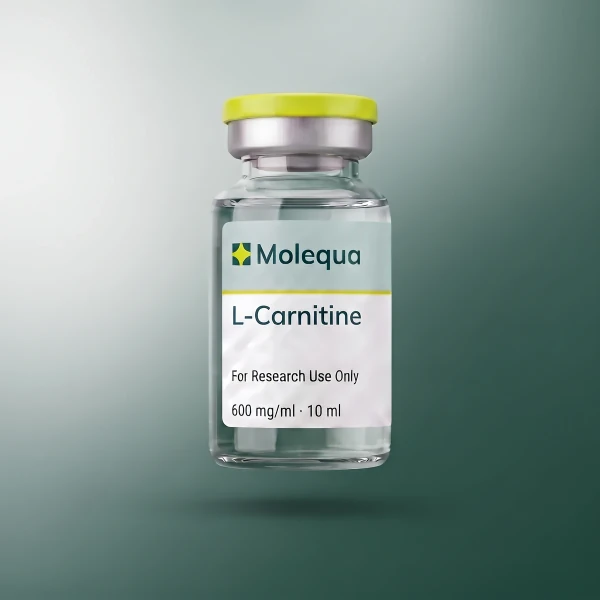
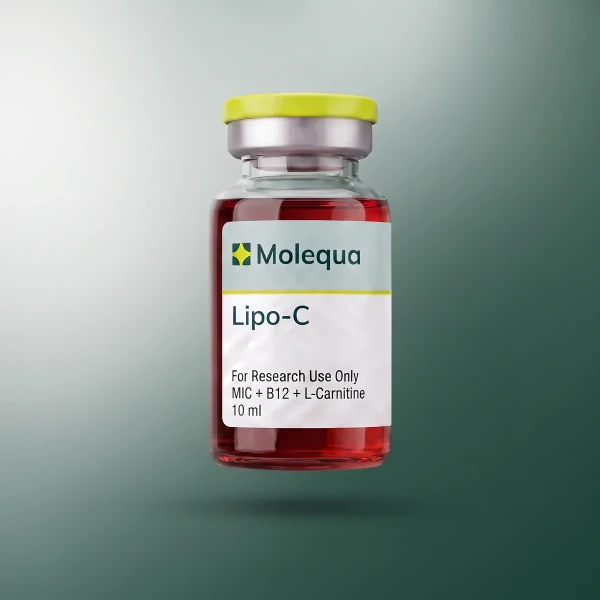
L-carnitine is the molecule that carries long-chain fatty acids into mitochondria for β-oxidation and buffers the acyl-CoA/CoA ratio. The sterile 600 mg/ml solution is a concentrated stock for dilution in cell culture, fatty acid metabolism models and analytical standards.
- 6,000 mg of L-carnitine in 10 ml, roughly 3.72 mol/l
- Sterile solution, not a lyophilizate, nothing to reconstitute
- CAS 541-15-1, 161.2 Da, the natural (3R) enantiomer
- Human meta-analyses quoted with their numbers, no promises
Read more Close
Overview
L-carnitine is a small molecule the body makes from lysine and methionine; it carries long-chain fatty acids into mitochondria, where they are oxidised. Molequa® offers it as a sterile aqueous solution of 600 mg/ml in a 10 ml vial, 6,000 mg of substance in one concentrated stock for dilution: for cell cultures, fatty acid metabolism models, mitochondrial respiration measurements and as an analytical standard. For laboratory research only.
What L-carnitine is and where it comes from
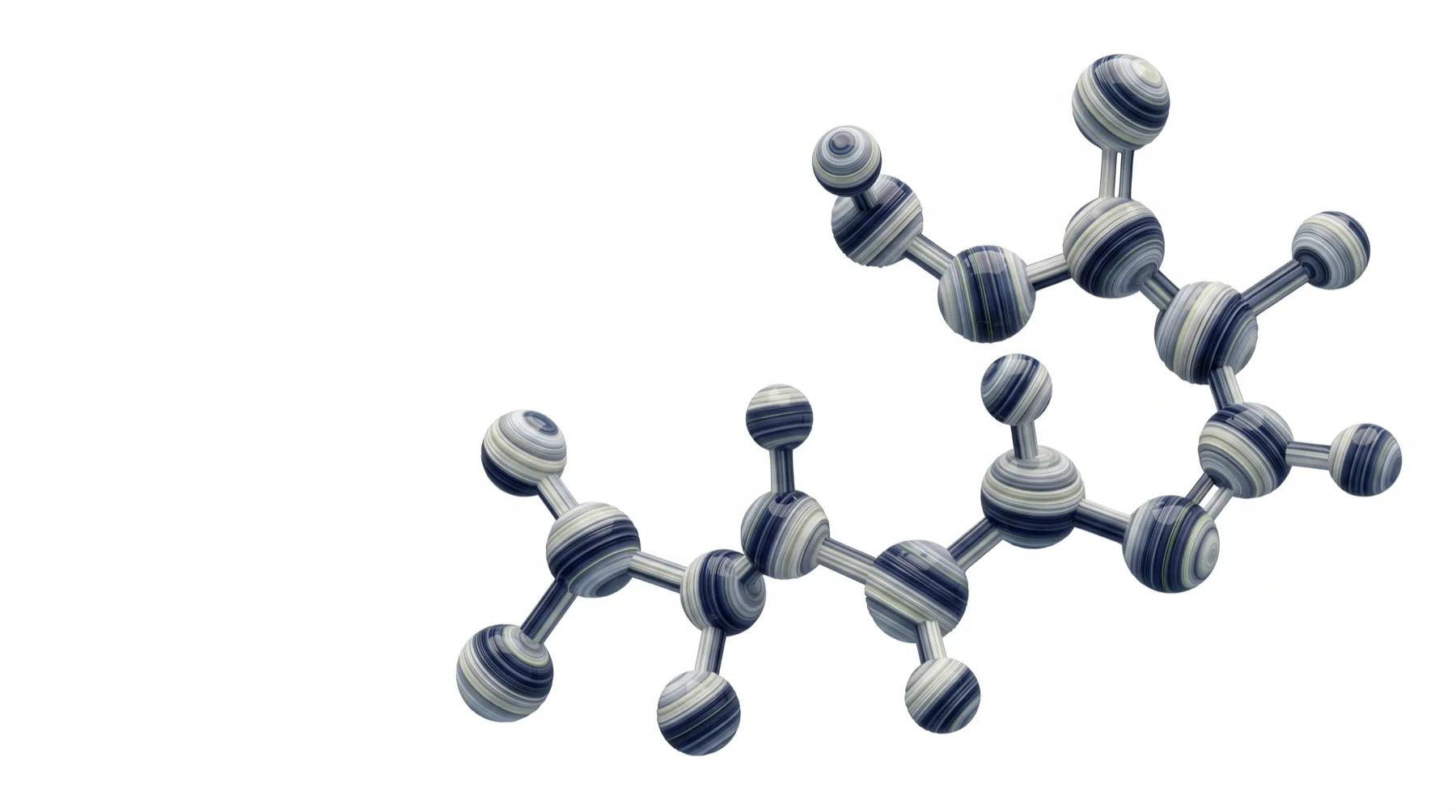
Systematically, L-carnitine is (3R)-3-hydroxy-4-(trimethylammonio)butanoate, formula C7H15NO3, 161.20 Da, CAS 541-15-1 (PubChem). It is a zwitterion: a positive charge on the quaternary nitrogen, a negative one on the carboxylate. That is why it dissolves in water extremely readily and has to be carried across the inner mitochondrial membrane by a dedicated transporter. The letter L denotes the natural (3R) enantiomer, the form the cell produces and the enzymes of the carnitine shuttle recognise.
The organism synthesises L-carnitine itself, mainly in the liver and kidneys, from the amino acids lysine and methionine. The rest comes from the diet, mostly from red meat; hence the name, Latin carnis means meat. Research, however, works with a defined amount of pure substance in a defined volume, which is what a stock solution is for.
Why a solution, and why 600 mg/ml
The 600 mg/ml solution is a concentrated stock for dilution, not a working concentration. A 10 ml vial holds 6,000 mg of L-carnitine, which at 161.20 g/mol corresponds to roughly 3.72 mol/l. One vial yields a large number of working dilutions, each taking only microlitres: 10 µl contains 6 mg of L-carnitine, in 10 ml of medium that is 0.6 mg/ml, roughly 3.72 mmol/l. This is arithmetic, not a protocol.
Why a solution and not a powder? The free base of L-carnitine is hygroscopic and picks up moisture while being weighed. A sterile solution of known concentration skips that step and, after dilution in sterile medium, goes straight into an aseptic workflow. It is not a lyophilizate and it is not reconstituted.
What you will not find on this page yet
The first batch has not been stocked yet, so for now we do not state the pH of the solution, its osmolality or any excipients. We will add them from the batch documentation and certificate of analysis the moment it is stocked. What has not been measured is not presented here as fact. Until stocking the product is available as a reservation without payment.
Where L-carnitine is used in research
- Fatty acid metabolism models: carnitine is the limiting link in the transport of long-chain fatty acids into the mitochondrion.
- Cell cultures: carnitine supplementation of the medium when following fatty acid oxidation.
- Mitochondrial respiration: oxygen consumption measurements on fatty substrates, where without carnitine the substrate never reaches β-oxidation.
- Analytical standards: calibration in the determination of carnitine and acylcarnitines by chromatography and mass spectrometry.
Science & use
The well-documented role of L-carnitine is the carnitine shuttle: CPT1 on the outer mitochondrial membrane moves a fatty acid from coenzyme A onto carnitine, the translocase CACT carries the acylcarnitine across the inner membrane, and CPT2 inside hands it back to coenzyme A for β-oxidation. Carnitine also buffers the acyl-CoA/CoA ratio. Human supplementation meta-analyses from 2016, 2020 and 2024 describe small body weight differences of around one kilogram: literature data, not instructions for this product.
The carnitine shuttle and the coenzyme A buffer
Long-chain fatty acids are excellent fuel, but activated as acyl-CoA they cannot cross the inner mitochondrial membrane by themselves. Carnitine is the ferry, and the cycle has three stations:
- CPT1 (carnitine palmitoyltransferase 1) on the outer membrane takes the fatty acid from acyl-CoA and attaches it to the hydroxyl of carnitine. Acylcarnitine is formed, coenzyme A is released.
- CACT (carnitine-acylcarnitine translocase) in the inner membrane is an exchanger: acylcarnitine in, free carnitine out. Carnitine is not consumed, it only circulates.
- CPT2 (carnitine palmitoyltransferase 2) on the inner side moves the fatty acid from acylcarnitine back onto mitochondrial coenzyme A. Acyl-CoA enters β-oxidation, carnitine returns to CACT.
In plain terms: CPT1 is loading, CACT the ferryman, CPT2 unloading. When boats are missing, cargo piles up on the shore no matter how efficient the harbour is; that is why the carnitine concentration in an experiment must be known and controlled.
The second role: free coenzyme A is needed by dozens of reactions at once. When acyl groups bound to CoA accumulate in the mitochondrion, carnitine takes them over, acylcarnitine is formed and coenzyme A is released. Carnitine is thus a reservoir for acyl groups that keeps the acyl-CoA/CoA ratio within its working range; it is followed through the acylcarnitine profile, and for that you need a pure standard of known concentration.
What human supplementation studies say
A warning up front: these papers studied L-carnitine supplementation in humans. The Molequa® product is for laboratory research only; nothing in the table is an instruction, a dose or a promise. We include it because it is the most cited part of the literature and the reader deserves the actual numbers.
| Paper | Year | Design | Result |
|---|---|---|---|
| Pooyandjoo M. et al., Obes Rev | 2016 | meta-analysis of 9 RCTs | mean body weight difference −1.33 kg versus control |
| Talenezhad N. et al., Clin Nutr ESPEN | 2020 | meta-analysis of 37 RCTs with dose-response analysis | body weight −1.21 kg, BMI −0.24 kg/m²; the effect no longer increased above roughly 2 g/day |
| Mirrafiei A. et al., Clin Ther | 2024 | meta-analysis of RCTs in people with type 2 diabetes | a further meta-analysis in the same line; we deliberately quote no figures here |
| Fielding R. et al., Nutrients | 2018 | review on recovery after exercise | 2–3 g/day in the included studies reduced markers of muscle damage and soreness after exertion |
How to read those numbers honestly:
- −1.21 kg is a difference of means between groups across 37 studies, not every participant’s effect. The 2016 meta-analysis of 9 RCTs arrived at a similar −1.33 kg; both show a small, consistent difference, not a dramatic one.
- The plateau around 2 g/day (Talenezhad 2020) concerns supplementation in humans and has no conversion to a concentration in a test tube. Fielding et al. (2018) is a review, not a meta-analysis.
- None of these papers studied this product or a sterile 600 mg/ml solution: studies of the molecule, not of the vial.
Storage & stability
Store the unopened vial at 15–25 °C, protected from light, and never freeze it. From the first puncture of the septum it belongs in the refrigerator at 2–8 °C; use it within 28 days. With an opened vial the critical point is sterility, not chemistry: every withdrawal through the septum is a contamination risk. The 28-day window is a common laboratory convention for multi-withdrawal vials; the expiry of an unopened vial is set by the batch documentation.
Unopened vial
- Temperature 15–25 °C, ordinary laboratory room temperature.
- Darkness. Keep it in the original box or a dark cabinet.
- Do not freeze. A concentrated solution can precipitate on freezing and the volume change of ice strains the closure. A frozen vial is not equivalent to an intact one.
- Shelf life according to the date on the batch label. Stability data beyond the release analysis will be added once we have them; we will not loosen the rules without data.
Opened vial
- After the first withdrawal move it to the refrigerator, 2–8 °C, still in the dark.
- Use within 28 days of the first puncture of the septum. Write the date of first withdrawal on the label; memory is not a laboratory record.
- Withdraw aseptically and never return a withdrawn volume to the vial.
- Let the vial from the refrigerator warm for 15 to 20 minutes before withdrawing; moisture condenses on a cold septum.
What the appearance tells you
The solution should be clear, colourless to slightly yellowish, with no turbidity, crystals or sediment. A faint yellowish tint is within the described appearance; turbidity and crystals are not, do not use such a vial. On receipt check appearance, an intact closure and a batch number that matches the certificate.
L-carnitine vs other carnitine forms
L-carnitine is the basic free form: a zwitterion that dissolves extremely well in water. Acetyl-L-carnitine (ALCAR) carries an acetyl group on the hydroxyl and also appears in research as a donor of acetyl groups. L-carnitine tartrate is a salt with tartaric acid, a stable crystalline powder that on dissolution splits into L-carnitine and tartrate. The forms differ in what you weigh and what you follow, not in what the shuttle ultimately transports.
| Property | L-carnitine (this product) | Acetyl-L-carnitine (ALCAR) | L-carnitine tartrate |
|---|---|---|---|
| Structure | free zwitterion, (3R)-3-hydroxy-4-(trimethylammonio)butanoate, 161.2 Da | L-carnitine acetylated on the hydroxyl of carbon three | salt of L-carnitine with tartaric acid |
| Form | sterile aqueous solution 600 mg/ml | powder, usually as the hydrochloride | crystalline powder, little hygroscopic |
| Water solubility | very good, already in solution | very good | good; in solution gives free L-carnitine and tartrate |
| What research follows | the shuttle, β-oxidation, the acyl-CoA/CoA ratio, analytical standard | acyl transport and donation of acetyl groups, models of nervous tissue and mitochondria | a form for human supplementation studies; in solution the same molecule as L-carnitine |
| What to remember when converting | mass of pure L-carnitine | mass includes the acetyl group | mass includes tartrate; L-carnitine share below 100 % |
What this means for the choice:
- If you follow fatty acid transport, β-oxidation or the acylcarnitine profile, you work with free L-carnitine; the 600 mg/ml solution gives a defined concentration without weighing.
- If you are interested in the acetyl group as such, ALCAR is the subject of study; results from one form do not transfer to the other automatically.
- When comparing with the literature, check which form the study used and how it converted to free carnitine. A gram of tartrate is not a gram of free base.
Tips & common mistakes
The most common mistakes with a concentrated L-carnitine solution are four: converting mass to molarity without a check (600 mg/ml is roughly 3.72 mol/l, not 0.6 mol/l), freezing the vial “to be safe”, leaving an opened vial at room temperature with no date of first withdrawal, and carrying grams per day from human supplementation studies into a concentration in the medium. Those two worlds have nothing to do with each other.
- Double-check the conversion. 600 mg/ml ÷ 161.20 g/mol = 3.72 mol/l. An order-of-magnitude error in dilution is the commonest reason a result cannot be repeated.
- Freezing. No place here, before or after opening.
- Missing date of first withdrawal and batch number in the protocol. Without the date you do not know when the 28-day window ends; without the batch number the result cannot be matched to a certificate.
- Returning solution to the vial. What has left the septum no longer belongs in the vial, even if you drew too much.
- No vehicle control. Give control samples the same volume of medium without carnitine, otherwise you cannot tell the effect of the substance from that of the volume.
- Mixing up forms. A gram of L-carnitine tartrate is not a gram of L-carnitine.
- Ignoring appearance. Turbidity, crystals or sediment are a reason to set the vial aside, not to shake it.
- Human doses in the test tube. Figures such as “2 g/day” belong to supplementation studies in humans; the concentration for your model comes from your own design, not a meta-analysis.
Key figures & facts
L-carnitine: C7H15NO3, 161.20 Da, CAS 541-15-1. Molequa® vial: 10 ml, 600 mg/ml, 6,000 mg, roughly 3.72 mol/l. Storage 15–25 °C unopened, 2–8 °C and 28 days after first withdrawal. Human meta-analyses: −1.33 kg (9 RCTs, 2016), −1.21 kg and BMI −0.24 kg/m² (37 RCTs, 2020). Price €44.90 per vial, EU offers €35–48.
| Item | Value | Source |
|---|---|---|
| Systematic name | (3R)-3-hydroxy-4-(trimethylammonio)butanoate | PubChem |
| Molecular formula | C7H15NO3 | PubChem |
| Molecular weight | 161.20 Da | PubChem |
| CAS number | 541-15-1 | PubChem |
| Solution concentration | 600 mg/ml | product specification |
| Content per vial | 6,000 mg in 10 ml | product specification |
| Molarity of the stock | ≈ 3.72 mol/l | calculation 600 g/l ÷ 161.20 g/mol |
| Body weight difference, 9 RCTs | −1.33 kg versus control | Pooyandjoo 2016, PMID 27335245 |
| Body weight difference, 37 RCTs | −1.21 kg; BMI −0.24 kg/m²; plateau above roughly 2 g/day | Talenezhad 2020, PMID 32359762 |
| Meta-analysis in people with type 2 diabetes | no figures on this page | Mirrafiei 2024, PMID 38594107 |
| Recovery after exercise, review | 2–3 g/day, lower markers of muscle damage and soreness | Fielding 2018, PMID 29534031 |
| EU offers for 10 ml 600 mg/ml | €35–48 | survey of offers, November 2026 |
| Molequa® price | €44.90 per 10 ml, that is €7.48 per gram | price list |
| Direct studies on this product | 0 | as of November 2026 |
Frequently asked questions about L-carnitine
Answers to the most common questions about L-carnitine in a research context: what the molecule does in the cell, what the 600 mg/ml solution is for, how to convert it to molarity, what the meta-analyses say, how the carnitine forms differ, how the solution is stored and where to buy it in the EU. Sources are in the sections above.
What is L-carnitine and what does it do in the cell?
L-carnitine is (3R)-3-hydroxy-4-(trimethylammonio)butanoate, C7H15NO3, 161.20 Da, CAS 541-15-1. The body synthesises it in the liver and kidneys from lysine and methionine; in the diet it comes mostly from red meat. In the cell it carries long-chain fatty acids across the inner mitochondrial membrane to β-oxidation (CPT1, CACT, CPT2) and buffers the acyl-CoA/CoA ratio.
What is a 600 mg/ml L-carnitine solution used for in research?
It is a concentrated stock for dilution: fatty acid metabolism models, carnitine supplementation of cell culture media, mitochondrial respiration measurements on fatty substrates and an analytical standard for carnitine and acylcarnitines. The Molequa® product is for laboratory research only.
How do I convert 600 mg/ml to molarity?
Divide the mass concentration by the molecular weight: 600 g/l ÷ 161.20 g/mol ≈ 3.72 mol/l, so the whole vial (6,000 mg) holds roughly 37.2 mmol. Example: 10 µl of stock in 10 ml of medium gives 0.6 mg/ml, roughly 3.72 mmol/l. Always check the conversion.
What do the meta-analyses actually say about L-carnitine and body weight?
A meta-analysis of 9 RCTs (Pooyandjoo 2016, PMID 27335245) reports a mean body weight difference of −1.33 kg versus control; one of 37 RCTs (Talenezhad 2020, PMID 32359762) reports −1.21 kg and BMI −0.24 kg/m² with a plateau above roughly 2 g/day. Human supplementation data and small differences of means, not a promise or instructions for this product.
What is the difference between L-carnitine, acetyl-L-carnitine and L-carnitine tartrate?
L-carnitine is the free form, a zwitterion, supplied here as a sterile solution. Acetyl-L-carnitine carries an acetyl group on the hydroxyl and also serves as a donor of acetyl groups. L-carnitine tartrate is a salt with tartaric acid, a stable powder that in solution splits into L-carnitine and tartrate. A gram of each form holds a different amount of free carnitine.
How is the L-carnitine solution stored and how long does it last after opening?
Unopened: 15–25 °C, protected from light, never frozen. After the first puncture of the septum move the vial to the refrigerator (2–8 °C) and use it within 28 days; write the date of first withdrawal on the label. The expiry of an unopened vial is set by the batch documentation.
Where to buy L-carnitine 600 mg/ml in the EU for research use?
Molequa® offers the sterile L-carnitine solution 600 mg/ml, 10 ml, for €44.90, shipped from the EU; comparable EU offers range from €35 to €48. The batch certificate of analysis will be published when the first batch is stocked; until then the product is a reservation without payment. Laboratory research only (RUO).
For research use only
The Molequa® L-carnitine solution is intended exclusively for laboratory and analytical purposes (Research Use Only, RUO). It is not a medicine, a food supplement, a medical device or a product intended for human or veterinary use, diagnosis, treatment or consumption. The human supplementation studies cited on this page describe the literature on the molecule, not the use of this product.
Perform handling in accordance with applicable laboratory practice and the legislation in your jurisdiction. Before any work, study the relevant documentation and the batch certificate of analysis.