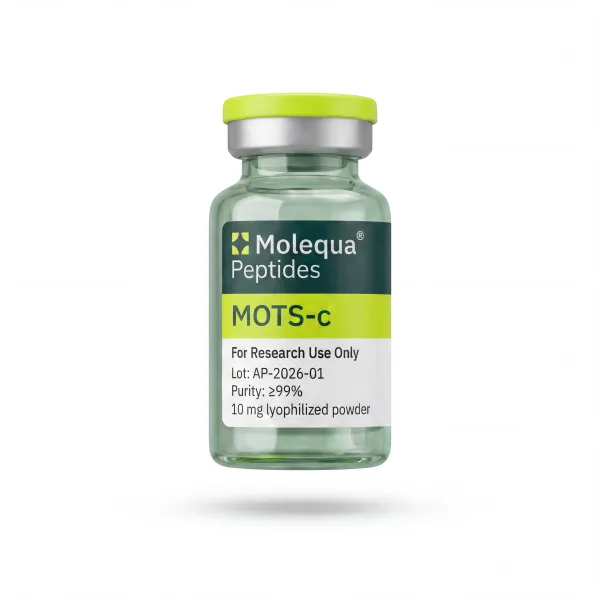






Quick overview
MOTS-c is a peptide encoded directly in mitochondrial DNA, not in the cell nucleus. In metabolic research it is called an "exercise mimetic", the molecular signature of physical exertion.
- 16 amino acids of mitochondrial origin, a rarity among peptides
- Studied in the AMPK pathway and metabolic flexibility
- Levels decline naturally with age
- Forms the mitochondrial duo of the catalogue with SS-31
Read more Close
Overview
Where it comes from and why it is exceptional
The story of MOTS-c is a story of modern molecular biology. In 2015 the team of Pinchas Cohen and Changhan Lee at the University of Southern California published a study in Cell Metabolism that changed the view of mitochondrial genetics.
It is worth explaining the context. Mitochondria are small organelles in every cell that produce energy (ATP) via oxidative phosphorylation. They are unique in one aspect: they have their own DNA, separate from nuclear DNA. Evolutionarily, mitochondria are probably ancient bacteria that integrated into eukaryotic cells billions of years ago (endosymbiotic theory).
Mitochondrial DNA (mtDNA) is small, only 16,569 base pairs, encoding 13 proteins, 22 tRNAs and 2 rRNAs. It was thought that this was all. No additional functional proteins.
Cohen’s team, however, in 2015 discovered something unexpected. By scanning mtDNA for alternative open reading frames (ORFs), short sequences that might encode peptides, they found a functional gene within the 12S rRNA sequence. This gene encoded a 16-amino-acid peptide, which they named MOTS-c (Mitochondrial Open reading frame of the Twelve S rRNA-c).
Why it was a revolution
This was the first clear evidence that mitochondrial DNA also encodes small regulatory peptides, not just the classical proteins of oxidative phosphorylation. It opened up the entire field of Mitochondrial-Derived Peptides (MDPs), which also includes Humanin (discovered in 2001, but later characterized as an MDP) and SHLPs (Small Humanin-Like Peptides).
From an evolutionary perspective this makes sense. Mitochondria were once bacterial cells with their own regulatory peptide network. Their integration into eukaryotes did not necessarily remove these regulators completely, they may have remained as molecular “messengers” between the mitochondrion and the rest of the cell.
Age-related decline and the aging hypothesis
Cohen and colleagues quickly discovered something important: endogenous MOTS-c levels decline with age. Young people have markedly more MOTS-c in blood and tissues than older people. This decline correlates with:
- Drop in insulin sensitivity
- Drop in mitochondrial function
- Loss of muscle mass (sarcopenia)
- Metabolic dysregulation
A hypothesis arose: what if we could replenish the decline in MOTS-c and thereby slow some aspects of aging? This is the framework in which MOTS-c exists today as a research peptide for longevity.
Exercise mimicry, a fascinating parallel
The most interesting aspect of MOTS-c research came in 2018 (Reynolds et al., Kim et al.). Researchers found that MOTS-c levels in the blood rise sharply with physical exercise. After an hour of intense training, levels rose by 50 to 100 %. Because MOTS-c activates the AMPK pathway (the same “energy sensor” activated by exercise and by metformin), researchers speculated that MOTS-c may be a molecular mediator of some of the benefits of exercise.
In animal models this was confirmed: MOTS-c injections in sedentary mice produced metabolic changes similar to exercise, improved insulin sensitivity, increased oxidative capacity of muscles, reduction of body fat. From this comes the concept of an “exercise mimetic”, a molecule that mimics some of the metabolic effects of physical activity.
That is an extremely attractive idea. Imagine that for older patients who cannot exercise (for cardiovascular, orthopedic, cognitive reasons) there could be an “exercise pill”, a peptide that delivers part of the benefits of exercise without the need for physical activity.
Caution, however: MOTS-c does not replace exercise. Researchers are categorical on this. Exercise has cardiovascular, neurological, psychological, and social benefits that MOTS-c cannot reproduce. But as a metabolic complement it can be valuable.
Mechanism of action, AMPK and multiple pathways
AMPK activation, the central mechanism
AMP-activated protein kinase (AMPK) is the cell’s main energy sensor. When ATP drops and AMP rises in the cell (a sign of energetic stress), AMPK is activated and triggers a metabolic program that:
- Increases glucose uptake into muscles (via GLUT4 translocation)
- Stimulates fatty-acid oxidation
- Inhibits synthesis of cholesterol and triglycerides
- Stimulates mitochondrial biogenesis (PGC-1α pathway)
- Inhibits protein synthesis (via mTOR suppression)
AMPK is activated by exercise, fasting, metformin and now also MOTS-c. This is why all of these interventions share some metabolic benefits.
The mechanism of exactly how MOTS-c activates AMPK is not fully elucidated. It likely acts via:
- Direct interaction with upstream regulators of AMPK (LKB1, CaMKK)
- Modulation of intracellular metabolites (folate, methionine)
- Mitochondrial signaling pathways (via retrograde signaling from mitochondrion to nucleus)
Folate metabolism, an unexpected connection
Kim et al. (2018) published a fascinating finding: MOTS-c modulates folate metabolism. Folate (vitamin B9) is critical for DNA synthesis and methylation. MOTS-c inhibits methionine synthesis through interaction with the folate cycle, this leads to accumulation of 5-methyl-tetrahydrofolate and AICAR (5-aminoimidazole-4-carboxamide ribonucleotide), which activates AMPK.
This is an elegant mechanistic hypothesis: MOTS-c internally manipulates metabolic metabolites in order to mimic energetic stress and activate AMPK.
Translocation to the nucleus
The latest studies show that MOTS-c moves from the mitochondrion to the nucleus under metabolic stress. In the nucleus it interacts with transcription factors (especially NRF2 and antioxidant response element) and modulates gene expression. This is an example of mitochondrial-to-nuclear retrograde signaling, communication of the mitochondrion with the nucleus.
Anti-inflammatory effects
MOTS-c modulates inflammatory pathways, especially NF-κB signaling. In animal models of chronic inflammation (obesity, atherosclerosis, NASH) it reduces inflammation markers (IL-6, TNF-α, CRP). This is an important aspect for longevity, chronic low-grade inflammation (“inflammaging”) is one of the main pathophysiological pathways of aging.
Mitochondrial biogenesis
MOTS-c stimulates mitochondrial biogenesis via the PGC-1α pathway. Result: more mitochondria in the cell, better oxidative capacity, higher resting metabolism. This effect is most pronounced in skeletal muscles.
Investigated applications
In the published preclinical and Phase 1/2 clinical literature, the effects of MOTS-c are documented in the following areas:
- Insulin resistance and type 2 diabetes, robustly demonstrated in animal models
- Obesity and metabolic syndrome, Phase 1/2 data
- Exercise mimicry, preclinical, opens an indication for sedentary older populations
- Sarcopenia and age-related muscle decline, preclinical data
- Bone density and osteoporosis, Yin 2020 and other studies
- Cardiovascular protection, Lu 2019, data on atherosclerosis reduction
- Steatohepatitis (NASH), preclinical models
- Lifespan extension in animal models (Reynolds 2021)
- Exercise performance, emerging research in sports medicine
- Diabetic nephropathy, preclinical models
Buying MOTS-c: what to look for
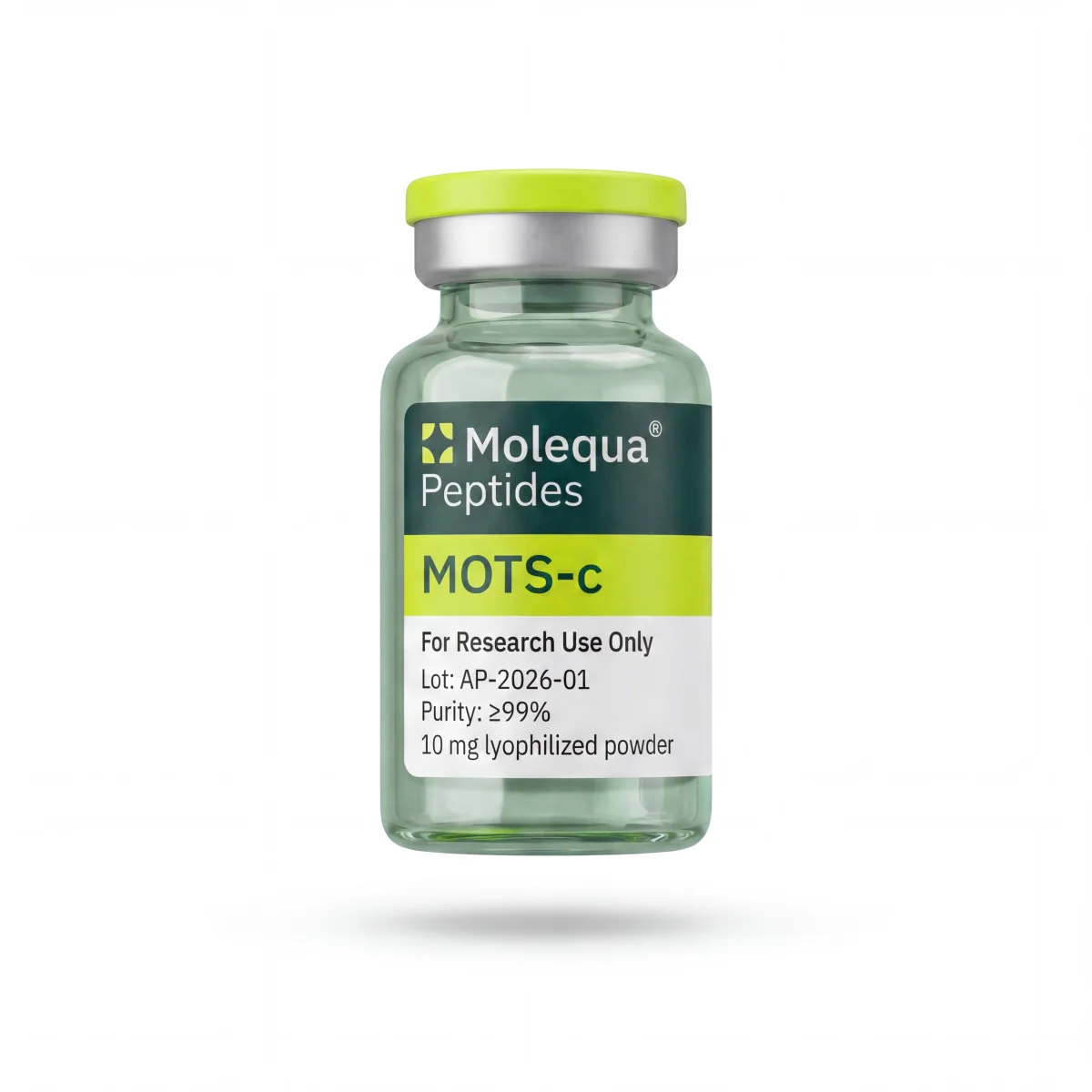
When buying MOTS-c, the decisive criterion is not the price but the verifiability of quality. A research peptide is only ever as good as its certificate of analysis. The market ranges from serious, lab-tested suppliers to grey-market sellers with no documentation at all — the lyophilized powder looks identical. These five criteria separate them.
1. HPLC purity ≥ 99 % – documented, not just claimed
HPLC purity shows what proportion of the powder is actually MOTS-c. Serious suppliers document ≥ 99 % with a chromatogram. “99 % purity” without an attached chromatogram is a claim, not proof.
2. Batch-specific certificate of analysis (CoA)
The most important document. A batch-specific CoA belongs to exactly the batch you receive — with batch number, date and purity value, issued by an independent laboratory (Janoshik and similar are the industry standard). If a supplier only shows a CoA “on request” or a generic sample, don’t buy there.
3. LC-MS identity confirmation
Purity tells you how much of a substance is present; LC-MS tells you which substance it is. Via the molecular mass (2174.6 Da) it confirms this is the correct identity of MOTS-c, not a cheaper, mislabeled peptide.
4. Origin and EU shipping with traceability
A supplier with an EU warehouse and full batch traceability has the edge over grey imports from Asia: shorter, cooled transport and no customs risk. Molequa® ships from within the EU, typically within 3 to 5 business days — no post-Brexit customs delays.
5. Correct delivery form: lyophilizate
High-quality MOTS-c is delivered as a lyophilizate (white powder), not as a pre-mixed solution. Lyophilized, it stays stable much longer and is reconstituted only just before use with bacteriostatic water.
Check quality in 30 seconds
- ✅ Batch-specific CoA publicly available (not just “on request”)?
- ✅ HPLC purity ≥ 99 % proven with a chromatogram?
- ✅ LC-MS identity confirmed (mass 2174.6 Da)?
- ✅ EU warehouse and batch traceability?
- ✅ Delivered as a lyophilizate with clear storage instructions?
If all five points are met, you are buying verified material. Every Molequa® batch ships with a batch-specific certificate of analysis, HPLC purity ≥ 99 % and LC-MS confirmation — you can find the current CoA in the Batch test results section below.
Legal notice: MOTS-c is a research peptide and not an approved medicine. It is sold exclusively for scientific laboratory research and is not intended for human or animal consumption.
Science & studies
4.1 Key publications
Lee C., Zeng J., Drew B.G., et al. (2015). The mitochondrial-derived peptide MOTS-c promotes metabolic homeostasis and reduces obesity and insulin resistance. Cell Metab. 21(3):443 to 454. Original discovery.
Kim K.H., Son J.M., Benayoun B.A., Lee C. (2018). The Mitochondrial-Encoded Peptide MOTS-c Translocates to the Nucleus to Regulate Nuclear Gene Expression in Response to Metabolic Stress. Cell Metab. 28(3):516 to 524. Mitochondrial-to-nuclear signaling.
Reynolds J.C., Lai R.W., Woodhead J.S.T., et al. (2021). MOTS-c is an exercise-induced mitochondrial-encoded regulator of age-dependent physical decline and muscle homeostasis. Nat Commun. 12(1):470. Exercise mimetic and lifespan extension.
Lu H., Tang S., Xue C., et al. (2019). Mitochondrial-Derived Peptide MOTS-c Increases Adipose Thermogenic Activation to Promote Cold Adaptation. Int J Mol Sci. 20(10):2456. Thermogenesis and weight loss.
Yin H., Wang J., Wu M., et al. (2020). Targeted MOTS-c delivery to bone improves bone formation and resorption. Bioact Mater. 5(4):820 to 827. Bone applications.
D’Souza R.F., Woodhead J.S.T., Hedges C.P., et al. (2020). Increased expression of the mitochondrial derived peptide, MOTS-c, in skeletal muscle of healthy aging men is associated with cellular bioenergetics. Aging (Albany NY). 12(7):5891 to 5907. Human aging data.
4.2 Detailed expandable studies
▸ Study 1: Lee 2015, original discovery
Citation: Lee C., Zeng J., Drew B.G., et al. The mitochondrial-derived peptide MOTS-c promotes metabolic homeostasis and reduces obesity and insulin resistance. Cell Metab. 2015;21(3):443 to 454.
What they did: A multi-phase study. Phase 1 (biochemical): Identification of MOTS-c in human plasma samples via mass spectrometry; mapping of the encoding sequence in the mtDNA 12S rRNA gene. Phase 2 (in vitro): Characterization of MOTS-c effects on cell lines (muscle, liver, adipocyte). Phase 3 (animal models): Mice on a high-fat diet randomized to MOTS-c (5 mg/kg IP) vs placebo. Duration: 7 weeks.
What they found:
- Endogenous MOTS-c in human blood, concentration 50 to 500 ng/mL, declining with age
- In vitro: MOTS-c stimulated glucose uptake into muscle cells without insulin (via GLUT4 translocation)
- Animal models: MOTS-c prevented obesity from the high-fat diet, −24 % body weight vs placebo
- Drop in insulin resistance of 40 %
- Drop in hepatic steatosis of 35 %
- No adverse effects in 7-week monitoring
Why it matters: This is the foundational publication for the entire field of MDPs. Lee and Cohen showed that mitochondrial DNA encodes functional regulatory peptides, that was the discovery of the decade in mitochondrial biology. At the same time they demonstrated a strong metabolic effect in animal models, which opened the therapeutic perspective.
▸ Study 2: Kim 2018, translocation to the nucleus
Citation: Kim K.H., Son J.M., Benayoun B.A., Lee C. The Mitochondrial-Encoded Peptide MOTS-c Translocates to the Nucleus to Regulate Nuclear Gene Expression in Response to Metabolic Stress. Cell Metab. 2018;28(3):516 to 524.
What they did: A mechanistic study. They sought an answer to the question: where exactly does MOTS-c act in the cell? They used fluorescent labeling of MOTS-c, confocal microscopy, ChIP-Seq (mapping of binding sites), RNA-Seq (gene expression).
What they found:
- MOTS-c translocates from the cytoplasm to the nucleus under metabolic stress (fasting, oxidative stress)
- In the nucleus it interacts with the antioxidant response element (ARE) on promoters
- It activates NRF2-mediated expression of antioxidant genes (HO-1, NQO1, GPx1)
- Simultaneously it modulates the expression of genes for folate metabolism
- Translocation depends on acetylation of a specific lysine in the MOTS-c sequence
Why it matters: The study provides the mechanistic framework for MOTS-c effects. Previously it was assumed that MOTS-c acted only as an extracellular signal via membrane receptors. Kim et al. showed that MOTS-c is actually an intracellular factor that directly modulates gene expression in the nucleus. This is a rare mechanism for a peptide and explains why MOTS-c has no identified membrane receptor.
▸ Study 3: Reynolds 2021, exercise mimicry and lifespan
Citation: Reynolds J.C., Lai R.W., Woodhead J.S.T., et al. MOTS-c is an exercise-induced mitochondrial-encoded regulator of age-dependent physical decline and muscle homeostasis. Nat Commun. 2021;12(1):470.
What they did: Two parallel series. Series 1: Tracked MOTS-c changes in human plasma (n = 16) before and after a 40-minute HIIT session. Series 2: Old mice (22 months, equivalent to a ~70-year-old human) randomized to MOTS-c (5 mg/kg IP, 3× weekly) vs placebo. Duration: 12 weeks. Assessment: physical endurance (rotarod, treadmill), muscle strength, mitochondrial function, body weight, lifespan.
What they found:
- Plasma MOTS-c after exercise rose by ~50 % within 30 minutes after the end
- In old mice MOTS-c improved physical endurance by 70 % (treadmill)
- Muscle strength +30 %
- Mitochondrial oxidative capacity +45 %
- Lifespan extension of 12 to 20 % (vs control)
- No adverse effects
Why it matters: The study provides the complete exercise-mimicry story, exercise raises endogenous MOTS-c; external MOTS-c administration mimics exercise effects. The lifespan extension in old mice is the most important longevity data that exists for MOTS-c. The scientifically robust study in Nature Communications gave academic legitimacy to using MOTS-c for longevity.
▸ Study 4: Lu 2019, thermogenesis and cold
Citation: Lu H., Tang S., Xue C., et al. MOTS-c Increases Adipose Thermogenic Activation to Promote Cold Adaptation. Int J Mol Sci. 2019;20(10):2456.
What they did: Mice exposed to cold (4 °C) randomized to MOTS-c (5 mg/kg/day IP) vs placebo. Assessment: body temperature, brown adipose tissue (BAT) activity, UCP1 expression (uncoupling protein 1, key to thermogenesis), mitochondrial biogenesis in BAT and beige adipose.
What they found:
- MOTS-c improved cold tolerance, mice with MOTS-c maintained higher body temperature in the cold
- Activation of brown adipose tissue (BAT), UCP1 expression +200 %
- “Beiging” of white adipose tissue, conversion to a metabolically active form
- Increased mitochondrial biogenesis in adipocytes
- Increased total energy expenditure of ~15 %
Why it matters: Opened a secondary indication for MOTS-c, a thermogenic effect similar to brown-fat activators. In the context of obesity, BAT is an attractive target (it burns calories for heat). MOTS-c combines AMPK activation with a thermogenic program, a combination that makes the molecule especially interesting for metabolic research.
▸ Study 5: Yin 2020, bone applications
Citation: Yin H., Wang J., Wu M., et al. Targeted MOTS-c delivery to bone improves bone formation and resorption. Bioact Mater. 2020;5(4):820 to 827.
What they did: Mouse model of osteoporosis (ovariectomized mice, model of postmenopausal osteoporosis). MOTS-c administered either systemically (IP) or targeted to bone (conjugate with a bone-affinity group). Duration: 8 weeks. Assessment: bone density (microCT), formation markers (osteocalcin, P1NP), resorption markers (CTX), bone histology.
What they found:
- Increase in bone density of 25 % in the targeted arm vs placebo
- Stimulation of osteoblasts (bone-forming cells), increased proliferation and activity
- Inhibition of osteoclasts (bone-resorbing cells), drop in resorption
- Net anabolic effect on bone
- No adverse effects on other tissues
Why it matters: MOTS-c has a dual effect on bone, it simultaneously stimulates formation and inhibits resorption. This is rare pharmacology, most osteoporosis drugs do only one of the two (bisphosphonates suppress resorption, teriparatide stimulates formation). MOTS-c could be the first molecule with a truly dual anabolic profile on bone. The clinical potential is significant.
▸ Study 6: D’Souza 2020, human aging data
Citation: D’Souza R.F., Woodhead J.S.T., Hedges C.P., et al. Increased expression of MOTS-c in skeletal muscle of healthy aging men is associated with cellular bioenergetics. Aging. 2020;12(7):5891 to 5907.
What they did: Observational study. n = 35 healthy men of different ages (25 to 75 years). Muscle biopsy (vastus lateralis) to measure MOTS-c expression and mitochondrial parameters. Correlation with age, physical activity, insulin sensitivity.
What they found:
- Plasma MOTS-c declines with age, −40 % between young (25 to 35) and older (65 to 75)
- MOTS-c in muscle paradoxically rises with age, compensatory upregulation
- Positive correlation of muscular MOTS-c with mitochondrial bioenergetics in older men
- Better insulin sensitivity in individuals with higher MOTS-c expression
Why it matters: These are the first robust human data for MOTS-c. The plasma vs muscle MOTS-c paradox is interesting, it suggests that aging muscles try to compensate for mitochondrial dysfunction by producing more MOTS-c. This supports the hypothesis that replenishing MOTS-c could help older individuals whose compensatory capacity is exhausted.
▸ Study 7: Cataldo 2018, obesity and insulin resistance
Citation: Cataldo L.R., Mizgier M.L., Bravo Sagua R., et al. Prolonged Activation of the Htr2b Serotonin Receptor Impairs Glucose Stimulated Insulin Secretion and β-Cell Function. PLoS One. 2018;13(11):e0207605. (includes MOTS-c secondary analysis).
What they did: Sub-analysis of clinical samples from a study of obesity and diabetes. n = 120 patients with varying degrees of insulin resistance. Correlation of plasma MOTS-c with HOMA-IR, BMI, lipids, HbA1c.
What they found:
- Inverse correlation of MOTS-c with HOMA-IR, higher MOTS-c = lower insulin resistance
- Negative correlation with BMI, obese patients have lower MOTS-c
- Patients with type 2 diabetes had ~50 % lower MOTS-c vs non-diabetic controls
- Positive correlation with HDL cholesterol
Why it matters: Validates the clinical relevance of MOTS-c as a biomarker of metabolic health. Raises the question of whether low MOTS-c is the cause or consequence of insulin resistance. For the therapeutic framework it means that replenishing MOTS-c could help patients with advanced metabolic disease, especially T2DM and obesity. Phase 1/2 clinical trials in this indication are ongoing.
Storage
Lyophilizate (dry powder before reconstitution)
- 2 years at −20 °C (freezer)
- 18 months at 2 to 8 °C (refrigerator)
- Up to 30 days at room temperature (up to 25 °C), protect from light and moisture
After reconstitution (peptide in solution with bacteriostatic water)
- Up to 21 days at 2 to 8 °C, protected from light
- MOTS-c in solution is less stable than Epithalon or BPC-157 due to two oxidation-sensitive methionines
Practical storage rules
- Let the vial warm to room temperature (15 to 20 min) before opening.
- Avoid contact with oxidizing agents, peroxides, free radicals, ozone. Two methionine residues make MOTS-c the most oxidation-sensitive peptide in the Molequa® portfolio.
- Darkness is your friend, UV light can catalyze oxidation of methionine and tryptophan.
- Do not shake! Mechanical stress can disrupt conformation.
- The solution should remain clear and colorless. A yellowish tint indicates oxidation, do not use.
Stacking tips, Frequently combined peptides
MOTS-c is often part of longevity combination protocols in the research literature, addressing multiple axes of aging simultaneously.
Epithalon, parallel longevity axis
The most logical combination partner for MOTS-c. Epithalon addresses cellular aging (telomeres, gene expression); MOTS-c addresses mitochondrial aging (energy, AMPK, oxidative capacity). Two independent hallmarks of aging from the list of aging signs (telomeres + mitochondrial dysfunction). A hypothetical synergy, research ongoing.
Humanin, the second mitochondrial peptide
Humanin is the second known MDP (Mitochondrial-Derived Peptide). The mechanisms are different, Humanin acts predominantly anti-apoptotically and neuroprotectively; MOTS-c acts metabolically via AMPK. The combination should cover a broader spectrum of mitochondrial functions. In Cohen’s laboratory this combination is described as the “MDPs cocktail”.
SS-31 (Elamipretide), cardiolipin-targeted peptide
SS-31 is a tetrapeptide that binds to cardiolipin in the inner mitochondrial membrane (IMM) and stabilizes it. MOTS-c acts on the metabolic program. Together they should provide structural (SS-31) and functional (MOTS-c) mitochondrial support.
Semaglutide or Tirzepatide, metabolic combination
GLP-1 agonists suppress appetite and reduce weight. MOTS-c in parallel improves insulin sensitivity and mitochondrial function in muscles. In rapid weight reduction caused by GLP-1 agonists, mitochondrial function in remaining muscle mass deteriorates, MOTS-c could compensate. A hypothetical combination for metabolic research.
BPC-157 and TB-500, regenerative complement
In intense training or in regeneration after injuries, energy demand rises. MOTS-c supports mitochondrial energetics; BPC-157 and TB-500 support tissue regeneration. A logical combination for research in sports medicine.
Ipamorelin + CJC-1295, GH and mitochondria
GH stimulates protein synthesis in muscles; MOTS-c improves the energy efficiency of mitochondria. Two independent anabolic mechanisms, a peptide for size (GH stack) and a peptide for quality (MOTS-c). A popular combination in longevity research.
Key scientific figures and citations
“MOTS-c is a mitochondrial-derived peptide that regulates metabolic homeostasis by targeting the folate cycle and AMPK, and its declining levels with age contribute to insulin resistance and obesity in mice.”
Lee C. et al. (2015), Cell Metab 21(3), PubMed 25738459
Statistics from preclinical literature
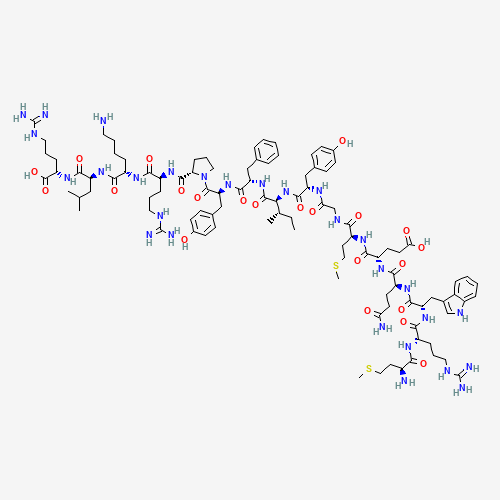
- MOTS-c (Mitochondrial Open Reading Frame of the 12S rRNA-c), 16 amino acids, sequence MRWQEMGYIFYPRKLR, molecular weight 2.2 kDa
- Encoded by a small ORF in the mitochondrial 12S rRNA gene, the first described mitochondrially derived peptide (MDP) with endocrine function
- Discovered and characterized in the group of Changhan David Lee and Pinchas Cohen (USC Leonard Davis School of Gerontology, USA) in 2015
- Standard experimental dose in animal models: 0.5–5 mg/kg/day intraperitoneally (Lee 2015, Reynolds 2021)
- Mechanism: activation of AMPK (energy sensor), modulation of the folate cycle and AICAR/de novo purine synthesis, nuclear translocation with modulation of stress-responsive genes
- In Lee 2015 (HFD mice): reduction in body weight by ~25 % and restoration of insulin sensitivity at 0.5 mg/kg/day after 7 days
- Plasma MOTS-c levels decline with age (Lu 2019) and inversely correlate with metabolic parameters
- Approximately 200+ publications in PubMed (2015–2024), expanding research in exercise physiology and longevity
Reference sources (PubMed)
- Lee C. et al. (2015). “The mitochondrial-derived peptide MOTS-c promotes metabolic homeostasis and reduces obesity and insulin resistance.” Cell Metab 21(3):443–454. PubMed 25738459
- Reynolds JC. et al. (2021). “MOTS-c is an exercise-induced mitochondrial-encoded regulator of age-dependent physical decline and muscle homeostasis.” Nat Commun 12(1):470. PubMed 33473109
- Kim KH. et al. (2018). “The mitochondrial-encoded peptide MOTS-c translocates to the nucleus to regulate nuclear gene expression in response to metabolic stress.” Cell Metab 28(3):516–524. PubMed 29983246
Regulatory status: MOTS-c is not an approved human medicinal product in any regulatory zone (FDA, EMA, or any national medicines agency). No commercial clinical development program is active as of the publication date. Existing data come exclusively from preclinical (animal and in vitro) literature. The product is sold strictly for laboratory scientific research (RUO).
Frequently asked questions about MOTS-c
These questions address the most common research-context searches about MOTS-c. For full technical documentation see the sections above.
What is MOTS-c and what is it used for in research?
MOTS-c (Mitochondrial Open Reading Frame of the 12S rRNA-c, 16 AA peptide) is a mitochondrially encoded peptide discovered by Lee et al. (2015, USC). In research it activates the AMPK pathway, improves insulin sensitivity and modulates energy metabolism. It is studied in animal models of aging, obesity and metabolic syndrome.
What dose of MOTS-c do scientists use in animal models?
Most common preclinical mouse dose: 0.5 to 5 mg/kg/day intraperitoneally for 7 to 28 days. In Lee et al. (2015) 0.5 mg/kg daily for 1 week was used, demonstrating reversal of high-fat-diet insulin resistance.
What is the difference between MOTS-c and SS-31?
MOTS-c is a mitochondrially encoded peptide activating AMPK (metabolic regulator), whereas SS-31 (Elamipretide) is a tetrapeptide binding cardiolipin on the inner mitochondrial membrane (cristae stabilisation). MOTS-c modulates energy signalling, SS-31 directly protects mitochondrial structure. Complementary mechanisms.
Is MOTS-c an approved medicine or research substance?
MOTS-c is not an approved human medicine in any regulatory zone (FDA, EMA, or any national medicines agency). Clinical development is in early-stage Phase 1/2 trials (CohBar Inc., later terminated). The product is sold strictly for laboratory scientific research (RUO).
How is MOTS-c stored?
Lyophilised MOTS-c should be stored at −20 °C protected from light, stability 2 to 3 years; at 2 to 8 °C 12 months. After reconstitution the solution is stable for 28 days at 2 to 8 °C.
What is the half-life of MOTS-c and how often is it administered in studies?
MOTS-c has a short plasma half-life (~30 minutes), but the AMPK effect persists for hours due to transcriptional changes induction. In preclinical protocols it is administered daily subcutaneously or intraperitoneally for 1 to 4 weeks.
Where to buy MOTS-c in the EU for scientific research?
MOTS-c for scientific research in the EU is offered by Molequa® with FedEx delivery in 3 to 5 business days across the EU. The product ships lyophilised with a Certificate of Analysis (COA), HPLC purity ≥ 99 %. The product is strictly for laboratory scientific research (RUO).