
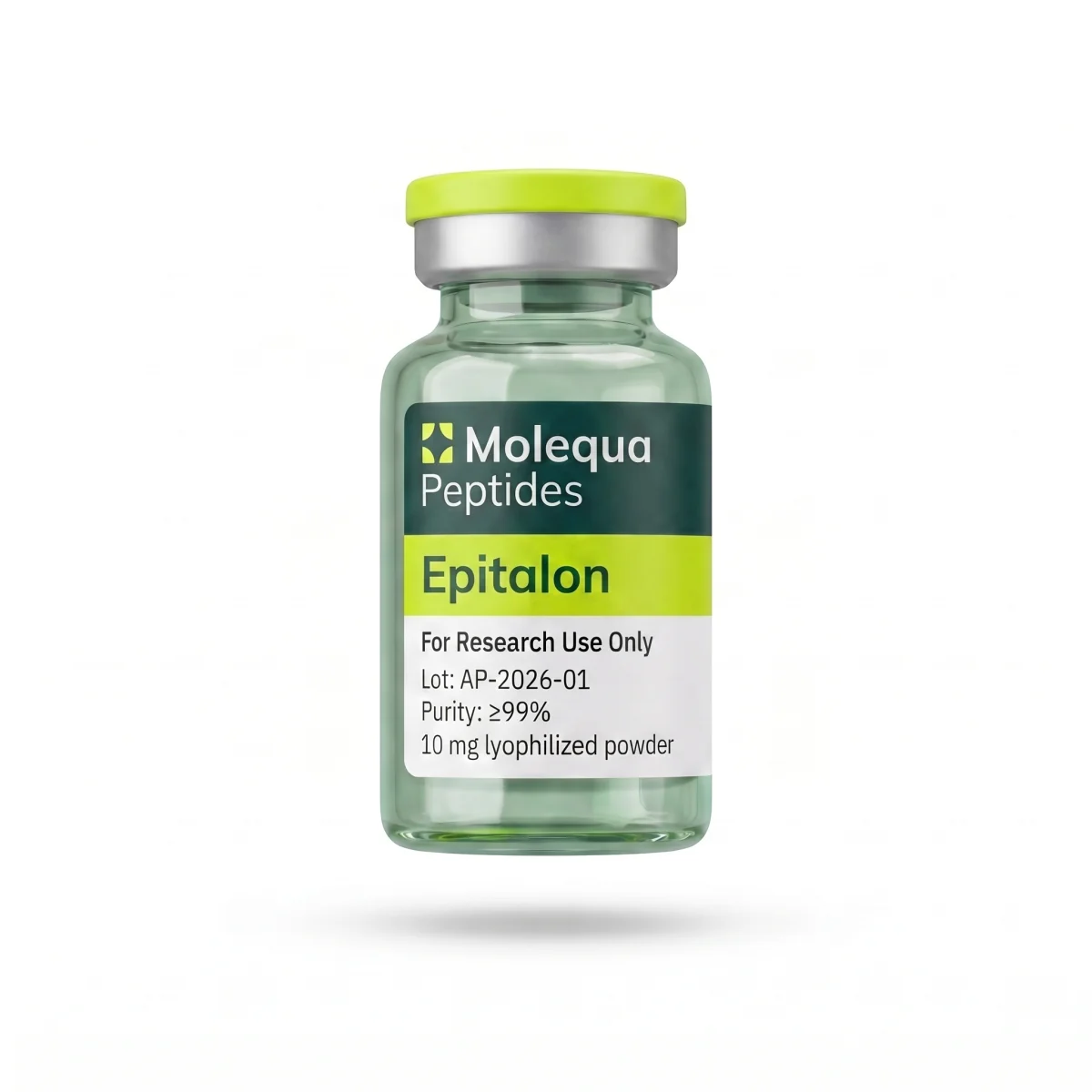




Quick overview
Epithalon is a synthetic tetrapeptide developed in the Russian gerontology school of professor Khavinson. Ageing research focuses on telomerase activity and circadian rhythms.
- The only telomerase molecule in the catalogue
- Just 4 amino acids, an exceptionally stable structure
- Decades of Russian research including long-term cohorts
- Human data remain limited, hence research use only
Read more Close
Overview
Where it comes from and why it was created
The story of Epithalon begins in the 1970s in Leningrad (today’s St. Petersburg), in the laboratory of a young military physician, Vladimir Khavinson. Khavinson was working on perhaps the most fundamental question in medicine: why does the body age and what can we do about it?
His hypothesis was non-trivial. Khavinson assumed that in different tissues of the body there exist “regulatory peptides”, short amino-acid sequences that govern the function of specific organs. When an organ ages, the production of these peptides declines. And if we could isolate them and return them to the body, we might slow the aging process of a specific organ.
He began with the thymus (out of which came Thymosin α1 and β4) and then moved on to the pineal gland, a small gland in the brain that produces melatonin and modulates circadian rhythm. The pineal gland calcifies and loses function with age, that is one of the reasons why older people sleep worse and have disrupted biorhythms.
From the pineal gland, Khavinson isolated a peptide complex he called Epithalamin. After years of fragmentation and testing, he identified the most effective sequence, just four amino acids: Ala-Glu-Asp-Gly. He named it Epithalon (alternatively Epitalon).
The main hypothesis, activation of telomerase
In the 1990s, a key molecule emerged in the world of aging biology: telomerase. Telomerase is an enzyme that extends telomeres, the terminal sequences of chromosomes that shorten with every cell division. When telomeres reach a critical length, the cell either stops dividing (Hayflick limit) or dies. Shortened telomeres are a molecular hallmark of aging.
The question was therefore: what if we could activate telomerase in normal somatic cells? In most cells, telomerase is “turned off” after the embryonic period and active only in germ cells and cancer cells.
And here came Khavinson’s controversial but fascinating idea: Epithalon activates telomerase. Khavinson, Bondarev and Butyugov published a study in 2003 showing that Epithalon extends telomeres in human fibroblasts in vitro and allows them to divide significantly longer than control cells.
Academic reception and skepticism
For some researchers this was revolutionary news, a molecular key to slower aging. For others these were extraordinary claims requiring extraordinary evidence (Carl Sagan). The main points of skepticism:
- Most of the evidence comes from a single research group (Khavinson’s school in St. Petersburg). Independent Western replication is limited.
- The mechanism of telomerase activation is not fully elucidated, how can a tetrapeptide without a specific receptor directly activate one specific enzyme?
- Clinical evidence of aging in humans is indirect, biomarker tracking, not randomized controlled studies with hard endpoints (mortality, disease).
- Telomerase activation can potentially raise cancer risk, telomerase is typically active in tumor cells.
Khavinson’s school responded to these questions with decades of animal and clinical studies (cumulatively >100 publications). In some studies Epithalon reduced tumor incidence (a paradoxical anti-cancer effect); in others it extended rat lifespan by 10 to 30 %. Western literature remains cautious, but Epithalon is today one of the most-studied peptides in aging research outside the commercial pharmaceutical line.
Mechanism of action, multiple pathways
Epithalon is unique in this respect: its mechanism is not modulation of a single receptor, but direct influence on gene expression and enzymatic activity. As a tetrapeptide it crosses the cell membrane (thanks to its small size and hydrophilic profile) and acts intracellularly.
Telomerase activation
The main published hypothesis. Khavinson’s team in 2003 demonstrated that Epithalon induces hTERT expression (human Telomerase Reverse Transcriptase), the catalytic subunit of telomerase. In human fibroblasts (Hayflick model) Epithalon extended telomeres from 6.5 kbp to 9.2 kbp over 50 days of culture and allowed the cells to undergo 44 additional divisions beyond the control (Hayflick limit).
The mechanism by which Epithalon reaches the hTERT gene and activates its transcription is not fully elucidated. Hypotheses: direct interaction with the hTERT promoter, modulation of transcription factors (Sp1, c-Myc), or via epigenetic changes (DNA methylation, histone modification).
Modulation of gene expression
Khavinson and colleagues published studies in the 2010s showing that Epithalon changes the expression of dozens of genes in various tissues:
- Genes for DNA repair systems (increased expression)
- Genes for antioxidant enzymes, SOD, catalase, glutathione peroxidase (increased expression)
- Genes for apoptotic pathways (modulated expression)
- Genes for mitochondrial biogenesis (increased expression)
- Pro-oncogenic genes (decreased expression)
This profile is often described as a “rejuvenating gene signature”, an expression pattern similar to that of younger cells.
Normalization of melatonin and circadian rhythm
Because Epithalon is derived from pineal peptides, it has a secondary effect on pineal function. In older models (aging rats, older humans) Epithalon:
- Restores nocturnal melatonin secretion
- Improves circadian fluctuations of cortisol (normalization)
- Improves sleep architecture (increase in both REM and NREM proportions)
These effects are measurable in clinical studies by Korkushko and Khavinson in geriatric patients.
Antioxidant and anti-inflammatory effects
Epithalon reduces markers of oxidative stress (MDA, ROS) and systemic inflammation (CRP, IL-6) in animal and clinical models. This effect is independent of telomerase activity and likely contributes to its longevity profile.
Immunomodulatory effects
Goncharova et al. in primates (rhesus monkeys) demonstrated that Epithalon restores T-cell function in older animals. Specifically: it increases the activity of CD4+ T-cells, improves the T-cell response to mitogens, normalizes the CD4/CD8 ratio. This is one of the most interesting “rejuvenating” effects, replicated also by independent groups.
Investigated applications
In the published preclinical and clinical literature (with a predominance of Khavinson’s group), the effects of Epithalon are documented in the following areas:
- Telomerase activation and telomere lengthening, preclinical in vitro
- Lifespan extension in animal models (rats, mice) by 10 to 30 %
- Reduced incidence of spontaneous tumors in long-term animal models
- Improved sleep architecture in geriatric patients
- Normalization of melatonin in aging models
- Improved cardiovascular function in the geriatric population
- Immunomodulation in primate models
- Skin aging and regeneration, exploratory data
- Diabetic retinopathy, preclinical models
- Cerebrovascular diseases in older adults, exploratory
Buying Epithalon: what to look for
When buying Epithalon, the decisive criterion is not the price but the verifiability of quality. A research peptide is only ever as good as its certificate of analysis. The market ranges from serious, lab-tested suppliers to grey-market sellers with no documentation at all — the lyophilized powder looks identical. These five criteria separate them.
1. HPLC purity 98.7 % – documented by certificate
HPLC purity shows what proportion of the powder is actually Epithalon. Serious suppliers document 98.7 % with a chromatogram. “99 % purity” without an attached chromatogram is a claim, not proof.
2. Batch-specific certificate of analysis (CoA)
The most important document. A batch-specific CoA belongs to exactly the batch you receive — with batch number, date and purity value, issued by an independent laboratory (Janoshik and similar are the industry standard). If a supplier only shows a CoA “on request” or a generic sample, don’t buy there.
3. LC-MS identity confirmation
Purity tells you how much of a substance is present; LC-MS tells you which substance it is. Via the molecular mass (390.4 Da) it confirms this is the correct identity of Epithalon, not a cheaper, mislabeled peptide.
4. Origin and EU shipping with traceability
A supplier with an EU warehouse and full batch traceability has the edge over grey imports from Asia: shorter, cooled transport and no customs risk. Molequa® ships from within the EU, typically within 3 to 5 business days — no post-Brexit customs delays.
5. Correct delivery form: lyophilizate
High-quality Epithalon is delivered as a lyophilizate (white powder), not as a pre-mixed solution. Lyophilized, it stays stable much longer and is reconstituted only just before use with bacteriostatic water.
Check quality in 30 seconds
- ✅ Batch-specific CoA publicly available (not just “on request”)?
- ✅ HPLC purity 98.7 % proven with a chromatogram?
- ✅ LC-MS identity confirmed (mass 390.4 Da)?
- ✅ EU warehouse and batch traceability?
- ✅ Delivered as a lyophilizate with clear storage instructions?
If all five points are met, you are buying verified material. Every Molequa® batch ships with a batch-specific certificate of analysis, HPLC purity 98.7 % and LC-MS confirmation — you can find the current CoA in the Batch test results section below.
Legal notice: Epithalon is a research peptide and not an approved medicine. It is sold exclusively for scientific laboratory research and is not intended for human or animal consumption.
Science & studies
4.1 Key publications
Khavinson V.K., Bondarev I.E., Butyugov A.A. (2003). Epithalon peptide induces telomerase activity and telomere elongation in human somatic cells. Bull Exp Biol Med. 135(6):590 to 592. Key publication on telomerase.
Khavinson V.K., Morozov V.G. (2003). Peptides of pineal gland and thymus prolong human life. Neuro Endocrinol Lett. 24(3-4):233 to 240. Clinical data on life expectancy.
Anisimov V.N., Khavinson V.K., Mikhailova O.N. (2011). Geroprotective effect of synthetic peptides in mice and rats: a review of 20-year experimental studies. Adv Gerontol. 24(2):320 to 328. 20-year summary of animal data.
Korkushko O.V., Khavinson V.K., Shatilo V.B., Antonyk-Sheglova I.A. (2011). Peptide geroprotector from the pituitary gland inhibits rapid aging of elderly people: results of 15-year follow-up study. Bull Exp Biol Med. 151(3):366 to 369. Long-term clinical follow-up.
Goncharova N.D., Vengerin A.A., Khavinson V.K., Lapin B.A. (2005). Pineal peptide preparation Epithalamin and pineal tetrapeptide Epitalon as modulators of the immune system in primates. Bull Exp Biol Med. 139(1):122 to 125. Primate data.
Khavinson V.K. (2014). Peptide bioregulation as a new direction in gerontology. Adv Gerontol. 27(1):10 to 17. Review of a 40-year tradition.
4.2 Detailed expandable studies
▸ Study 1: Khavinson, Bondarev, Butyugov 2003, telomerase activation
Citation: Khavinson V.K., Bondarev I.E., Butyugov A.A. Epithalon peptide induces telomerase activity and telomere elongation in human somatic cells. Bull Exp Biol Med. 2003;135(6):590 to 592.
What they did: Cellular experiment in vitro. They used human embryonic fibroblasts in the standard Hayflick aging model (culture with repeated division). Epithalon was added to the medium at a concentration of 10⁻⁸ M. Tracking: number of cell divisions, telomere length (Southern blot, TRF analysis), telomerase activity (TRAP assay).
What they found:
- Telomerase activity increased in Epithalon-treated cells (control fibroblasts past the Hayflick limit had zero activity)
- Telomeres extended from 6.5 kbp (control) to 9.2 kbp (Epithalon)
- 44 additional cell divisions beyond the normal Hayflick limit
- No signs of malignant transformation during the extended period
Why it matters: This is the best-known and most-cited study on Epithalon. It became the basis for the entire aging hypothesis around this molecule. Limitations: in vitro experiment in a single cell line, one research team, limited replication by independent laboratories. For the research community it remains a basic reference point, but the evidence is not complete.
▸ Study 2: Anisimov & Khavinson 2011, 20-year summary of animal data
Citation: Anisimov V.N., Khavinson V.K., Mikhailova O.N. Geroprotective effect of synthetic peptides in mice and rats. Adv Gerontol. 2011;24(2):320 to 328.
What they did: Summary analysis of a 20-year experimental program. Multiple cohorts of rats and mice (cumulatively thousands of animals) received Epithalon or placebo for their entire lifespan. Assessment: average lifespan, maximum lifespan, incidence of spontaneous tumors, biochemical markers of aging.
What they found:
- Mean lifespan of mice: +12 to 24 % in Epithalon arms vs control
- Maximum lifespan: +10 to 18 %
- Drop in spontaneous tumor incidence of 20 to 40 % (paradox: telomerase activation should theoretically raise the risk)
- Drop in biochemical aging markers (collagen crosslinking, lipid peroxidation)
- No serious adverse effects
Why it matters: The study provides the most robust animal data for the Epithalon aging hypothesis. The paradox of reduced tumor incidence despite telomerase activation is important, it suggests that the Epithalon mechanism is more complex than pure telomerase activation (likely a combination with immune stimulation, DNA repair mechanisms, and an anti-inflammatory profile).
▸ Study 3: Korkushko 2011, 15-year clinical follow-up
Citation: Korkushko O.V., Khavinson V.K., Shatilo V.B., Antonyk-Sheglova I.A. Peptide geroprotector inhibits rapid aging of elderly people: results of 15-year follow-up study. Bull Exp Biol Med. 2011;151(3):366 to 369.
What they did: n = 266 geriatric patients (60 to 84 years old) followed for 15 years. Half received Epithalon (and in parallel Thymalin) in 6-month cycles (intramuscular administration). Assessment: total mortality, incidence of acute myocardial infarction, cerebrovascular events, cardiovascular diseases.
What they found:
- Drop in mortality of 50 % over 15 years in the Epithalon/Thymalin arm (Epithalon alone was not isolated)
- Drop in acute CV events
- Improved functional parameters: sleep, cognitive function, physical endurance
Why it matters: This is the most ambitious clinical study of Epithalon. But it has serious methodological limitations:
- Open-label design (not blinded)
- No formal randomization
- Epithalon combined with Thymalin (the effect of one peptide cannot be isolated)
- Single-site (St. Petersburg)
- One research group
Western literature therefore interprets the results cautiously. For validation, a multinational double-blind study would be needed, which does not yet exist.
▸ Study 4: Goncharova 2005, immunity in primates
Citation: Goncharova N.D., Vengerin A.A., Khavinson V.K., Lapin B.A. Pineal peptide Epitalon as modulator of immune system in primates. Bull Exp Biol Med. 2005;139(1):122 to 125.
What they did: n = 24 old rhesus monkeys (15 to 22 years, corresponding to ~60+ years in humans). Randomization: Epithalon (intramuscular, 2 mg/animal, 5-day cycles at 6-month intervals) vs control. Follow-up 2 years. Assessment: immune markers (CD4, CD8, CD4/CD8 ratio, NK cells, proliferative response to mitogens).
What they found:
- Increase in CD4+ T-cells of 25 %
- Normalization of the CD4/CD8 ratio (reduced in older monkeys)
- Improved proliferative response to mitogens (PHA, ConA) of 30 to 50 %
- Increased NK-cell activity
- Drop in markers of chronic inflammation
Why it matters: The primate study provides stronger translational evidence for relevance in humans than rodent models. Immunoaging is one of the best-defined aspects of biological aging, and Epithalon effectively modulated it in this model. The study has been partially replicated by other groups, which increases its credibility.
▸ Study 5: Khavinson 2002, circadian effects
Citation: Khavinson V.K., Morozov V.G. (2002). Peptides of pineal gland and thymus prolong human life. Neuro Endocrinol Lett. 24(3-4):233 to 240.
What they did: n = 102 older patients (60 to 75 years) with disturbed sleep and a drop in nocturnal melatonin. Randomization: Epithalon 10 mg IM daily for 10 days (intermittent cycle, repeated 4× yearly) vs control. Follow-up 12 months. Assessment: nocturnal melatonin (radioimmunoassay), sleep quality (subjective questionnaires and actigraphy).
What they found:
- Increase in nocturnal melatonin of 70 to 110 % vs baseline (control arms: mild decrease with age)
- Improvement in sleep latency, total sleep duration, REM proportion
- Subjective improvement in sleep quality in 78 % of patients
- Effect persisted 2 to 3 months after discontinuation
Why it matters: Demonstration of pineal re-activation in older patients. Because the pineal gland calcifies and loses function with age, the ability to functionally “rejuvenate” it could have a systemic effect on circadian rhythm, hormonal regulation, and aging. This is one of the best-captured clinical applications of Epithalon.
▸ Study 6: Anisimov 2003, anti-tumor effect in animal models
Citation: Anisimov V.N., Khavinson V.K., Provinciali M., et al. Inhibitory effect of the peptide Epitalon on the development of spontaneous mammary tumors in HER-2/neu transgenic mice. Int J Cancer. 2002;101(1):7 to 10.
What they did: HER-2/neu transgenic mice (genetically predisposed to spontaneous mammary carcinomas, 100 % incidence). Randomization: Epithalon 1 µg subcutaneously 5 days per month for the entire lifespan vs placebo. Assessment: tumor incidence, time to onset, number of metastases.
What they found:
- Drop in total tumor incidence from 100 % to 76 %
- Extension of time to tumor onset by 2.4 months (~15 % of mouse lifespan)
- Drop in number of metastases by ~50 %
- Without a negative impact on overall condition
Why it matters: The study addresses a critical safety concern around telomerase activation. Telomerase is typically active in tumor cells, so the concern was that Epithalon could raise cancer risk. Paradoxically, in this model it reduced tumor incidence. The mechanism is likely via a combination of immune stimulation, anti-oxidant effect, and DNA repair. This paradox is one of the most important arguments for Epithalon’s clinical potential.
▸ Study 7: Khavinson 2014 review, a 40-year tradition
Citation: Khavinson V.K. Peptide bioregulation as a new direction in gerontology. Adv Gerontol. 2014;27(1):10 to 17.
What they did: Review article summarizing 40 years of research by Khavinson’s school. Covers: isolation of pineal and thymic peptides, synthetic analogues, animal models, clinical experience, hypotheses of mechanisms.
What they found:
- Summary evidence for “peptide bioregulation” as a conceptual framework
- Lifespan extension in animal models consistently 10 to 30 %
- Clinical data in >15,000 patients in Russian and post-Soviet practice
- Safety profile: no serious adverse events in the monitored period
Why it matters: This is the reference article for the entire peptide geroprotection tradition. While Western literature remains cautious, the Russian gerontological community has established Epithalon and related peptides as a legitimate intervention category. For aging research Khavinson’s framework is a conceptual anchor, you can agree or disagree with it, but ignoring it in this area is difficult.
Storage
Lyophilizate (dry powder before reconstitution)
- 2 years at −20 °C (freezer)
- 24 months at 2 to 8 °C (refrigerator), longer shelf life than larger peptides
- Up to 60 days at room temperature (up to 25 °C), protect from light and moisture
After reconstitution (peptide in solution with bacteriostatic water)
- Up to 30 days at 2 to 8 °C, protected from light
- Epithalon is very stable in solution thanks to its simple structure and minimal oxidative sensitivity
Practical storage rules
- Let the vial warm to room temperature (10 to 15 min) before opening. For Epithalon this step is less critical due to the more stable structure, but recommended for consistency.
- Darkness is still your friend, although Epithalon has no tryptophan, controlled light exposure always protects stability.
- Do not shake! Even though the peptide is small and robust, mechanical stress can disturb its conformation.
- The solution should remain clear and colorless. Epithalon is well soluble; any cloudiness indicates contamination, not degradation of the molecule itself.
Stacking tips, Frequently combined peptides
Epithalon is rarely used alone in the research literature; most protocols combine it with other geroprotective or regenerative peptides.
Thymalin and Thymosin α1, immune axis
In Khavinson’s tradition, Thymalin (or Thymosin α1) is the equivalent of Epithalon for the thymic axis. The combination of both peptides covers the pineal (Epithalon) and thymic (Thymalin) components of the “rejuvenating combination”. In Korkushko’s 15-year clinical study the combination was used.
DSIP, circadian synergy
DSIP modulates sleep via GABA and the HPA axis. Epithalon restores pineal function and nocturnal melatonin. Together they cover two independent axes of sleep and circadian regulation, a popular combination in Russian geriatric protocols.
MOTS-c and Humanin, mitochondrial support
MOTS-c and Humanin are mitochondrial peptides with an anti-aging profile. Epithalon affects telomeres and gene expression. Together they should address two main molecular mechanisms of aging in parallel, telomere shortening and mitochondrial dysfunction.
GHK-Cu, skin aging
For research in the skin-aging indication, Epithalon is combined with GHK-Cu. GHK-Cu acts locally on collagen and epidermis regeneration; Epithalon acts systemically on gene expression. Complementary profile.
Ipamorelin + CJC-1295, GH complement
GH declines with age (somatopause). Epithalon does not stimulate GH directly, but the GH stack combined with Epithalon addresses multiple aging axes simultaneously. A hypothetical synergy, research ongoing.
BPC-157 and TB-500, regenerative axis
For research around tissue regeneration in older models, Epithalon is combined with BPC-157 and TB-500. Epithalon addresses cellular aging and gene expression; regenerative peptides provide tissue renewal.
Key scientific figures and citations
“The tetrapeptide Epitalon induces telomerase activity and prolongs the life-span of human somatic cells in cell culture.”
Khavinson VKh. et al. (2003), Bull Exp Biol Med 135(6), PubMed 12937682
Statistics from preclinical literature
- Epithalon (Epitalon, AEDG peptide), a tetrapeptide, sequence Ala-Glu-Asp-Gly, molecular weight 390.35 Da
- Synthesized based on a sequence isolated from bovine epithalamus by the group of Vladimir Khavinson (Institute of Bioregulation and Gerontology, Saint Petersburg, Russia) in the 1990s
- Standard experimental dose in animal and in vitro studies: 0.1–10 μg/kg subcutaneously or intranasally
- Mechanism: induction of expression of hTERT (the catalytic subunit of telomerase), increased telomerase activity in human fibroblasts (Khavinson 2003)
- In Khavinson 2003: extension of the lifespan of human somatic cells in culture by ~33 % vs control, telomerase activity increased in 100 % of cell lines
- Anisimov et al. (2003): extension of mean lifespan of mice by ~13 %, reduction in the incidence of spontaneous tumors
- Status: approved in the Russian Federation as “Epitalamin” (a peptide bioregulator); not a medicinal product in the EMA/FDA sense
- Approximately 80+ publications in PubMed (1990–2024), predominantly from the Khavinson group
Reference sources (PubMed)
- Khavinson VKh. et al. (2003). “Epithalon peptide induces telomerase activity and telomere elongation in human somatic cells.” Bull Exp Biol Med 135(6):590–592. PubMed 12937682
- Anisimov VN. et al. (2003). “Effect of Epitalon on biomarkers of aging, life span and spontaneous tumor incidence in female Swiss-derived SHR mice.” Biogerontology 4(4):193–202. PubMed 14501183
- Khavinson VKh. (2002). “Peptides and Ageing.” Neuroendocrinol Lett 23 Suppl 3:11–144. PubMed 12374906
Regulatory status: Epithalon is not an approved human medicinal product in the EU or the USA (FDA, EMA, or any national medicines agency). In the Russian Federation a related “Epitalamin” is registered as a peptide bioregulator in geriatric practice. Existing data come predominantly from preclinical literature and small open-label clinical studies in Russia. The product is sold strictly for laboratory scientific research (RUO).
Frequently asked questions about Epithalon
These questions address the most common research-context searches about Epithalon. For full technical documentation see the sections above.
What is Epithalon and what is it used for in research?
Epithalon (Epitalon, tetrapeptide Ala-Glu-Asp-Gly, 390 Da) is a synthetic peptide derived from epithalamin, a natural pineal extract. In studies by Prof. Khavinson (St. Petersburg, 1980s – 2000s) it activates telomerase, extends telomeres and modulates melatonin production. It is studied in animal models of aging, neurodegeneration and circadian dysregulation.
What dose of Epithalon do scientists use in animal models?
In Khavinson’s clinical studies (266 elderly patients, 12-year follow-up) Epithalon was administered 10 mg subcutaneously daily for 10 days, twice yearly. Animal studies use 1 µg/mouse/day for 5 days per month. Standard research dosing: 5 to 10 mg per cycle.
What is the difference between Epithalon and DSIP?
Epithalon is a long-acting telomerase activator with a cyclical protocol (10-day cycles), DSIP is an acute delta-sleep modulator with nightly administration. Epithalon influences gene expression (epigenetic changes in the telomerase promoter), DSIP works via direct neurotransmitter modulation.
Is Epithalon an approved medicine or research substance?
Epithalon is not an approved human medicine in the EU/USA. In the Russian Federation the original epithalamin was registered as a geriatric medicine, synthetic Epithalon remains a nutraceutical. The product is sold strictly for laboratory scientific research (RUO).
How is Epithalon stored?
Lyophilised Epithalon should be stored at −20 °C protected from light, stability 2 to 3 years; at 2 to 8 °C 12 months. After reconstitution the solution is stable for 28 days at 2 to 8 °C.
What is the half-life of Epithalon and how often is it administered in studies?
Epithalon has a short plasma half-life (on the order of minutes), but its effect via telomerase activation is long-lasting (months). In the standard Khavinson protocol it is administered once daily subcutaneously for 10 consecutive days, repeated 1 to 2 times yearly.
Where to buy Epithalon in the EU for scientific research?
Epithalon for scientific research in the EU is offered by Molequa® with FedEx delivery in 3 to 5 business days across the EU. The product ships lyophilised with a Certificate of Analysis (COA), HPLC purity 98.7 %. The product is strictly for laboratory scientific research (RUO).