

In short
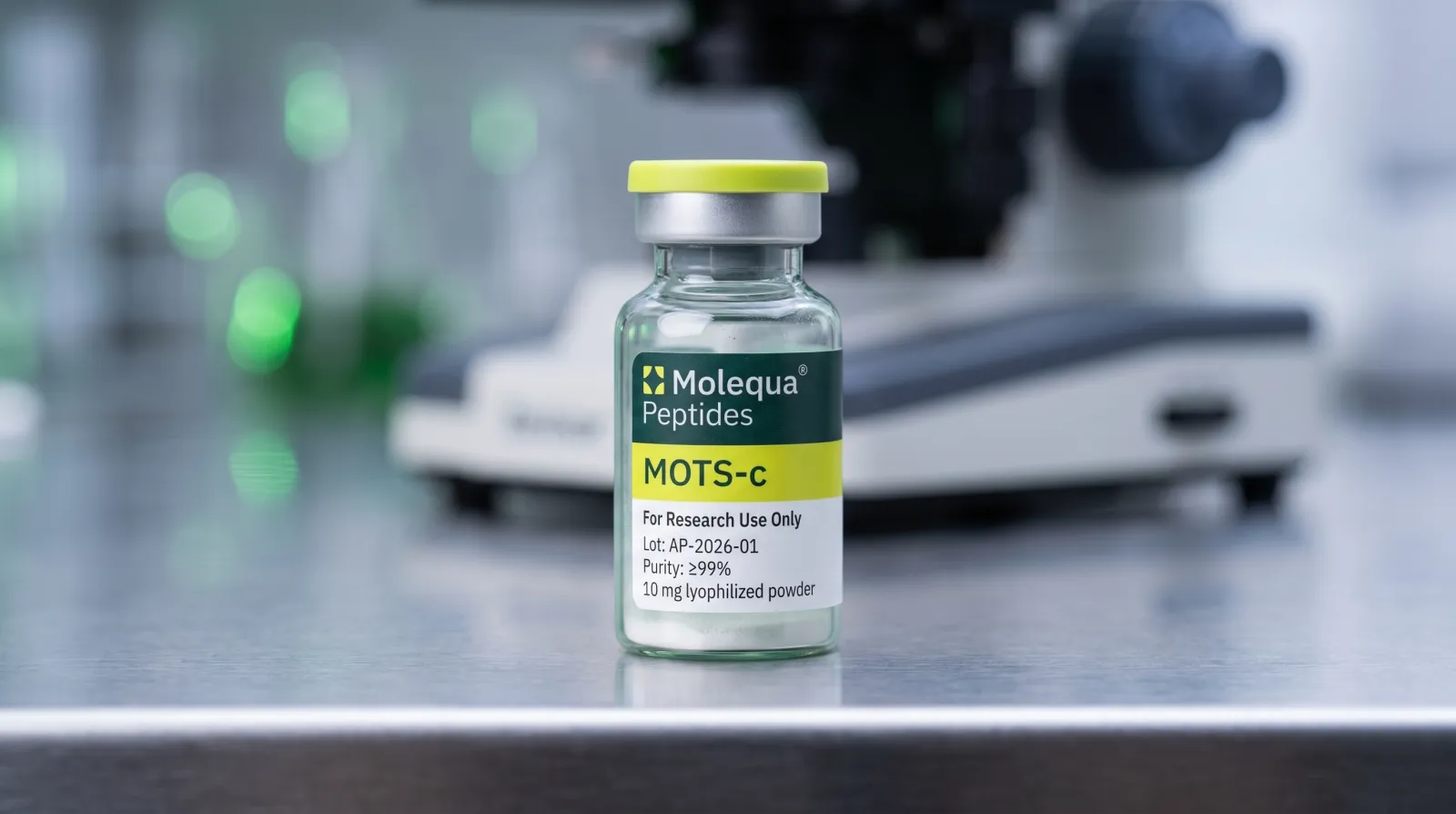
MOTS-c is a 16-amino-acid peptide encoded directly in mitochondrial DNA, not in the cell nucleus, and it is one of the most studied molecules in longevity research. The essentials:
- Discovered in 2015 by the Lee laboratory as a regulator of metabolic homeostasis
- Called an “exercise mimetic”: its levels rise with physical exertion
- Acts through the folate cycle and the AMPK pathway, the cell’s energy sensor
- Levels decline naturally with age
- Sold exclusively as a research reference material (RUO), not for human use
Everything in this guide refers to laboratory research, not human application.
What is MOTS-c?
MOTS-c (Mitochondrial Open reading frame of the Twelve S rRNA type-c) is a peptide encoded in mitochondrial DNA, a rarity among peptides: almost all others are encoded in the nucleus. It was described in 2015 in Cell Metabolism by Lee et al. as a regulator of metabolic homeostasis that reduced obesity and insulin resistance in mouse models. That discovery opened a new field of mitochondrial-derived peptides.
The molecule is short, 16 amino acids, and works as a signal from the mitochondria to the rest of the cell. Because mitochondria are the cell’s power plants, a peptide they encode themselves has become a natural focus of ageing and metabolism research. Research overviews of this pathway are collected on our MOTS-c product page.
Why is MOTS-c called an exercise mimetic?
Because its levels rise with physical exertion and it activates the same cellular program as exercise. In a 2021 study in Nature Communications, Reynolds et al. showed that MOTS-c is an exercise-induced regulator of age-dependent physical decline and muscle homeostasis in mice. The phrase “exercise in a molecule” is a simplification, but it captures why the research community watches it so closely.
The key published findings:
| Study | Year | Model | Finding |
|---|---|---|---|
| Lee et al., Cell Metab | 2015 | mouse | reduced obesity and insulin resistance, folate cycle + AMPK |
| Reynolds et al., Nat Commun | 2021 | mouse | exercise-induced, regulates age-dependent physical decline |
Both are preclinical. Human data remain limited, which is exactly why MOTS-c stays a research molecule.

How does MOTS-c work in the cell?
MOTS-c acts on the folate cycle and through it activates AMPK, the central energy sensor of the cell. When energy is scarce, AMPK switches the cell into an economical mode: more glucose uptake, more fatty-acid oxidation, less synthesis. MOTS-c effectively presses that switch from the mitochondrial side.
There is a second layer: under metabolic stress MOTS-c can translocate to the nucleus and influence gene expression directly. A mitochondrially encoded peptide regulating nuclear genes was one of the more surprising findings of the past decade, and it is the reason MOTS-c research spans metabolism, muscle physiology and ageing at once.
What should researchers check before buying MOTS-c?
Four things: a batch-specific CoA from an independent laboratory available before purchase, HPLC purity of at least 99 %, LC-MS identity confirmation, and the full declared 16-amino-acid sequence rather than a cheaper fragment. MOTS-c is frequently substituted with shorter fragments, which only mass spectrometry can catch.
The checklist:
- CoA of the current batch open before ordering, with the laboratory named
- HPLC ≥ 99 % and LC-MS identity confirmed
- Full 16-AA sequence declared in the technical data sheet
- RUO labelling on the product page
- EU warehouse: no customs risk, delivery in 2 to 4 days
At Molequa®, every MOTS-c batch is tested by the independent laboratory Janoshik Analytical before release, and the CoA is public on the product page. In research protocols it is often paired with SS-31, the second mitochondrial molecule of our longevity category.

Frequently asked questions
What is MOTS-c in one sentence? A 16-amino-acid peptide encoded in mitochondrial DNA, studied as a regulator of metabolism and an exercise mimetic in preclinical research.
Is MOTS-c approved for human use? No. It is not an approved drug or supplement anywhere. It is sold strictly as a research reference material.
Why do MOTS-c levels decline with age? Published work links the decline to falling mitochondrial function with age; the exact mechanism is still under investigation, which is one of the active research questions.
How is MOTS-c different from GLP-1 peptides? GLP-1 molecules act on incretin receptors and appetite; MOTS-c acts inside the cell on the folate cycle and AMPK. They belong to entirely different research fields.
How should MOTS-c be stored? Lyophilized at 2 to 8 °C it lasts 2 to 3 years; after reconstitution with bacteriostatic water use within 28 days refrigerated.
How do I verify quality before buying? Open the batch CoA before purchase: laboratory name, batch number, HPLC purity and LC-MS identity. Without those four items the certificate proves nothing.
Legal note
All Molequa® products are intended exclusively for laboratory research (Research Use Only). They are not medicinal products, dietary supplements or cosmetics and are not intended for human or animal consumption.
