
In short
Melanotan 2 (melanotan II, MT-II) is a synthetic cyclic heptapeptide analogue of alpha-melanocyte-stimulating hormone, developed at the University of Arizona in the 1980s. It is a potent but non-selective agonist across the human melanocortin receptors, and today its main documented role is as a reference tool compound in melanocortin receptor research. The essentials:
- Structure: cyclic heptapeptide, Ac-Nle-cyclo[Asp-His-D-Phe-Arg-Trp-Lys]-NH2, molecular weight 1024.18 Da
- Receptor profile: non-selective agonist of the human melanocortin receptors (Tomassi 2022, J Med Chem)
- Current research role: listed among the recommended tool compounds for melanocortin receptor GPCRs (Weirath 2024, ACS Pharmacol Transl Sci)
- Regulatory status: not licensed as a medicine; supplying it for human use is not lawful in the UK and many other countries (Alsabbagh 2025, Int J Oral Maxillofac Surg)
- Quality problem: vials bought from online shops contained 4.32 to 8.84 mg against a claimed 10 mg, with unknown impurities of 4.1 to 5.9 % (Breindahl 2015, Drug Test Anal)
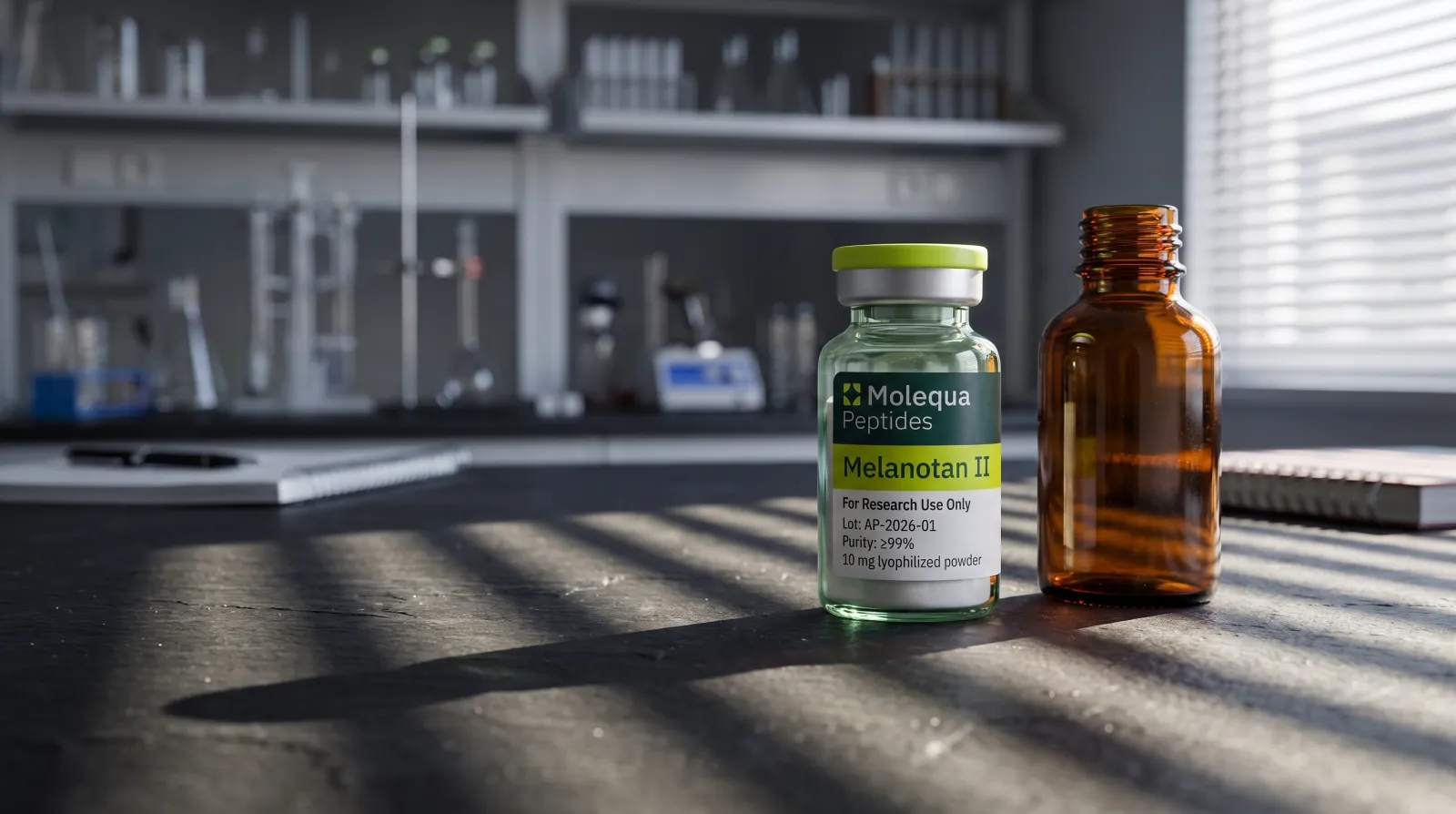
Molequa® supplies melanotan 2 strictly as research use only (RUO) laboratory reference material. It is not a medicine, not a cosmetic, and not intended for human or animal consumption.
What is melanotan 2?
Melanotan 2 is a synthetic cyclic analogue of alpha-melanocyte-stimulating hormone (alpha-MSH), built as a seven residue ring closed by a lactam bridge between aspartate and lysine, with a molecular weight of 1024.18 Da. Two deliberate substitutions define it: norleucine replaces methionine, which removes an oxidation-prone residue, and D-phenylalanine replaces the L form, which slows peptidase cleavage. The result is a far more stable and far more potent molecule than the native hormone.
The origin story is dermatological. A group at the University of Arizona led by Mac Hadley and Victor Hruby set out to produce pigmentation without ultraviolet exposure, and characterised a family of melanogenic analogues of which melanotan I and melanotan 2 were the two lead compounds (Hadley 1998, Pharm Biotechnol). Batch specifications, purity data and the certificate of analysis for the research material are on the melanotan 2 product page.
How does melanotan 2 work at the melanocortin receptors?
Melanotan 2 is a non-selective agonist: it activates the human melanocortin receptor family broadly rather than one subtype, which is exactly why it is useful as a laboratory reference ligand and exactly why it is a poor candidate for a targeted intervention. MC1R activation drives melanogenesis in melanocytes, while MC3R and MC4R sit in central circuits related to energy balance, and MC5R is expressed in exocrine tissue.
That lack of selectivity is stated plainly in the medicinal chemistry literature. Work that re-engineered the ring of MT-II with xylene-derived thioethers described the parent molecule as “a potent and unselective agonist of human MCRs”, and the point of the exercise was to find analogues that were selective where MT-II is not (Tomassi 2022, J Med Chem). A 2024 review of the field lists MT-II alongside NDP-MSH and SHU9119 as one of the core tool compounds used to validate receptor cell lines, to solve cryo-EM structures of active receptor complexes, and to serve as a reference in mechanism of action studies (Weirath 2024, ACS Pharmacol Transl Sci).
Melanotan 2 vs melanotan I (afamelanotide)
The two molecules from the same Arizona programme diverged completely: melanotan I became a licensed medicine with a narrow indication, and melanotan 2 never obtained an authorisation anywhere and remained a research compound. Melanotan I is the linear 13 residue analogue NDP-MSH, marketed as afamelanotide and reviewed for erythropoietic protoporphyria (Am J Clin Dermatol 2016); melanotan 2 is the shorter cyclic peptide described above.
| Criterion | Melanotan 2 (MT-II) | Melanotan I (afamelanotide) |
|---|---|---|
| Structure | cyclic heptapeptide, lactam bridge | linear 13 residue alpha-MSH analogue |
| Molecular weight | 1024.18 Da | higher, full alpha-MSH backbone |
| Receptor selectivity | non-selective across MCRs | used clinically as an MC1R directed agent |
| Regulatory status | no authorisation anywhere | authorised medicine for erythropoietic protoporphyria |
| Typical current use | laboratory reference tool compound | prescribed under specialist supervision |
| Available from Molequa® | yes, RUO reference material only | no |
The practical reading of this table is that “the same research programme” is not the same as “the same regulatory position”. Only one of the two molecules went through a full authorisation process, and it was not melanotan 2.
What does the published human literature report?
The published record on human melanotan 2 use is a case report literature, not a trial literature. It documents systemic toxicity, vascular events and pigmented lesion outcomes in people who obtained the substance outside any medical setting, and it is one of the clearest reasons the material is supplied for laboratory work only.
Reported cases include systemic toxicity with sympathomimetic features and rhabdomyolysis after a self-administered dose (Nelson 2012, Clin Toxicol), renal infarction with a review of the earlier renal literature (Peters 2020, CEN Case Rep), and a mucosal malignant melanoma of the anterior maxilla in a 22 year old after use of a melanotan II nasal spray (Alsabbagh 2025, Int J Oral Maxillofac Surg).
A qualitative study of UK and Ireland online forums extracted 623 discussion entries from 205 participants between January 2016 and October 2017, and its authors concluded that clinicians should be aware not only of risks to pigmented skin lesions but also of infectious disease transmission, contaminated product and concurrent sunbed use (Gilhooley 2021, Dermatology). The pattern was already flagged in the general population more than a decade earlier (Evans-Brown 2009, BMJ).
None of this is presented here as guidance about human use. It is the reason there is none.
What analysis found inside melanotan 2 sold online
When a Danish group bought melanotan II vials from three online shops and analysed them by LC-UV-MS/MS, the vials contained 4.32 to 8.84 mg of peptide although every shop claimed 10 mg, and material from two of the shops carried unknown impurities of 4.1 to 5.9 % (Breindahl 2015, Drug Test Anal). In other words, buyers received between 43 % and 88 % of the stated quantity, with a contaminant profile nobody had characterised.
This is the single most useful study in the whole melanotan 2 literature for anyone sourcing reference material, because it measures the thing that marketing cannot fake: what is actually in the glass. It also explains why a purity percentage quoted without a chromatogram, a batch number and a named laboratory tells you nothing. The same logic applies across the category and is unpacked in the guide on how to verify a peptide supplier.
How Molequa® verifies each batch
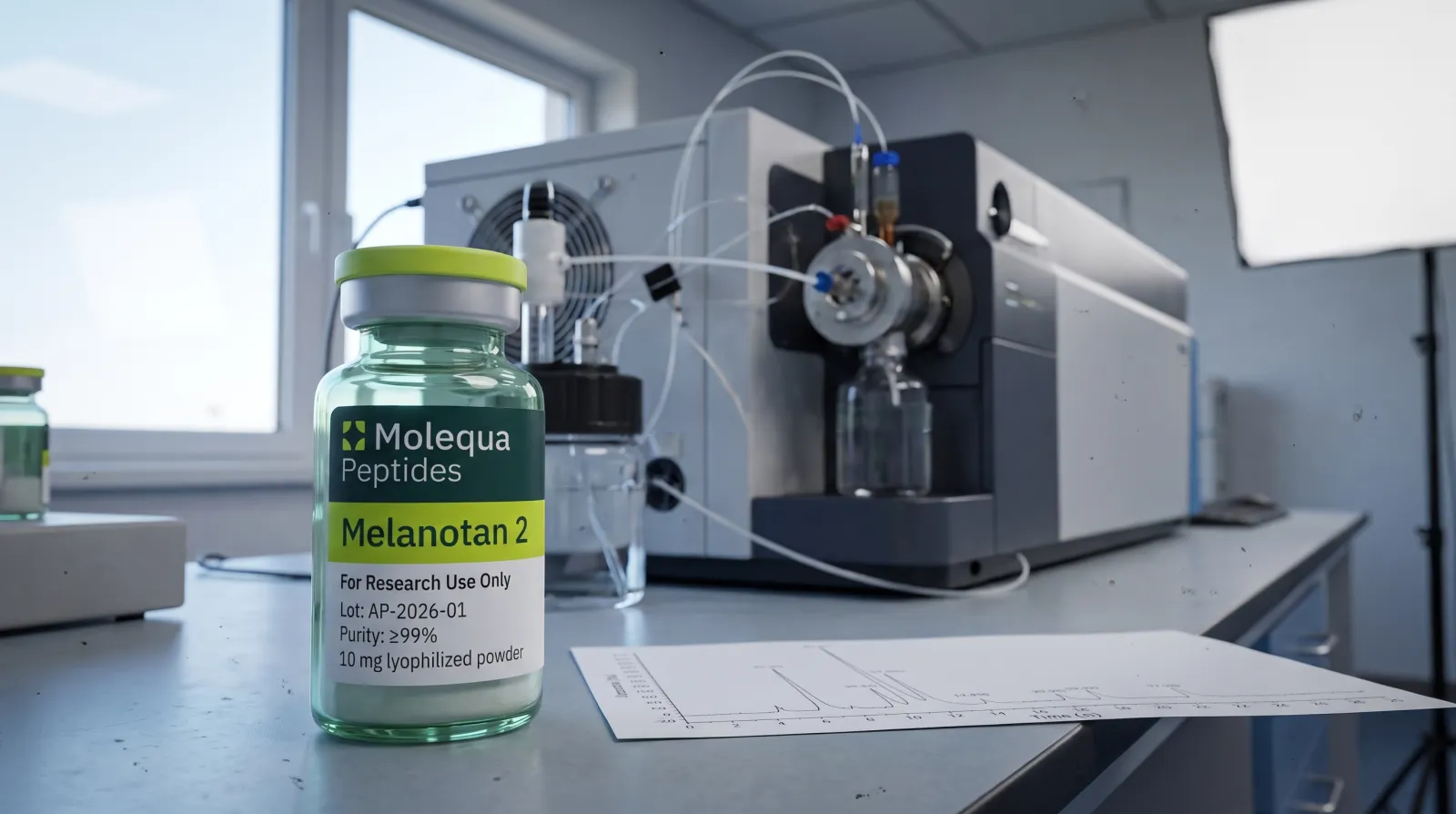
Every Molequa® batch is analysed by the independent laboratory Janoshik Analytical. The certificate states HPLC purity for that specific lot and confirms identity by mass spectrometry, and it is published on the product page before purchase rather than sent afterwards.
For melanotan 2 the mass spectrometry step carries unusual weight. Purity tells you how much of something is present; mass confirmation tells you which molecule it is, and at 1024.18 Da the identity check is what separates the declared peptide from a cheaper mislabelled one. Given what the analytical literature found in vials sold online, an in-house number from the seller and a signed report from an independent laboratory are simply not the same evidence.
A usable certificate names the lot, the analysis date, the method, the HPLC result with the chromatogram attached, and the mass confirmation. Read it in that order.
Where to buy melanotan 2 for research in the UK and EU
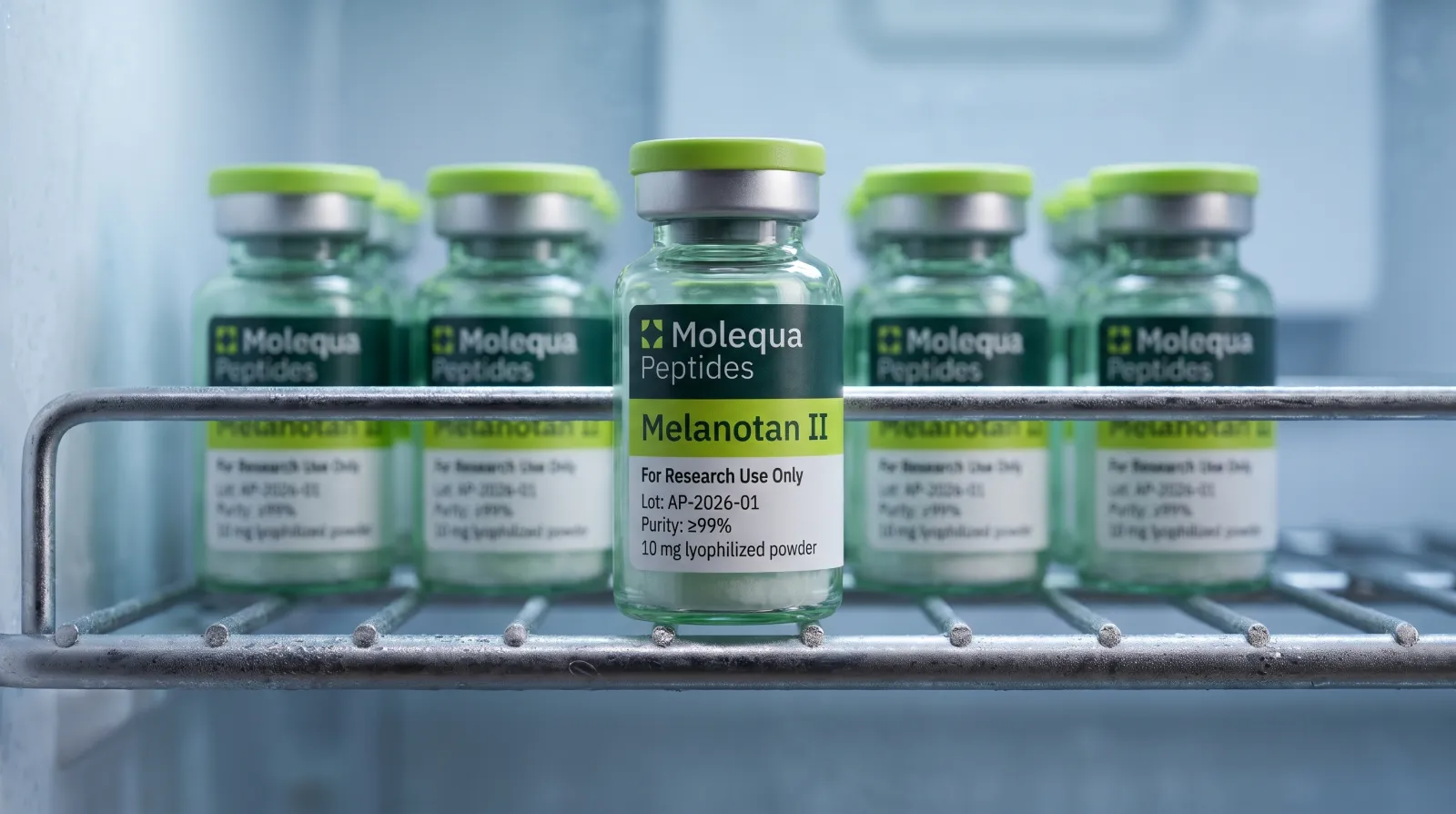
Molequa® supplies lyophilised melanotan 2 as RUO laboratory reference material with HPLC purity of 99 % or higher and a per batch certificate of analysis, shipped from within the European Union. The 5 mg format is 26.90 € and the 10 mg format 44.90 €, which works out at 5.38 € and 4.49 € per milligram.
One point has to be stated without hedging, particularly for readers in the UK. Melanotan 2 is not licensed as a medicine and offering it for human use, including for tanning, is not lawful in the United Kingdom or in many other countries. What is on sale here is laboratory reference material for in vitro and preclinical research, and the buyer is responsible for confirming that the intended use complies with local rules. Readers comparing suppliers across the wider category will find the market overview in the guide to research peptides in the UK, and a structural primer in what peptides are. Current availability, the batch certificate and full specifications for melanotan 2 are on the product page.
Melanotan 2 and the cosmetic peptide category
Melanotan 2 is frequently filed alongside cosmetic peptides, and pharmacologically that is a category error: it is a systemically acting melanocortin receptor agonist, not a topically applied cosmetic ingredient. The peptides studied for skin in a cosmetic context, such as GHK-Cu and argireline, act on the extracellular matrix or on neurotransmitter release at the dermal level and are formulated for topical application.
The distinction matters when reading claims online, because the two groups sit in different regulatory categories and carry entirely different evidence bases. The cosmetic side of the field is covered separately in the article on peptides for the face.
FAQ
What is melanotan 2? A synthetic cyclic heptapeptide analogue of alpha-MSH, sequence Ac-Nle-cyclo[Asp-His-D-Phe-Arg-Trp-Lys]-NH2, molecular weight 1024.18 Da, developed at the University of Arizona in the 1980s and used today mainly as a melanocortin receptor tool compound.
Is melanotan 2 the same as melanotan II? Yes. Melanotan 2, melanotan II and MT-II are three names for the same molecule. Melanotan I is a different compound, the linear analogue marketed as afamelanotide.
Which receptors does melanotan 2 act on? It is a non-selective agonist across the human melanocortin receptor family, which is why medicinal chemistry work has repeatedly tried to build selective analogues from its scaffold (Tomassi 2022, J Med Chem).
Is melanotan 2 legal in the UK? It has no medicines authorisation, and supplying it for human use is not lawful in the UK or in many other countries. Molequa® supplies it only as laboratory reference material for research, and the buyer is responsible for checking local rules.
What did testing find in melanotan 2 bought online? Vials from three online shops contained 4.32 to 8.84 mg against a claimed 10 mg, with unknown impurities of 4.1 to 5.9 % in material from two of them (Breindahl 2015, Drug Test Anal).
How much does research grade melanotan 2 cost? At Molequa®, 26.90 € for the 5 mg vial and 44.90 € for the 10 mg vial, that is 5.38 € and 4.49 € per milligram, with the batch certificate of analysis included.
Why do you not publish dosing information? Because the material is not intended for human use. Publishing an administration schedule for people would contradict the RUO framework under which it is lawfully supplied, and a supplier who provides one is signalling that it does not respect that framework.
Legal notice: Melanotan 2 supplied by Molequa® is intended exclusively for scientific laboratory research (RUO). It is not intended for human or animal consumption, it is not a medicine, and it must not be used as one. This article summarises published research and case report literature and is not medical advice.
