



Quick overview
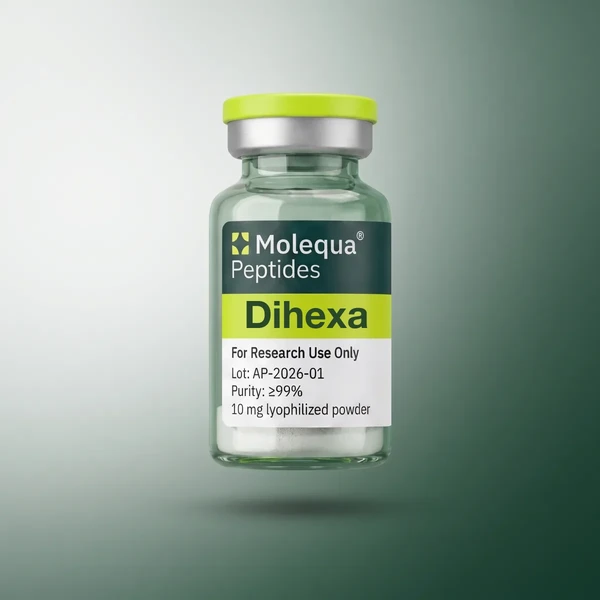
Dihexa is a small molecule derived from angiotensin IV, described in the literature as a modulator of the HGF system and its c-Met receptor. The evidence base is narrow and contested, two key papers have been retracted and there are no human clinical data.
- Parent molecule angiotensin IV, HGF system and c-Met receptor
- PI3K/AKT pathway in the most recent standing paper (Sun et al., 2021, APP/PS1 mouse)
- Two papers in this field retracted, expression of concern 2021, retraction 2025
- No human clinical data, no approval anywhere, for laboratory research only
Read more Close
Overview
Dihexa, PNB-0408, N-hexanoyl-Tyr-Ile: the same substance
| Designation | Origin |
|---|---|
| Dihexa | Common research name, after the two hexyl groups |
| PNB-0408 | Development code |
| N-hexanoyl-Tyr-Ile-(6)-aminohexanoic acid amide | Full chemical name |
Throughout this page we use Dihexa.
Origin and reason for development
Dihexa grew out of an observation about the renin-angiotensin system. Alongside the familiar regulation of blood pressure, the brain has its own branch of this system, with the peptide angiotensin IV at its center. Through the 1990s and 2000s, animal models repeatedly described angiotensin IV influencing learning and memory performance.
The problem was practical: angiotensin IV is a short peptide, is broken down quickly in blood and barely crosses the blood-brain barrier. The group around Joseph Harding at Washington State University therefore pursued the question of whether the active region could be transferred into a more stable, more lipophilic molecule.
The answer was Dihexa: a backbone reduced to two amino acids, carrying hexyl chains at both ends. Those fatty-acid chains raise lipophilicity considerably and thereby improve both stability and passage into the central nervous system.
Mechanism of action in the literature
HGF/c-Met potentiation. The central mechanism described is unusual: in the published work Dihexa does not act as a classic receptor agonist but as an amplifier of an existing interaction. It facilitates the binding of the body’s own hepatocyte growth factor HGF to its receptor c-Met.
Synaptogenesis. The HGF/c-Met pathway is linked in the literature to the formation of new dendritic spines. Benoist and colleagues described an increase in functional synapses in hippocampal cultures in 2014.
This mechanism sets Dihexa apart from classic nootropics, which are predominantly described through neurotransmitter systems.
State of research 2026
Dihexa is preclinical. The evidence consists of cell-culture work and rat models from a manageable number of groups. Independent replication at any scale is outstanding.
The high potency reported in the literature makes Dihexa an interesting model substance for studying the c-Met signalling pathway, but says nothing about safety or efficacy in other contexts.
A note to be read before everything else
The scientific record on Dihexa has a peculiarity we cannot leave unsaid and which you will not find on any other sales page.
Two of the most cited publications on Dihexa have been retracted.
- Kawas L.H. et al. (2012), Development of angiotensin IV analogs as hepatocyte growth factor/Met modifiers, J Pharmacol Exp Ther 340:539 to 548
- Benoist C.C. et al. (2014), The procognitive and synaptogenic effects of angiotensin IV-derived peptides are dependent on activation of the hepatocyte growth factor/c-Met system, J Pharmacol Exp Ther 351:390 to 402
Both papers received an expression of concern in 2021, and in 2025 the journal issued a formal retraction.
These are precisely the two papers from which the most widely repeated statements about Dihexa derive, in particular the comparative potency figures. We do not list them as sources, and we advise caution towards any page that continues to cite them without mentioning their status.
Valid literature on Dihexa does remain, and it is set out below. It is thinner and more restrained than the market would suggest.
What the substance is
Dihexa is a synthetic compound derived from angiotensin IV, a fragment of the renin-angiotensin system.
That system is known above all for blood-pressure regulation, but it also has a cerebral branch. Angiotensin IV occupies a special position within it, with cognitive effects described independently of blood pressure.
The full chemical name is N-hexanoyl-Tyr-Ile-(6)-aminohexanoic acid amide. The hexanoic acid chains at both ends are a deliberate modification to raise stability and lipophilicity relative to the native peptide.
It is the same acylation principle as in Matrixyl, in an entirely different field of application.
The HGF and c-Met system
The mechanism advanced for Dihexa concerns hepatocyte growth factor and its receptor c-Met.
The name is misleading. Despite its hepatic origin this system is present in the brain, where it is held to participate in neuronal survival and synapse formation. Wright and Harding proposed in 2015 in the Journal of Alzheimer’s Disease that this cerebral system be regarded as a therapeutic target in Alzheimer’s disease.
Dihexa is described as a modifier of this system, not as a direct receptor agonist.
Precision about the level of evidence is called for here: the detailed characterization of this interaction stood essentially in the two retracted papers. The conceptual proposal by Wright and Harding is not retracted, but it is a perspective article, not experimental proof.
What the valid literature says
| Paper | Model | What is reported |
|---|---|---|
| Sun et al. (2021) | APP/PS1 mouse, Alzheimer’s model | Memory recovery, PI3K/AKT pathway |
| Uribe et al. (2015) | Lateral line hair cells | Protection against aminoglycosides |
| Ho and Nation (2018) | Systematic review | Synthesis of the angiotensin IV data |
These papers are real and not retracted. They are also markedly less spectacular than the usual market claims, and no human clinical data whatsoever exist for Dihexa.
Buying Dihexa: what to look for
When buying Dihexa the deciding factor is not price but the verifiability of quality. A research peptide is only ever as good as its certificate of analysis. These five criteria separate serious suppliers from grey-market sellers, because from the outside lyophilized powder looks identical.
1. HPLC purity, documented rather than claimed
HPLC purity states what proportion of the powder is actually Dihexa and not a by-product of synthesis. Serious suppliers document the figure with a chromatogram. A purity number without an attached chromatogram is a claim, not evidence.
2. Batch-specific certificate of analysis (CoA)
The most important document. A batch-specific CoA belongs to exactly the batch you receive: with batch number, date of analysis and purity value, issued by an independent laboratory. Rule of thumb: if a supplier cannot show the CoA for the specific batch immediately, do not buy there.
3. LC-MS identity confirmation
Purity tells you how much of a substance is present. LC-MS tells you which substance it is. Through the molecular mass it confirms the correct identity and rules out cheaper, mislabeled material having been shipped.
4. Origin and EU dispatch with traceability
A supplier with a warehouse in the EU and full batch traceability has the advantage over grey imports: shorter transport routes, no customs risk, a documented path from synthesis to vial.
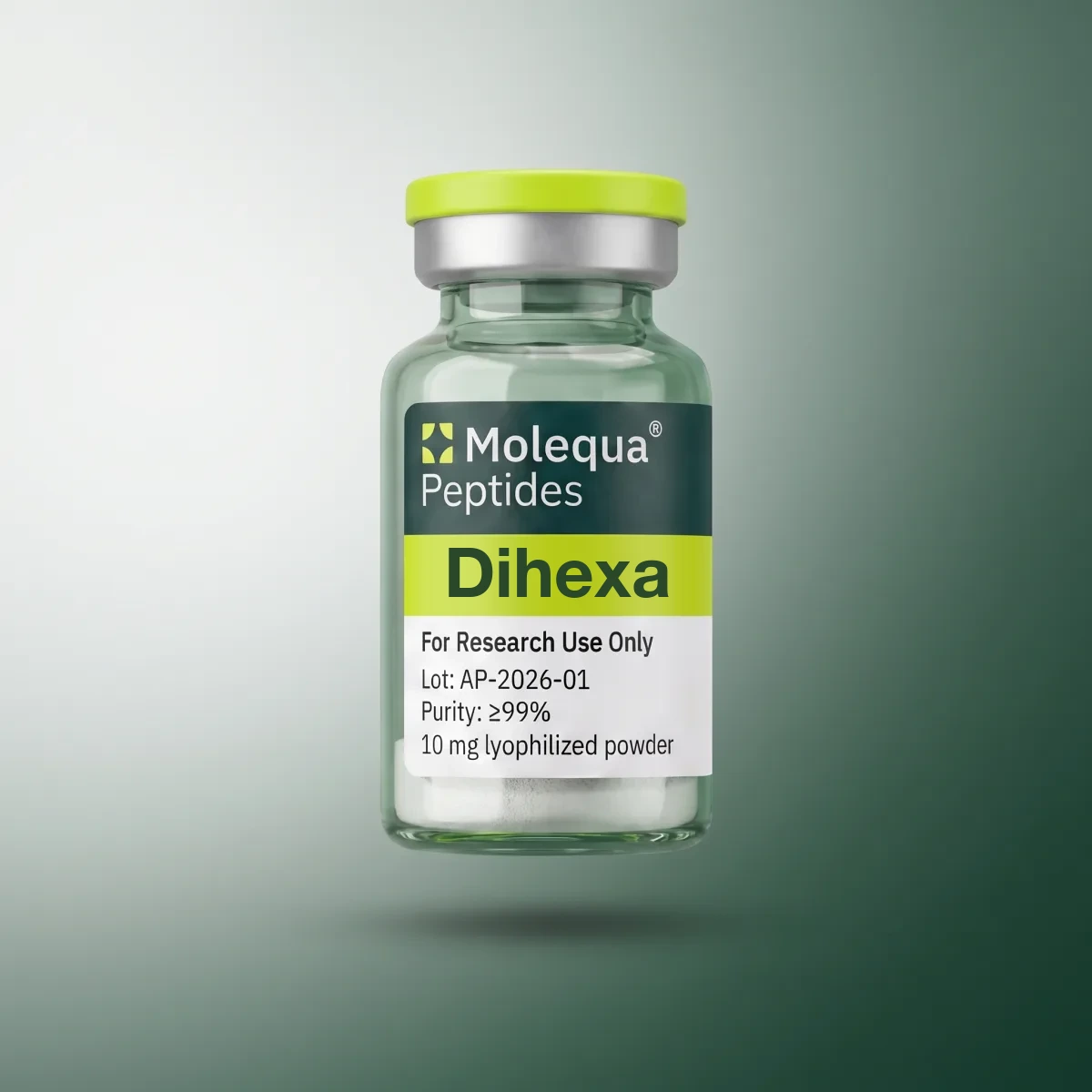
5. The correct delivery form: lyophilizate
Quality material is supplied as a lyophilizate, freeze-dried powder, not as a premixed solution. In dry form the substance is considerably more stable and is reconstituted only immediately before use.
Legal notice: Dihexa is a research material and not an authorized medicinal product. It is supplied exclusively for scientific laboratory research and is not intended for human or animal consumption. It has no approved therapeutic use.
Science & studies
Key publications
The listing below deliberately excludes the two retracted papers named above.
Uribe P.M., Kawas L.H., Harding J.W., Coffin A.B. (2015). Hepatocyte growth factor mimetic protects lateral line hair cells from aminoglycoside exposure. Front Cell Neurosci. 9:3. PubMed 25674052 Work in a non-neurological standard model of cell protection.
Wright J.W., Harding J.W. (2015). The Brain Hepatocyte Growth Factor/c-Met Receptor System: A New Target for the Treatment of Alzheimer’s Disease. J Alzheimers Dis. 45(4):985 to 1000. PubMed 25649658 The perspective article that sets the conceptual frame. To be read as a proposal, not as proof.
Ho J.K., Nation D.A. (2018). Cognitive benefits of angiotensin IV and angiotensin-(1-7): A systematic review of experimental studies. Neurosci Biobehav Rev. 92:209 to 225. PubMed 29733881 A systematic review, that is a methodical rather than promotional appraisal of the angiotensin IV field.
Sun X., Deng Y., Fu X. et al. (2021). AngIV-Analog Dihexa Rescues Cognitive Impairment and Recovers Memory in the APP/PS1 Mouse via the PI3K/AKT Signaling Pathway. Brain Sci. 11(11):1487. PubMed 34827486 The most directly relevant valid experimental paper, and also the most recent.
Studies in detail
▸ Study 1: the Alzheimer’s mouse model
Citation: Sun X. et al. AngIV-Analog Dihexa Rescues Cognitive Impairment and Recovers Memory in the APP/PS1 Mouse via the PI3K/AKT Signaling Pathway. Brain Sci, 2021. PubMed 34827486
What they did: administered Dihexa to the APP/PS1 mouse model, a standard transgenic model of Alzheimer’s disease, with behavioral memory testing and examination of the PI3K/AKT signalling pathway.
What they found: an improvement in memory performance in this model, linked to the PI3K/AKT pathway.
Why it counts: it is currently the most robust experimental paper on Dihexa and comes from a group outside the originating laboratory. Notably, the mechanism highlighted here is the PI3K/AKT pathway and not the HGF and c-Met system that dominates the commercial account.
▸ Study 2: cell protection outside the brain
Citation: Uribe P.M. et al. Hepatocyte growth factor mimetic protects lateral line hair cells from aminoglycoside exposure. Front Cell Neurosci, 2015. PubMed 25674052
What they did: examined protection of lateral line hair cells, a sensory system used as an ototoxicity model, against aminoglycoside antibiotics, which are known to destroy those cells.
What they found: a protective effect of the substance on those cells.
Why it counts: the model has nothing to do with cognition, which is exactly what makes it an interesting test of the general cellular mechanism. It widens the field beyond pure memory claims.
▸ Study 3: the systematic review
Citation: Ho J.K., Nation D.A. Cognitive benefits of angiotensin IV and angiotensin-(1-7): A systematic review of experimental studies. Neurosci Biobehav Rev, 2018. PubMed 29733881
What they did: a systematic review of the experimental work on cognitive effects of angiotensin IV and angiotensin-(1-7), with a selection methodology fixed in advance.
What they found: a synthesis of the available data together with its consistencies and methodological limits.
Why it counts: a systematic review applies selection criteria announced in advance and is therefore markedly more reliable than a narrative review. It is the right document for placing Dihexa without a commercial filter.
▸ Study 4: the conceptual frame and its exact nature
Citation: Wright J.W., Harding J.W. The Brain Hepatocyte Growth Factor/c-Met Receptor System: A New Target for the Treatment of Alzheimer’s Disease. J Alzheimers Dis, 2015. PubMed 25649658
What they did: an article proposing the cerebral HGF and c-Met system as a therapeutic target in Alzheimer’s disease and assembling the available arguments.
What they found: a reasoned proposal, not new experimental results.
Why it counts and how to read it: this article is not retracted and remains valid as a perspective. A working hypothesis is not proof, however, and a substantial part of the experimental work meant to support it sits in the two retracted publications. That distinction is precisely what disappears in commercial accounts.
Storage
Store lyophilized powder at 2 to 8 °C protected from light, at −20 °C for long-term storage. In dry form the substance stays stable for years that way. After reconstitution the solution belongs in the fridge, protected from light, and according to the literature should be used within 28 days. Avoid repeated freezing and thawing, which degrades peptides measurably.
Reservation
Dihexa is currently available for reservation. You reserve the quantity you want without obligation, and we confirm the batch and delivery date by email. No payment is taken at reservation.
Stacking tips: substances from the same field
Angiotensin IV and analogues
The obvious comparison, since Dihexa is derived from it. The systematic review by Ho and Nation covers this field and is the best entry point for relating the analogues to one another.
Semax and other nootropic peptides
Combining Dihexa with Semax, Noopept or other substances from the cognitive field is common in informal use. It should be said plainly that no published investigations of these combinations exist and that the described mechanisms differ.
Noopept is described through the neurotrophin axis of NGF and BDNF, Dihexa through the HGF and c-Met system or the PI3K/AKT pathway. The apparent proximity rests on the assumed field of application, not on the biology.
A substance-specific note
Given a record shaped by two retractions and the complete absence of human data, Dihexa is a substance where experimental restraint should be above average rather than below it.
Key scientific figures and citations
“Dihexa, an angiotensin IV analogue, rescues memory performance in the APP/PS1 mouse via the PI3K/AKT signalling pathway.” After Sun X. et al. (2021), Brain Sciences 11(11):1487 PubMed 34827486
Core figures from the literature
- Chemical name: N-hexanoyl-Tyr-Ile-(6)-aminohexanoic acid amide
- Parent molecule: angiotensin IV, a fragment of the renin-angiotensin system
- System named in the prevailing account: HGF and its receptor c-Met
- Pathway highlighted in the most recent valid paper: PI3K/AKT
- Animal model used in 2021: APP/PS1 mouse
- Retracted papers within this evidence base: two, expression of concern 2021, retraction 2025
- Human clinical data: none
- Marketing authorization: none, in any jurisdiction
- WADA prohibited list: not currently affected
Figures from the cited studies
- Systematic review (2018, Neurosci Biobehav Rev 92:209 to 225): of 450 articles identified, 32 met the inclusion criteria. In models of cognitive deficit, angiotensin IV or its analogues, dihexa included, improved performance in 8 of 9 studies; in healthy animals, in 7 of 11
- Hair-cell protection (Uribe 2015, Front Cell Neurosci 9:3): in the zebrafish larval lateral line a concentration of 1 µM dihexa gave optimal protection against both neomycin and gentamicin
- In the same work the protection was abolished by the HGF antagonist 6-AH, while dihexa did not change the entry of fluorescently tagged gentamicin into the cells. The protection is therefore intracellular, not at the level of antibiotic uptake
- Alzheimer’s model (2021, Brain Sci 11(11):1487): in APP/PS1 mice, dihexa restored spatial learning in the Morris water maze, increased neuronal counts and SYP expression, and lowered IL-1β and TNF-α while raising IL-10
- The effect ran through the PI3K/AKT pathway: the PI3K inhibitor wortmannin markedly reversed both the anti-inflammatory and the anti-apoptotic effects. That is a mechanistic control, not merely a correlation
- Limits of the evidence: everything is preclinical, there is no human clinical trial. Two originally central publications have been retracted. Marketing authorisation: none
Reference sources (PubMed)
- Uribe P.M. et al. (2015). Hepatocyte growth factor mimetic protects lateral line hair cells from aminoglycoside exposure. Front Cell Neurosci 9:3. PubMed 25674052
- Wright J.W., Harding J.W. (2015). The Brain Hepatocyte Growth Factor/c-Met Receptor System: A New Target for the Treatment of Alzheimer’s Disease. J Alzheimers Dis 45(4):985 to 1000. PubMed 25649658
- Ho J.K., Nation D.A. (2018). Cognitive benefits of angiotensin IV and angiotensin-(1-7): A systematic review of experimental studies. Neurosci Biobehav Rev 92:209 to 225. PubMed 29733881
- Sun X. et al. (2021). AngIV-Analog Dihexa Rescues Cognitive Impairment and Recovers Memory in the APP/PS1 Mouse via the PI3K/AKT Signaling Pathway. Brain Sci 11(11):1487. PubMed 34827486
Note on the retracted papers: the retraction notices for Kawas et al. (2012) and Benoist et al. (2014) can be consulted in the Journal of Pharmacology and Experimental Therapeutics, volume 392 (2025). We point this out because both papers continue to be cited widely on commercial pages about this substance.
Regulatory status: Dihexa is not authorized as a medicinal product in any jurisdiction and has never been the subject of a clinical trial in humans. Within the EU the competent authority for medicinal products is the EMA. The product offered here is a reagent exclusively for scientific laboratory research (RUO).
Frequently asked questions about Dihexa
What is Dihexa?
Dihexa is a synthetic tripeptide derivative derived from angiotensin IV. It was developed at Washington State University and carries the development code PNB-0408. In the literature it is described as a mimetic of hepatocyte growth factor HGF.
Which mechanism is described?
The published work describes a potentiation of the binding of HGF to its receptor c-Met. That signalling pathway is linked in the literature to synaptogenesis, the formation of new synaptic connections.
Why is Dihexa considered particularly potent?
The original publications by McCoy and Benoist reported effective concentrations several orders of magnitude lower than for angiotensin IV. Those figures come from cell culture and rat models and cannot be transferred to other contexts.
Are there clinical trials in humans?
No. Dihexa is in the preclinical phase. Controlled clinical trials do not exist, and there is no marketing authorization in any country.
Is it true that studies on Dihexa were retracted?
Yes. Two papers published in the Journal of Pharmacology and Experimental Therapeutics, Kawas et al. (2012) and Benoist et al. (2014), received an expression of concern in 2021 and were retracted in 2025. The most widely repeated statements about this substance come from them. We do not list them as sources.
Which literature remains valid?
Above all the paper by Sun and colleagues (2021) in the APP/PS1 mouse, the paper by Uribe and colleagues (2015) in hair cells, the systematic review by Ho and Nation (2018) and the perspective article by Wright and Harding (2015).
Is there human data?
No. None.
Where does Dihexa come from?
It is a synthetic compound derived from angiotensin IV, a fragment of the renin-angiotensin system whose cerebral branch has described cognitive effects.
Why does the substance dissolve poorly in water?
Because of the hexanoic acid chains at both ends, which deliberately raise lipophilicity. Published protocols generally use a co-solvent.
Why do you publish this unfavorable information?
Because a page that describes a substance without mentioning that two of its central publications have been retracted is not describing that substance. Every source on this page can be checked by you on PubMed.