




Quick overview
AHK-Cu is the copper tripeptide Ala-His-Lys, a relative of GHK-Cu with alanine instead of glycine in position one of the sequence. In research it is studied on human hair follicles ex vivo and dermal papilla cells in vitro; the only peer-reviewed study dates from 2007.
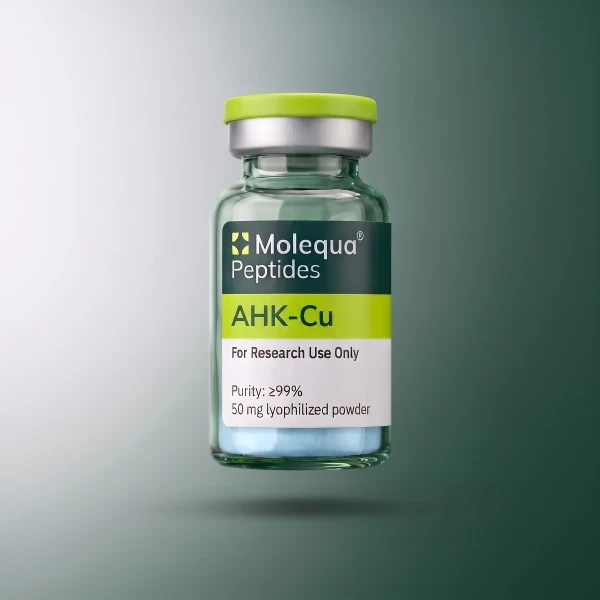
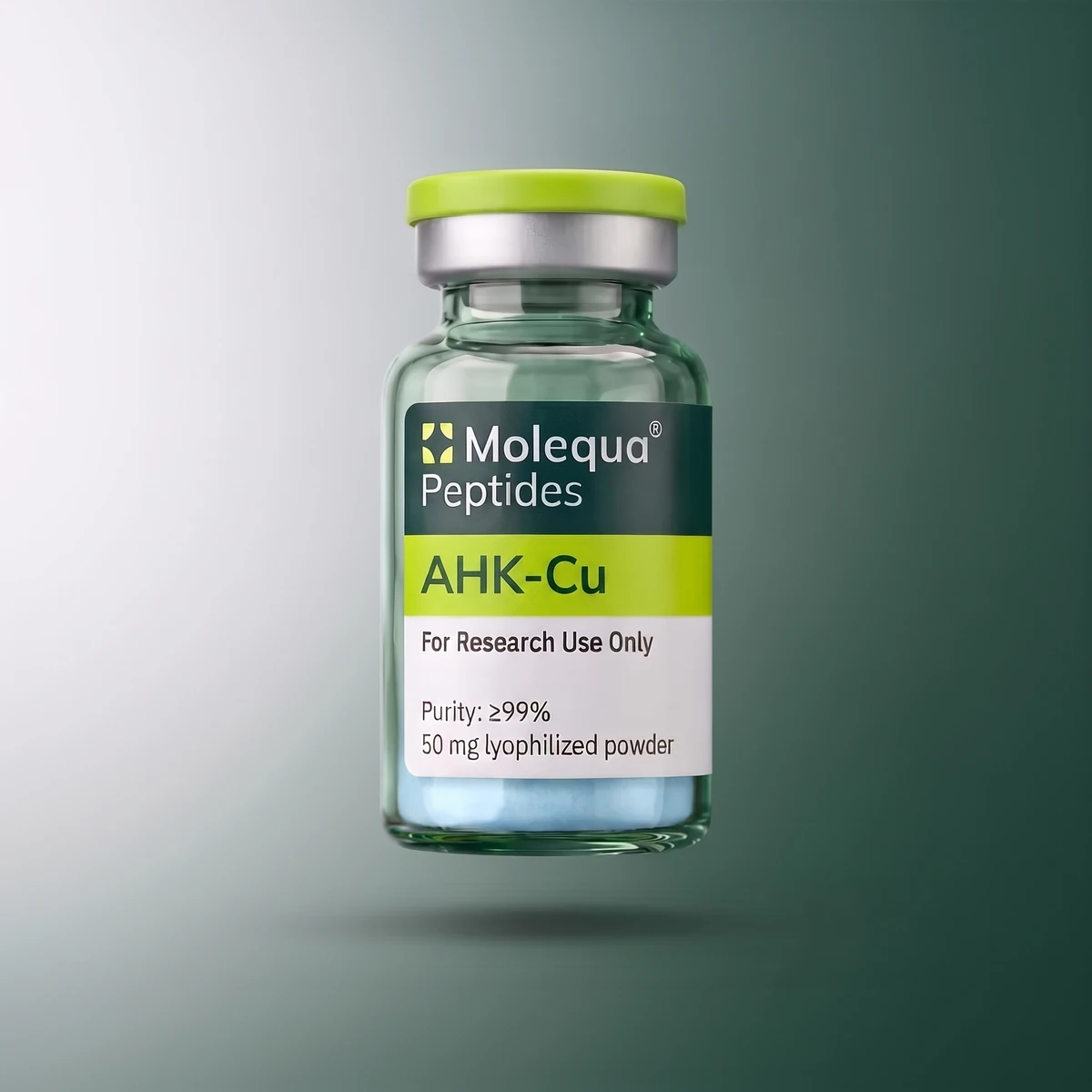
- Ala-His-Lys sequence with bound Cu²⁺, blue 50 mg lyophilizate
- One ex vivo and in vitro study (Pyo 2007), no human clinical trials
- GHK-Cu findings do not transfer to AHK-Cu, it differs by one amino acid
- HPLC + LC-MS batch certificate on stocking, reservation without payment until then
Read more Close
Overview
AHK-Cu is the copper tripeptide L-alanyl-L-histidyl-L-lysine complexed with a Cu²⁺ ion, the closest relative of GHK-Cu, from which it differs by one amino acid at the start of the sequence. In research it is linked to hair follicle and skin models: the only peer-reviewed study (Pyo 2007) examined it on human hair follicles ex vivo and dermal papilla cells in vitro. No human clinical trials exist. Molequa® supplies it as a blue 50 mg lyophilizate for laboratory research only.
What AHK-Cu is and where it comes from
AHK-Cu is a synthetic tripeptide Ala-His-Lys (alanine, histidine, lysine) carrying a bound cupric ion Cu²⁺. The quickest way to understand it is through its more famous relative: GHK-Cu has the sequence Gly-His-Lys, occurs naturally in human plasma and has been studied since the 1970s. AHK-Cu differs from it in the first amino acid: in place of glycine, the smallest amino acid with no side chain, the sequence starts with alanine with one extra methyl group. The histidine and lysine that hold the copper stay the same.
Picture two keys that differ by a single tooth. The part that fits the lock, the histidine and lysine that chelate Cu²⁺, is identical in both. The altered tooth is the alanine at the start: it may change how cells, enzymes and transporters see the peptide, but how much it changes has never been measured. That is exactly what makes AHK-Cu a research question rather than a finished answer.
In the peer-reviewed literature AHK-Cu has a single study from 2007 (Pyo et al., PubMed 17703734); otherwise it lives in research-peptide catalogues as “the copper peptide for the hair follicle”. Molequa® supplies it exclusively for laboratory research and consistently separates what has been measured on AHK-Cu from what is merely inferred from GHK-Cu.
What we know about the structure, and what we do not
The free tripeptide AHK has an unambiguous PubChem record: molecular formula C15H26N6O4 and molecular weight 354.41 Da. For the copper complex the number CAS 130120-57-9 is used. It dissolves readily in water and the solution is blue; the colour comes from the cupric ion held between histidine and lysine.
What you cannot read from a catalogue is the exact composition of the batch of the complex: copper-to-peptide ratio, counter-ions, bound water. Molequa® therefore states the mass of the free tripeptide, 354.4 Da, as the reference value and will add the mass of the complex from the LC-MS certificate of the first batch. What has not been measured is not presented here as fact.
| Parameter | AHK-Cu | GHK-Cu |
|---|---|---|
| Sequence | Ala-His-Lys + Cu²⁺ (alanine first) | Gly-His-Lys + Cu²⁺ (glycine first) |
| Molecular weight | 354.4 Da (free tripeptide) | 402 Da (with copper) |
| CAS | 130120-57-9 (copper complex) | 89030-95-5 |
| Colour of lyophilizate and solution | blue | blue |
| Evidence base | 1 peer-reviewed study (2007), ex vivo and in vitro | extensive literature since 1973 including gene data (Pickart 2015, 2018) |
| Human clinical trials | none | topical dermatological studies |
| Typical research focus | hair follicle, dermal papilla cells | skin, collagen, healing models, gene expression |
| Molequa® pack | 50 mg, €35.90 (€0.72/mg) | 100 mg, €53.90 (€0.54/mg) |
Mechanism: what is measured and what is inferred
With AHK-Cu two layers have to be kept apart: the single direct measurement from 2007 and the context of copper peptides, which comes almost entirely from GHK-Cu research.
Hair follicle ex vivo and dermal papilla cells (Pyo 2007)
The team of Pyo et al. worked with human hair follicles in culture (ex vivo) and with dermal papilla cells, the control centre of the follicle. AHK-Cu at concentrations of 10⁻¹² to 10⁻⁹ M stimulated follicle elongation and the proliferation of dermal papilla cells (Pyo 2007, PubMed 17703734). At 10⁻⁹ M the Bcl-2/Bax ratio rose and cleaved caspase-3 and PARP, markers of programmed cell death, fell; the decrease in the number of apoptotic cells (annexin V / propidium iodide), however, was not statistically significant. That is the entire direct measurement that exists for AHK-Cu.
What is inherited from GHK-Cu research, and what is not
The 2015 review by Pickart and Margolina describes how GHK-Cu modulates multiple cellular pathways in skin regeneration (Pickart 2015, PubMed 26236730), and the 2018 paper adds gene data from the Broad Institute database, according to which GHK-Cu changes the expression of a large share of human genes (Pickart 2018, PubMed 29986520). It is tempting to say: AHK-Cu is almost the same, so it must apply to it too. It does not. One amino acid changes charge, shape, cell entry and breakdown by peptidases. Nobody has measured the gene profile of AHK-Cu; for it the GHK-Cu literature is context, not evidence.
Why copper matters
Copper Cu²⁺ is a trace element and a cofactor of enzymes, for example lysyl oxidase in collagen cross-linking or Cu/Zn superoxide dismutase. The histidine and lysine in the tripeptide bind it firmly, and this bond gives both the powder and the solution their blue colour. The working hypothesis for the whole family is that the peptide acts as a copper carrier into cells. For AHK-Cu it is borrowed from GHK-Cu, not measured.
Research areas
With AHK-Cu these are research questions, not documented effects:
- Replicating the 2007 result in an independent laboratory: the first and most important question, still unpublished.
- Apoptotic markers: Bcl-2/Bax, caspase-3 and PARP moved, the count of apoptotic cells did not. Does the difference hold with more samples?
- Head-to-head comparison with GHK-Cu under identical conditions and with a copper-only control.
- Chemistry of the complex: stability of the copper bond, light sensitivity, behaviour in bacteriostatic water.
- Skin cell models (fibroblasts, keratinocytes), where GHK-Cu is described and AHK-Cu not at all.
Buying AHK-Cu: what to look for
When buying AHK-Cu, the batch certificate of analysis with HPLC purity and LC-MS identity decides, not the price. Blue powder looks the same from every seller, and the €32 to €39.90 range for 50 mg in the EU says nothing about what is in the vial. Molequa® supplies a 50 mg lyophilizate with declared purity ≥ 99 % HPLC; the first-batch certificate is published on stocking, until then the product is a reservation without payment.
These five criteria separate a serious seller from the grey zone.
1. HPLC purity ≥ 99 % backed by a chromatogram
Purity tells you what share of the powder is the main component. A number without a chromatogram is a claim, not evidence.
2. Certificate of analysis for the specific batch
A document with batch number, date and measured value, issued by an independent laboratory. If a seller shows only a generic template or a certificate “on request”, do not buy.
3. LC-MS identity: with AHK-Cu one methylene group decides
AHK and GHK differ by a single CH₂ group, roughly 14 Da in the mass spectrum; both powders are blue. Only LC-MS tells you whether you are holding AHK-Cu or relabelled GHK-Cu. A certificate without LC-MS is not enough for AHK-Cu.
4. EU origin and shipping with batch traceability
EU stock means shorter transport, no customs risk and a batch you can trace back. Molequa® ships from the EU, usually within 1 to 3 working days of stocking.
5. The right form: blue lyophilizate
Quality AHK-Cu is supplied as lyophilized powder, not as a ready-made solution. The colour is a check in itself: a deep blue powder means an intact copper complex, pale or greenish material is a warning sign. It is reconstituted with bacteriostatic water just before use.
Price per milligram
On the EU market 50 mg of AHK-Cu costs €32 to €39.90 and 100 mg €52.50 to €64.90. Molequa® 50 mg at €35.90 sits in the middle of the range, €0.72/mg (GHK-Cu 100 mg: €53.90, €0.54/mg). The difference is not in the price but in the public HPLC + LC-MS certificate for the batch.
Verify quality in 30 seconds
- ✅ CoA for the batch publicly available?
- ✅ HPLC purity ≥ 99 % backed by a chromatogram?
- ✅ Identity confirmed by LC-MS with the mass stated?
- ✅ EU stock and batch traceability?
- ✅ Supplied as blue lyophilizate with clear storage guidance?
Every Molequa® batch has a certificate from an independent laboratory before sale. For AHK-Cu the certificate (HPLC + LC-MS) will appear in the Batch test results section when the first batch is stocked; until then the product is a reservation without payment.
Legal notice: AHK-Cu is a research peptide and not an approved medicine in any country. It is sold exclusively for scientific laboratory research and is not intended for human or animal consumption.
Science & Studies
The scientific basis of AHK-Cu is a single peer-reviewed study: Pyo et al. 2007 on human hair follicles ex vivo and dermal papilla cells in vitro. No human clinical trials with AHK-Cu exist, and nobody has independently replicated the 2007 result. Everything else written about copper tripeptides comes from GHK-Cu research and cannot be transferred to AHK-Cu automatically. That is exactly how we write it on this page.
4.1 Key publications
A warning up front: of the three papers below, only the first studied AHK-Cu. The other two are GHK-Cu literature, context, not evidence.
Pyo H.K., et al. (2007). The effect of tripeptide-copper complex on human hair growth in vitro. Arch Pharm Res. PubMed 17703734, the only direct AHK-Cu study.
Pickart L., Vasquez-Soltero J.M., Margolina A. (2015). GHK Peptide as a Natural Modulator of Multiple Cellular Pathways in Skin Regeneration. Biomed Res Int. PubMed 26236730, review of GHK-Cu mechanisms, not AHK-Cu.
Pickart L., Margolina A. (2018). Regenerative and Protective Actions of the GHK-Cu Peptide in the Light of the New Gene Data. Int J Mol Sci. PubMed 29986520, GHK-Cu gene data, not AHK-Cu.
4.2 Detailed expandable studies
▸ Study 1: Pyo 2007, AHK-Cu on human follicles and dermal papilla cells
Citation: Pyo H.K., et al. The effect of tripeptide-copper complex on human hair growth in vitro. Arch Pharm Res. 2007. PubMed 17703734.
What they did: Human hair follicles were maintained in culture (ex vivo) and their elongation was measured. In parallel, dermal papilla cells were cultured and their proliferation and apoptosis markers were followed. AHK-Cu was added at concentrations of 10⁻¹² to 10⁻⁹ M.
What they found: Across the concentration range AHK-Cu stimulated both follicle elongation ex vivo and dermal papilla cell proliferation. At 10⁻⁹ M the Bcl-2/Bax ratio rose and the levels of cleaved caspase-3 and PARP fell. The decrease in the share of apoptotic cells (annexin V / propidium iodide) was visible but did not reach statistical significance.
What the study does not say: Nothing about people. It concerns tissue and cells outside the body, from one team, without independent replication. No follow-up clinical trial and no further peer-reviewed study with AHK-Cu exists.
Why it matters for AHK-Cu: It is the only direct measurement and the reason AHK-Cu is associated with the hair follicle. Anyone who wants to work with AHK-Cu starts here: the same model, the same concentrations, and the question whether the 2007 result repeats.
▸ Study 2: Pickart 2015, review of GHK-Cu pathways in skin regeneration
Citation: Pickart L., Vasquez-Soltero J.M., Margolina A. GHK Peptide as a Natural Modulator of Multiple Cellular Pathways in Skin Regeneration. Biomed Res Int. 2015;2015:648108. PubMed 26236730.
What they did and found: A review of decades of GHK-Cu research, from the discovery in human plasma to gene data. According to the authors GHK-Cu modulates several cellular pathways at once and changes the expression of a large share of human genes. Note: this is GHK-Cu, not AHK-Cu.
Why it matters for AHK-Cu: It shows what a fully characterised copper tripeptide looks like. For AHK-Cu it is a map of open questions, not a list of properties.
▸ Study 3: Pickart 2018, GHK-Cu gene data
Citation: Pickart L., Margolina A. Regenerative and Protective Actions of the GHK-Cu Peptide in the Light of the New Gene Data. Int J Mol Sci. 2018;19(7):1987. PubMed 29986520.
What they did and found: The authors linked the GHK-Cu literature with gene data from the Broad Institute database, according to which GHK-Cu changes the expression of a large share of human genes, and from this derive regenerative and protective actions at the level of gene regulation.
Why it matters for AHK-Cu: This is where the temptation to transfer is greatest. A gene profile, however, is sensitive to the exact structure of the molecule: swapping glycine for alanine can change receptor binding, cell entry and half-life in the medium. Until someone measures it with AHK-Cu, the only honest conclusion is: we do not know.
Storage
Store the AHK-Cu lyophilizate in the refrigerator at 2 to 8 °C or in the freezer, always protected from light; after reconstitution with bacteriostatic water keep the blue solution cold and dark and watch its colour. The figures are based on the storage of GHK-Cu and on the properties of copper peptides; once the first batch is stocked we will confirm them against the certificate.
Lyophilizate (blue dry powder before reconstitution)
- 2 years at −20 °C (freezer)
- 18 months at 2 to 8 °C (refrigerator)
- Up to 30 days at room temperature below 25 °C, strictly protected from light and moisture
After reconstitution (blue solution in bacteriostatic water)
- Up to 30 days at 2 to 8 °C, strictly protected from light
- Do not refreeze the solution after reconstitution; crystallisation can disrupt the copper complex
Practical rules for a copper peptide
Light sensitivity matters more with AHK-Cu than with ordinary peptides: on prolonged exposure to light the cupric ion can change oxidation state and the complex falls apart.
- Keep the vial in its original dark packaging or in aluminium foil, in a dark box in the refrigerator. Brief light during reconstitution is fine, weeks in the light are not.
- Let the vial warm to room temperature (15 to 20 minutes) before opening, otherwise moisture condenses on the powder.
- Do not shake, roll the vial gently between your fingers.
- A blue solution is normal. The depth of the blue is a marker of an intact Cu²⁺ complex. If the solution fades, turns greenish or loses its colour, the complex has changed; do not use such a solution.
- After each handling check clarity. Turbidity is a problem.
Combination tips, Frequently combined peptides
The most meaningful partner of AHK-Cu in research is GHK-Cu: a parallel experiment with both tripeptides under identical conditions and with a copper-only control is the only way to find out what alanine in position one changes. The other combinations from regeneration research (BPC-157, TB-500) are hypotheses, not documented synergies.
GHK-Cu, the direct comparison and the copper control
The sister molecule is also the best control: the same histidine and lysine, the same copper, the same colour, one different amino acid. An honest experiment runs AHK-Cu, GHK-Cu and a medium with equimolar copper and no peptide side by side, because copper alone changes the behaviour of cells in culture. Molequa® carries both copper tripeptides, so you get them in one shipment. With two copper peptides in one medium recalculate the total copper; its excess is a burden for cells.
BPC-157, the vascular complement
In regeneration research BPC-157 is associated with angiogenesis and fibroblast migration. The hypothesis for skin and follicle models: BPC-157 for blood supply, the copper tripeptide for copper and matrix metabolism. For AHK-Cu this is reasoning carried over from GHK-Cu, untested by any study.
TB-500, the cellular complement
In research TB-500 is associated with cell mobilisation and the actin cytoskeleton. In the trio with BPC-157 and a copper tripeptide it is described as the “cellular material” alongside the “vascular” and the “building” components. The same logic, the same caveat: unpublished for AHK-Cu.
Key scientific figures and citations
All direct figures on AHK-Cu come from a single paper: Pyo et al. 2007, concentrations of 10⁻¹² to 10⁻⁹ M, human follicles ex vivo and dermal papilla cells in vitro. The number of human clinical trials is zero, the number of independent replications zero. Figures on GHK-Cu are listed separately and labelled so that they are not confused with AHK-Cu.
“The effect of tripeptide-copper complex on human hair growth in vitro.”
Pyo HK. et al. (2007), Arch Pharm Res, PubMed 17703734
Figures from the research literature
- Direct peer-reviewed studies on AHK-Cu: 1 as of November 2026 (Pyo 2007, PubMed 17703734); human clinical trials: 0; independent replications: 0
- AHK-Cu at 10⁻¹² to 10⁻⁹ M: elongation of human follicles ex vivo and proliferation of dermal papilla cells in vitro; at 10⁻⁹ M Bcl-2/Bax up, cleaved caspase-3 and PARP down, apoptotic cells not statistically significant (Pyo 2007)
- GHK-Cu, not AHK-Cu: changes the expression of a large share of human genes according to Broad Institute data (Pickart 2018, PubMed 29986520); not transferable to AHK-Cu
Table of key figures
| Item | Value | Source |
|---|---|---|
| Sequence | Ala-His-Lys + Cu²⁺ | PubChem, CAS registry |
| Mass of the free tripeptide | 354.41 Da (C15H26N6O4) | PubChem |
| CAS of the copper complex | 130120-57-9 | CAS registry |
| Active concentrations in the model | 10⁻¹² to 10⁻⁹ M | Pyo 2007, PubMed 17703734 |
| Change in Bcl-2/Bax, caspase-3 and PARP | at 10⁻⁹ M | Pyo 2007 |
| Decrease in apoptotic cells (annexin V / PI) | not statistically significant | Pyo 2007 |
| Peer-reviewed studies directly on AHK-Cu / human clinical trials | 1 (year 2007) / 0 | PubMed, November 2026 |
| Molequa® pack and purity | 50 mg, €35.90, €0.72/mg, ≥ 99 % HPLC | this shop |
Reference sources (PubMed)
- Pyo HK. et al. (2007). “The effect of tripeptide-copper complex on human hair growth in vitro.” Arch Pharm Res. PubMed 17703734
- Pickart L., Vasquez-Soltero JM., Margolina A. (2015). “GHK Peptide as a Natural Modulator of Multiple Cellular Pathways in Skin Regeneration.” Biomed Res Int 2015:648108. PubMed 26236730
- Pickart L., Margolina A. (2018). “Regenerative and Protective Actions of the GHK-Cu Peptide in the Light of the New Gene Data.” Int J Mol Sci 19(7):1987. PubMed 29986520
Registration status: AHK-Cu is not approved or registered as a medicine in any jurisdiction (EMA or FDA). The Molequa® product is sold exclusively for laboratory scientific research (RUO).
Frequently asked questions about AHK-Cu
Short answers to the most common questions: AHK-Cu is the copper tripeptide Ala-His-Lys, it differs from GHK-Cu by one amino acid, it has a single peer-reviewed study from 2007 on follicles ex vivo and cells in vitro, it is not a medicine, it is stored cold and dark, and Molequa® supplies it as a blue 50 mg lyophilizate exclusively for laboratory research. Details are in the sections above.
What is AHK-Cu and how does it differ from GHK-Cu?
AHK-Cu is the tripeptide alanyl-histidyl-lysine complexed with the cupric ion Cu²⁺. It differs from GHK-Cu (glycyl-histidyl-lysine) in the first amino acid, alanine instead of glycine. The free tripeptide AHK is 354.4 Da, the copper complex CAS 130120-57-9. Both are blue, but GHK-Cu has decades of research, AHK-Cu a single study.
Are there studies directly on AHK-Cu?
Yes, one. Pyo et al. (2007, Arch Pharm Res, PubMed 17703734) examined AHK-Cu on human hair follicles ex vivo and on dermal papilla cells in vitro. No human clinical trials with AHK-Cu exist and nobody has independently replicated the 2007 result. All other data on copper tripeptides concern GHK-Cu.
What exactly did the Pyo 2007 study find?
AHK-Cu at concentrations of 10⁻¹² to 10⁻⁹ M stimulated follicle elongation ex vivo and the proliferation of dermal papilla cells. At 10⁻⁹ M the Bcl-2/Bax ratio rose and cleaved caspase-3 and PARP fell. The decrease in the share of apoptotic cells was not statistically significant. These are data from tissue and cells outside the body, not results in people.
Why is AHK-Cu blue and what does it mean when the solution fades?
The blue colour comes from the cupric ion Cu²⁺ bound between histidine and lysine. A deep blue powder and solution mean an intact complex. If the solution fades, turns greenish or loses its colour, the copper has changed oxidation state or the complex has broken down, most often through exposure to light. Such a solution does not belong in an experiment.
Is AHK-Cu an approved medicine or a research substance?
AHK-Cu is not approved or registered as a medicine in any country. In the EU, the USA and everywhere else it is exclusively a research substance. The Molequa® product is sold only for laboratory scientific research (RUO) and is not intended for human or animal consumption.
How is AHK-Cu stored?
Store the lyophilizate at −20 °C (stable for 2 years) or at 2 to 8 °C (18 months), always protected from light and moisture. After reconstitution with bacteriostatic water keep the blue solution for up to 30 days at 2 to 8 °C in the dark and do not refreeze it. The figures are based on GHK-Cu and we will confirm them against the certificate of the first batch.
Where to buy AHK-Cu in the EU for scientific research?
Molequa® offers AHK-Cu for scientific research in the EU as a blue 50 mg lyophilizate at €35.90 (€0.72/mg) with a declared purity of ≥ 99 % HPLC and a batch certificate of analysis (HPLC + LC-MS) from an independent laboratory. Until the first batch is stocked the product is available as a reservation without payment. Delivery by Packeta or courier (Slovakia 1 to 2, Czechia 2 to 3, other EU countries 3 to 5 working days). Research use only (RUO).