




Quick overview
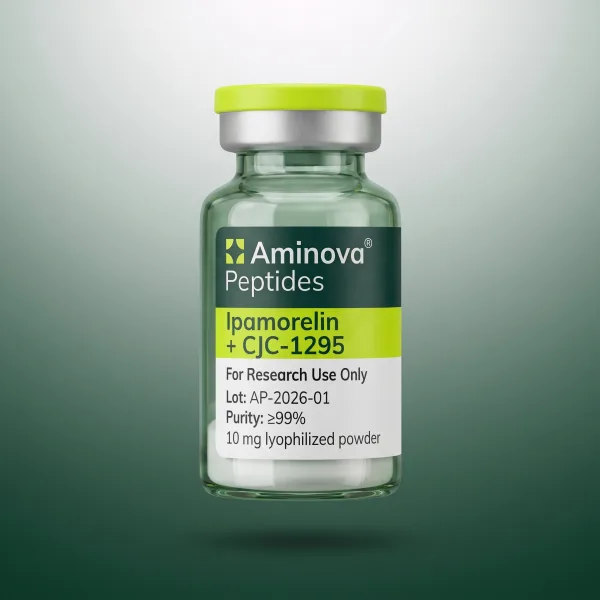
The Ipamorelin + CJC-1295 combination joins two pathways of growth hormone stimulation: a GHRH analogue and a selective ghrelin receptor agonist. It is the most used pair in GH axis research, here in a single vial.
- 2 in 1: an exact ratio without mixing two vials
- Ipamorelin does not raise cortisol or prolactin
- CJC-1295 extends GH pulses via the GHRH receptor
- The synergy of the two pathways is documented in research
Read more Close
Overview
Origin and why the pairing makes sense
Ipamorelin + CJC-1295 is not one molecule but a combination of two peptides that work as a pair in growth hormone (GH) research. Think of it like the accelerator and the clutch in a car, each does something on its own, but you only really get moving when you use them together. That is precisely why, in the preclinical literature (= preclinical animal testing prior to clinical trials), these two peptides are so often studied in a single protocol.
Ipamorelin is a short pentapeptide (5 amino acids) belonging to the GHRP group, the growth hormone releasing peptides. It was developed in the late 1990s by the Danish company Novo Nordisk, and in 1998 the team of Kilian Raun described it as “the first truly selective growth hormone secretagogue”. The word “selective” is the key here, more on that shortly.
CJC-1295 (also known as modified GRF 1-29 or mod GRF 1-29, in this version without DAC) is an analog of GHRH, the hormone that normally releases growth hormone. It was developed by the Canadian company ConjuChem and characterized in the mid-2000s by the teams of Léon Jetté and Sam Teichman. It is a shortened, stabilized version of natural GHRH.
So you have two peptides that both lead to growth hormone release, but each by a completely different route. And that is exactly why they are combined.
Two locks, two keys, one door
The pituitary gland is the “dispatch center” for growth hormone. On its cells there are two different receptors that control when and how much GH is released:
- The GHRH receptor, the main “accelerator pedal”. When you activate it, the cell is told to produce and release growth hormone.
- The ghrelin receptor (GHS-R1a), a second, independent mechanism. It simultaneously strengthens GH release and suppresses somatostatin, the body’s natural “brake” on growth hormone.
CJC-1295 presses the first pedal (the GHRH route). Ipamorelin presses the second one (the ghrelin route) and additionally releases the brake. When you press both pedals at once and let off the brake, the resulting GH “pulse” in studies is markedly larger than the sum of the two on their own. Scientists call this a synergistic effect, the two mechanisms don’t add up, they multiply.
Why Ipamorelin is special, selectivity
The first generation of GHRPs (for example GHRP-6 or GHRP-2) had one problem: besides growth hormone, they also stirred up hormones that nobody wanted there, cortisol (the stress hormone), prolactin and, above all, intense hunger. GHRP-6 literally triggered a “ravenous appetite”.
Ipamorelin was the first peptide in this family that released GH without this side baggage. In Raun’s 1998 study, it raised growth hormone comparably to GHRP-6, but cortisol and prolactin stayed practically at resting levels. That is why Ipamorelin became the reference “clean” GHRP and why it is precisely this peptide that is used in combinations.
Why CJC-1295 (without DAC) is so popular
Natural GHRH has a lifetime in the body of roughly 7 minutes, after which the enzyme DPP-4 chops it up. That is impractical for research. CJC-1295 solves this problem with a few targeted amino acid substitutions that make the molecule resistant to DPP-4, extending its half-life to the order of tens of minutes to hours.
Watch out for an important distinction: there is CJC-1295 with DAC (Drug Affinity Complex), which binds to albumin in the blood so its action lasts for days, and CJC-1295 without DAC (i.e. mod GRF 1-29), which has a shorter, “pulsed” profile. This product contains the version without DAC, precisely because it is paired with Ipamorelin, both act in short pulses that mimic the natural, pulsatile way the body releases growth hormone.
Mechanism of action, what happens at the cellular level
CJC-1295, activation of the GHRH receptor
CJC-1295 binds to the GHRH receptor on the somatotroph cells of the pituitary. This receptor is coupled to a G-protein; on binding, cyclic AMP (cAMP) rises inside the cell, the classic “second messenger”. cAMP then triggers, via the PKA pathway, the synthesis and release of growth hormone stores. In simple terms: CJC-1295 tells the cell “produce and release GH”.
The key point is that CJC-1295 does not create one large non-physiological surge of GH, but rather increases the amplitude of the natural pulses. The body keeps its own feedback, more on that below.
Ipamorelin, activation of the ghrelin receptor and lifting the brake
Ipamorelin binds to GHS-R1a, the ghrelin receptor. This one is also G-protein-coupled, but takes a different intracellular route (phospholipase C, calcium signaling). The result has two parts:
- Direct release of GH from the pituitary.
- Suppression of somatostatin, the hormone that normally “brakes” growth hormone.
The second part is the reason for the synergy. CJC-1295 may press the accelerator, but if somatostatin is holding the brake, only a limited amount of GH is released. Ipamorelin lets off that brake, opening the way for the full effect of GHRH stimulation.
IGF-1, where it all leads
Growth hormone on its own is only a middleman. Most of the anabolic (tissue growth and renewal) signals are actually carried out by IGF-1 (insulin-like growth factor 1), which is produced mainly in the liver in response to GH. That is why studies measure IGF-1 in addition to GH, it is a more stable, longer-term indicator of how the GH axis responded.
Preserved feedback, an important safeguard
This is significant from a research standpoint: the Ipamorelin + CJC-1295 combination stimulates the animal’s own pituitary, it does not supply growth hormone from outside. This means the physiological feedback loops (somatostatin, IGF-1 negative feedback) remain intact. In preclinical models this makes the profile different from administering recombinant growth hormone itself, where you bypass those safeguards.
Researched applications
The published preclinical and, in part, clinical literature (Phase 1/2 for CJC-1295) documents the effects of GH secretagogues in the following areas (mostly in animal models or early human safety studies):
- Growth hormone and IGF-1 secretion, robustly demonstrated for both molecules
- Soft tissue regeneration and healing, via the GH/IGF-1 axis, tendon and muscle models
- Muscle mass and body composition, preclinical anabolism models
- Sarcopenia (age-related muscle loss), research on the GH axis in aging
- Bone density, GH and IGF-1 as regulators of bone remodeling
- Fat metabolism (lipolysis), GH as a signal for fatty acid release
- Sleep and recovery, GH pulses are physiologically tied to deep sleep
- Post-training and post-operative recovery, in combination with regenerative peptides
Buying Ipamorelin + CJC-1295: what to look for
When buying Ipamorelin + CJC-1295, the decisive criterion is not the price but the verifiability of quality. A research blend is only ever as good as its certificate of analysis, and because there are two different molecules, you need documentation for each of them. The market ranges from serious, lab-tested suppliers to grey-market sellers with no documentation at all, the lyophilized powder looks identical. These five criteria separate them.
1. HPLC purity ≥ 99 % – documented for both peptides
HPLC purity shows what proportion of the powder is actually the given peptide. For a blend, serious suppliers document ≥ 99 % with a chromatogram for Ipamorelin and for CJC-1295 separately. “99 % purity” without an attached chromatogram is a claim, not proof.
2. Batch-specific certificate of analysis (CoA)
The most important document. A batch-specific CoA belongs to exactly the batch you receive, with batch number, date and purity value, issued by an independent laboratory (Janoshik and similar are the industry standard). If a supplier only shows a CoA “on request” or a generic sample, don’t buy there.
3. LC-MS identity confirmation
Purity tells you how much of a substance is present; LC-MS tells you which substance it is. Via the molecular mass it confirms this is Ipamorelin (711.86 Da) and CJC-1295 (approximately 3367.9 Da), not a cheaper, mislabeled peptide.
4. Origin and EU shipping with traceability
A supplier with an EU warehouse and full batch traceability has the edge over grey imports from Asia: shorter cooled transport and no customs risk. Molequa® ships from within the EU, typically within 3 to 5 business days.
5. Correct delivery form: lyophilizate
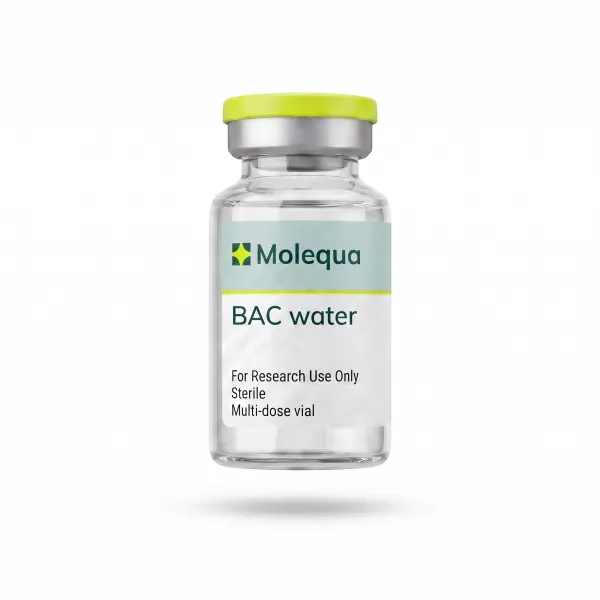
A high-quality GH combination is delivered as a lyophilizate (white powder), not as a pre-mixed solution. Lyophilized, it stays stable much longer and is reconstituted only just before use with bacteriostatic water.
Check quality in 30 seconds
- ✅ Batch-specific CoA publicly available (not just “on request”)?
- ✅ HPLC purity ≥ 99 % proven with a chromatogram for both peptides?
- ✅ LC-MS identity confirmed (Ipamorelin 711.86 Da, CJC-1295 ~3367.9 Da)?
- ✅ EU warehouse and batch traceability?
- ✅ Delivered as a lyophilizate with clear storage instructions?
If all five points are met, you are buying verified material. Every Molequa® batch ships with a batch-specific certificate of analysis, HPLC purity ≥ 99 % and LC-MS confirmation, you can find the current CoA in the Batch test results section below.
Legal notice: Both Ipamorelin and CJC-1295 are research peptides and not approved medicines. They are sold exclusively for scientific laboratory research and are not intended for human or animal consumption.
Science & studies
4.1 Key publications
Before going into the details, here are 5 key publications on which the evidence base for this GH combination rests:
Raun K., Hansen B.S., Johansen N.L., et al. (1998). Ipamorelin, the first selective growth hormone secretagogue. Eur J Endocrinol. 139(5):552 to 561. Original description of Ipamorelin and its selectivity.
Teichman S.L., Neale A., Lawrence B., et al. (2006). Prolonged stimulation of growth hormone (GH) and insulin-like growth factor I secretion by CJC-1295, a long-acting analog of GH-releasing hormone, in healthy adults. J Clin Endocrinol Metab. 91(3):799 to 805. Human Phase 1/2 study of CJC-1295.
Jetté L., Léger R., Thibaudeau K., et al. (2005). Human growth hormone-releasing factor (hGRF)1-29-albumin bioconjugates activate the GRF receptor on the anterior pituitary in rats. Endocrinology. 146(7):3052 to 3058. Mechanistic proof of GHRH receptor activation.
Sinha D.K., Balasubramanian A., Tatem A.J., et al. (2020). Beyond the androgen receptor: the role of growth hormone secretagogues in the modern management of body composition in hypogonadal males. Transl Androl Urol. 9(Suppl 2):S149 to S159. Review of GH secretagogues and body composition.
Ionescu M., Frohman L.A. (2006). Pulsatile secretion of growth hormone (GH) persists during continuous stimulation by CJC-1295, a long-acting GH-releasing hormone analog. J Clin Endocrinol Metab. 91(12):4792 to 4797. Evidence that pulsatile secretion is preserved.
4.2 Detailed expandable studies
Here are the most important studies that researchers in this field reference most often. Summarized in plain language: what they did, what they found, and why it matters.
▸ Study 1: Raun 1998, the birth of the selective GHRP
Citation: Raun K., Hansen B.S., Johansen N.L., et al. Ipamorelin, the first selective growth hormone secretagogue. Eur J Endocrinol. 1998;139(5):552 to 561.
What they did: A screen of a series of peptides in rats and pigs. They measured how much growth hormone was released after Ipamorelin, and at the same time watched whether cortisol and prolactin went up (that was the weakness of older GHRPs). They compared it with GHRP-6.
What they found:
- Ipamorelin released growth hormone comparably strongly to GHRP-6
- Cortisol and prolactin stayed practically at resting levels, unlike GHRP-6, which raised them markedly
- The effect was dose-dependent and well reproducible
Why it matters: This is the founding study. For the first time it showed that a GHRP can be designed to release GH “cleanly”, without unwanted stimulation of stress hormones. This selectivity is precisely why Ipamorelin is still used today as the reference GHRP in combination protocols.
▸ Study 2: Teichman 2006, CJC-1295 in humans
Citation: Teichman S.L., Neale A., Lawrence B., et al. Prolonged stimulation of GH and IGF-I secretion by CJC-1295 in healthy adults. J Clin Endocrinol Metab. 2006;91(3):799 to 805.
What they did: A randomized, placebo-controlled study in healthy adult volunteers (one of the few early clinical studies of a GH secretagogue). They administered various doses of CJC-1295 and measured the time course of GH and IGF-1.
What they found:
- Mean GH levels rose 2 to 10-fold depending on the dose
- IGF-1 rose 1.5 to 3-fold and remained elevated for several days
- The profile was well tolerated in the tested dose range
Why it matters: This is one of the few human studies in this field. It showed that a GHRH analog can reliably and measurably raise both the GH and IGF-1 axes. (Note: this study used the DAC version for a long duration of action, but the mechanism of GHRH receptor activation is the same as for the DAC-free version in this product.)
▸ Study 3: Jetté 2005, proof of mechanism
Citation: Jetté L., Léger R., Thibaudeau K., et al. hGRF(1-29)-albumin bioconjugates activate the GRF receptor on the anterior pituitary in rats. Endocrinology. 2005;146(7):3052 to 3058.
What they did: A rat study focused on the question of exactly how CJC-1295 works. They tracked binding to the GHRH (GRF) receptor in the anterior pituitary and the subsequent release of GH.
What they found:
- The conjugate directly activated the GHRH receptor on the somatotroph cells
- It triggered prolonged but still pulsatile GH release
- The effect was specific to the GHRH receptor
Why it matters: It confirmed that CJC-1295 is not just “some stimulator”, but targets exactly the receptor that natural GHRH does. This is the mechanistic foundation of the whole combination.
▸ Study 4: Ionescu 2006, the pulses are preserved
Citation: Ionescu M., Frohman L.A. Pulsatile secretion of GH persists during continuous stimulation by CJC-1295. J Clin Endocrinol Metab. 2006;91(12):4792 to 4797.
What they did: They measured the detailed time course of GH during CJC-1295 stimulation to find out whether the natural pulsatile pattern of secretion would be disrupted.
What they found:
- Despite continuous stimulation, the pulsatile character of GH secretion was preserved
- What increased was mainly the amplitude (height) of the pulses, not their complete “smearing” into a constant level
Why it matters: Physiologically, pulsatile GH secretion is important, the body is “tuned” to it. The fact that it is preserved is one of the arguments for why this approach is closer, in models, to natural regulation than continuous GH administration.
▸ Study 5: GHRH + GHRP synergy
Citation: Review summary of GH secretagogue physiology (Sinha D.K. et al., 2020, Transl Androl Urol; and related endocrinology reviews).
What they did: A summary of several studies comparing a GHRH analog alone, a GHRP alone, and their combination.
What they found:
- The combination of a GHRH analog (CJC-1295 type) and a GHRP (Ipamorelin type) produced a larger GH pulse than the sum of the two on their own
- Mechanistic explanation: two independent pathways plus suppression of the somatostatin brake
Why it matters: This is the entire reason Ipamorelin and CJC-1295 are sold and studied together. They work individually, but together the effect multiplies, the classic synergy of two mechanisms.
Storage
Lyophilizate (dry powder before reconstitution)
- 2 to 3 years at −20 °C (freezer)
- 6 to 12 months at 2 to 8 °C (refrigerator)
- Up to 30 days at room temperature (up to 25 °C), protect from light and moisture
After reconstitution (peptide in solution with bacteriostatic water)
- Up to 28 days at 2 to 8 °C, protected from light
- After this period degradation products (= broken fragments of the molecule, which do not function) can rise significantly
- Sterile water without preservative shortens stability to 7 to 10 days
Practical storage rules
- Allow the vial to warm to room temperature (15 to 20 min) before opening. Cold vial + warm air = condensation of moisture inside, which disrupts the peptide.
- Do not refreeze after reconstitution, crystallization during freezing/thawing can damage the peptide structure.
- Darkness is your friend, UV light gradually degrades the peptide. Store in the original vial or box.
- Do not shake! Mechanical stress can denature the peptide (= disrupt its three-dimensional structure). Always swirl gently only.
Stacking tips, frequently combined peptides
In the research literature the Ipamorelin + CJC-1295 GH combination is often paired with other peptides. Below are the three most common combinations and why they make sense.
BPC-157 (Body Protection Compound-157)
The classic regenerative combination. Ipamorelin + CJC-1295 raise systemic GH/IGF-1 signaling (“tissue, grow and renew”), while BPC-157 provides local regenerative capacity via angiogenesis and cell migration. In the literature this combination is described in models of tendon and muscle healing and post-training recovery.
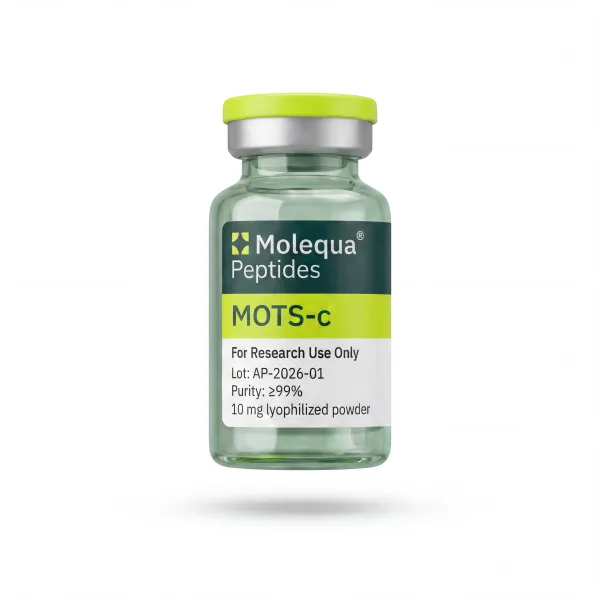
MOTS-c (mitochondrial peptide)
If the research is focused on tissue quality and energetics, MOTS-c brings a complementary mechanism. The GH combination is the peptide “for size” (anabolism), MOTS-c is the peptide “for quality” (mitochondrial energetics via AMPK). Two independent anabolic mechanisms, a popular combination in longevity and metabolism research.
TB-500 (Thymosin β-4 fragment)
For research focused on comprehensive soft tissue regeneration. TB-500 acts via actin polymerization and stem-cell mobilization, while the GH combination supplies systemic anabolic support. Together with BPC-157, TB-500 is often described as part of regenerative protocols.
Key scientific figures and citations
“Ipamorelin is the first GHRP-receptor agonist with a selectivity for GH release similar to that of GHRH. Neither ACTH nor cortisol levels were elevated above vehicle-induced levels.”
Raun K. et al. (1998), European Journal of Endocrinology 139(5), PubMed 9849822
Statistics from the preclinical and clinical literature
- Ipamorelin, a pentapeptide (5 amino acids), sequence Aib-His-D-2-Nal-D-Phe-Lys-NH2, molecular weight 711.86 Da, CAS 170851-70-4
- CJC-1295 without DAC (mod GRF 1-29), a 30-amino-acid GHRH analog, molecular weight approximately 3367.9 Da, CAS 863288-34-0
- Ipamorelin developed by Novo Nordisk, described in 1998 (Raun et al.); CJC-1295 developed by ConjuChem, characterized in 2005–2006 (Jetté, Teichman)
- Mechanism: CJC-1295 activates the GHRH receptor (cAMP/PKA), Ipamorelin activates the ghrelin receptor GHS-R1a and suppresses somatostatin
- Natural GHRH has a half-life of ~7 minutes (degraded via DPP-4); CJC-1295 without DAC has a prolonged but still pulsed profile
- In Teichman 2006 (humans): CJC-1295 raised mean GH 2 to 10-fold and IGF-1 1.5 to 3-fold depending on dose
- Ipamorelin releases GH without a significant rise in cortisol and prolactin, unlike older GHRPs (GHRP-6, GHRP-2)
Reference sources (PubMed)
- Raun K. et al. (1998). “Ipamorelin, the first selective growth hormone secretagogue.” Eur J Endocrinol 139(5):552–561. PubMed 9849822
- Teichman SL. et al. (2006). “Prolonged stimulation of GH and IGF-I secretion by CJC-1295 in healthy adults.” J Clin Endocrinol Metab 91(3):799–805. PubMed 16352683
- Jetté L. et al. (2005). “hGRF(1-29)-albumin bioconjugates activate the GRF receptor on the anterior pituitary in rats.” Endocrinology 146(7):3052–3058. PubMed 15817669
- Ionescu M., Frohman LA. (2006). “Pulsatile secretion of GH persists during continuous stimulation by CJC-1295.” J Clin Endocrinol Metab 91(12):4792–4797. PubMed 16968788
Regulatory status: Neither Ipamorelin nor CJC-1295 is an approved human medicinal product in any regulatory zone (FDA, EMA, or any national medicines agency). GH secretagogues are on the WADA prohibited substances list. Existing data come predominantly from preclinical (animal) literature and early human safety studies (CJC-1295). The product is sold strictly for laboratory scientific research (RUO).
Frequently asked questions about Ipamorelin + CJC-1295
These questions address the most common research-context searches about this GH combination. For full technical documentation see the sections above.
What is Ipamorelin + CJC-1295 and what is it used for in research?
It is a combination of two peptides that release growth hormone by two different routes. Ipamorelin is a selective GHRP (an agonist of the ghrelin receptor GHS-R1a), CJC-1295 without DAC is a GHRH analog (it activates the GHRH receptor). Together they produce a larger GH pulse than either one alone. In research, GH and IGF-1 secretion, tissue regeneration and metabolism are studied in animal models.
What is the difference between Ipamorelin and CJC-1295?
Ipamorelin is a short pentapeptide that acts via the ghrelin receptor and suppresses somatostatin (the natural GH brake). CJC-1295 is a longer GHRH analog that activates the GHRH receptor (the accelerator pedal). Ipamorelin is selective, so it does not raise cortisol or prolactin; CJC-1295 prolongs the duration of the GH signal. That is why they are combined, two independent mechanisms reinforce each other.
What is the difference between CJC-1295 with DAC and without DAC?
CJC-1295 with DAC (Drug Affinity Complex) binds to albumin in the blood and its action lasts several days. CJC-1295 without DAC (mod GRF 1-29) has a shorter, pulsed profile (on the order of tens of minutes to hours). This product contains the version without DAC, precisely because it is paired with Ipamorelin, both act in short pulses that mimic natural pulsatile GH secretion.
Are Ipamorelin and CJC-1295 approved medicines or research substances?
Neither peptide is an approved human medicine in any regulatory zone (FDA, EMA, or any national medicines agency). GH secretagogues are on the WADA prohibited substances list. The product is sold strictly for laboratory scientific research (RUO).
How is this GH combination stored?
Store the lyophilized peptides at −20 °C (2 to 3 years), at 2 to 8 °C for 6 to 12 months, room temperature up to 30 days. After reconstitution with bacteriostatic water the solution is stable 28 days at 2 to 8 °C protected from light. Both peptides are usually reconstituted separately.
Why doesn’t Ipamorelin raise hunger and cortisol like older GHRPs?
Older GHRPs (GHRP-6, GHRP-2) stimulated not only growth hormone but also cortisol, prolactin and intense hunger. In the study by Raun et al. (1998), Ipamorelin was the first peptide to release GH selectively, without a significant rise in these hormones. This “cleanness” is why Ipamorelin is used as the reference GHRP in combination protocols.
Where to buy Ipamorelin + CJC-1295 in the EU for scientific research?
This GH combination for scientific research in the EU is offered by Molequa® with delivery in 3 to 5 business days across Slovakia, Czechia and the EU. The product ships lyophilized with a Certificate of Analysis (COA), HPLC purity ≥ 99 %. The product is strictly for laboratory scientific research (RUO).