




Quick overview
Glutathione (GSH) is the γ-Glu-Cys-Gly tripeptide, the most abundant low-molecular-weight thiol in cells and the reference molecule of redox balance. Research follows the GSH/GSSG ratio, the activity of glutathione peroxidases and S-transferases, and S-glutathionylation of proteins.
- Atypical γ-peptide bond, resistant to common peptidases
- The free thiol group of cysteine carries the redox activity
- Oxidises to GSSG in solution, prepare the solution fresh
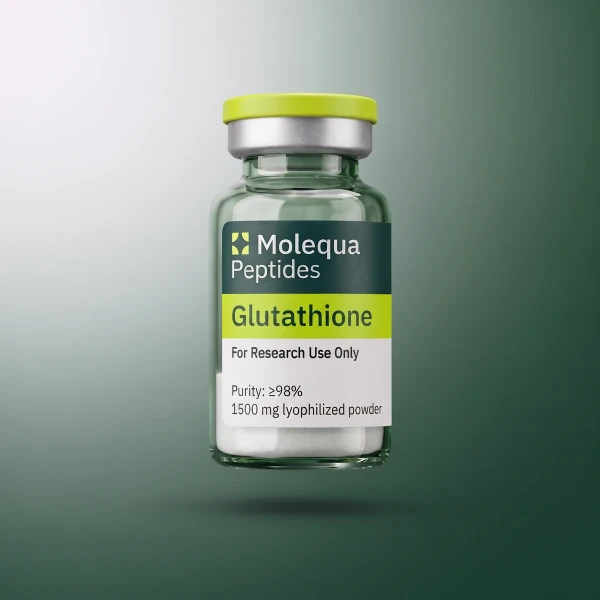
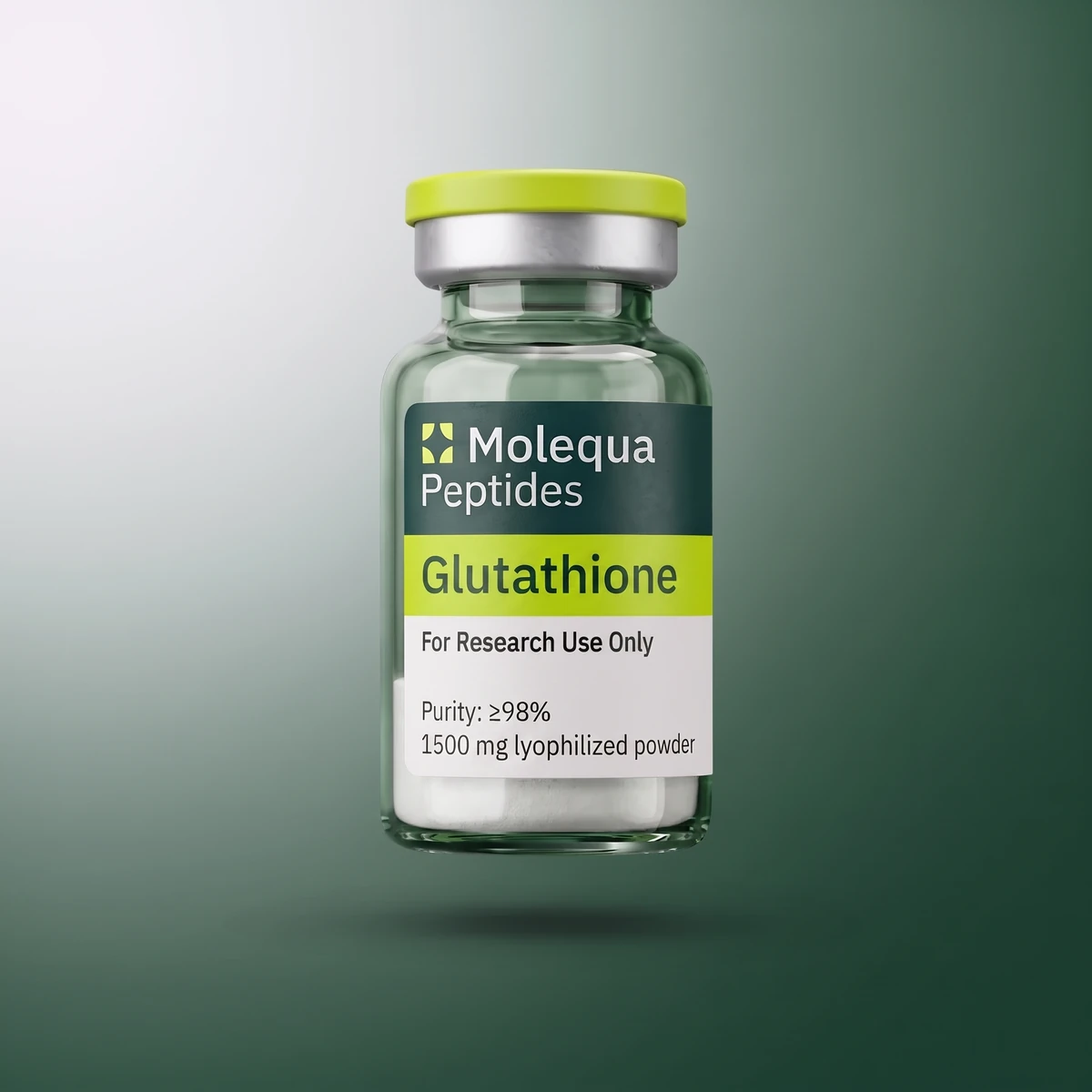
- 1,500 mg lyophilisate, declared purity ≥ 98 % HPLC
Read more Close
Overview
Glutathione (GSH) is the tripeptide γ-L-glutamyl-L-cysteinyl-glycine, formula C10H17N3O6S, 307.3 Da, CAS 70-18-8. It is the most abundant low-molecular-weight thiol in cells, present at millimolar concentrations, and in research it serves as the reference molecule of redox balance: the ratio of reduced GSH to the oxidised disulfide GSSG is an established indicator of cellular redox state. Molequa® offers it as a 1,500 mg lyophilisate with a declared purity of ≥ 98 % HPLC, exclusively for laboratory research.
What glutathione is and where it comes from
Glutathione is not a designer molecule from a catalogue, it is the native tripeptide of every nucleated cell. It consists of three ordinary amino acids, glutamic acid, cysteine and glycine, and the cell synthesises it itself; that is why you find it at millimolar concentrations in every tissue (review by Forman 2009).
Think of the cell as a workshop where every job involving oxygen throws sparks, the reactive oxygen species. Glutathione is the bucket of water next to every workstation: it is “used up” in the act of extinguishing (oxidised to GSSG) and then refilled (reduced back to GSH). The ratio of full to empty buckets is what a researcher measures as the GSH/GSSG ratio.
What we know about the structure, and what we do not
The structure of glutathione is entirely unambiguous, a welcome difference from many research peptides. Two things make it unusual:
- The γ-peptide bond. Glutamic acid is attached to cysteine not through its ordinary α-carboxyl group but through the carboxyl on its side chain (the γ position). This atypical bond is resistant to common peptidases, which is why glutathione survives long enough in the cell.
- The free thiol group (–SH) of cysteine. The carrier of redox activity: the thiol gives up an electron, two GSH molecules join through a disulfide bridge, and oxidised glutathione GSSG is formed.
| Molecule | Structure | Role in research | What is measured |
|---|---|---|---|
| GSH (reduced glutathione) | Tripeptide γ-Glu-Cys-Gly, 307.3 Da, free thiol group –SH | Electron donor, substrate of glutathione peroxidases and S-transferases, source of S-glutathionylation | GSH concentration, thiol content, GSH/GSSG ratio |
| GSSG (oxidised glutathione) | Two GSH molecules joined by a disulfide bridge –S–S– | Product of GSH oxidation, indicator of oxidative load | GSSG concentration, GSH/GSSG ratio |
| N-acetylcysteine (NAC) | Acetylated L-cysteine, a derivative of a single amino acid, not a peptide | Cysteine source for cellular GSH synthesis, thiol reducing agent | Thiol content, cysteine, subsequently GSH in cells |
What we do not yet know about the Molequa® product are the data of the specific batch: measured HPLC purity and mass confirmed by LC-MS. The first batch is not yet in stock, so this page shows only declared values (≥ 98 % HPLC) and database values (307.3 Da); the measured figures will be added on the day of stocking.
Mechanism: what glutathione does in the cell
Antioxidant protection (glutathione peroxidases)
Glutathione peroxidases reduce hydrogen peroxide and lipid peroxides with electrons from two GSH molecules; GSSG is formed, which the cell reduces back. That is why the GSH/GSSG ratio reflects oxidative load so sensitively: when peroxides accumulate, the buckets empty faster than they refill (Forman 2009, PubMed 18796312).
Conjugation of xenobiotics (glutathione S-transferases)
Glutathione S-transferases attach glutathione through its thiol group to foreign electrophilic molecules; the conjugate is more water-soluble and the cell can export it. The classic research model for the metabolism of foreign compounds.
Redox signalling and S-glutathionylation of proteins
The GSH/GSSG ratio and the state of thiol groups in proteins also act as a signal that changes the activity of enzymes and transcription factors (Lushchak 2012, PubMed 22500213). Under oxidative load glutathione additionally binds reversibly through a disulfide to cysteines in proteins; this S-glutathionylation protects sensitive cysteines from irreversible oxidation and can be mapped proteomically.
Research areas
The Molequa® lyophilisate is the molecule itself, not a cell: it is used wherever GSH is needed as a defined substance, that is as a standard, a substrate or a reducing agent. Typical questions:
- Measuring redox state: the GSH/GSSG ratio in cells, tissues and blood fractions, validation of HPLC and enzymatic methods (Forman 2009).
- In vitro models of oxidative load: whether adding GSH to a medium translates into the intracellular GSH/GSSG ratio is an experimental question, not a property of the product.
- Enzymology and analytical chemistry of thiols: kinetics of glutathione peroxidases and S-transferases with GSH as substrate, stability of GSH in solution at different pH and oxygen exposure, comparison with N-acetylcysteine.
Buying Glutathione: what to look for
When buying glutathione for research, five things decide: a certificate of analysis for the specific batch, HPLC purity backed by a chromatogram, identity confirmed by LC-MS (307.3 Da), the lyophilisate form rather than a solution, and shipping from the EU with batch traceability. A 1,500 mg vial costs €39.99 to €59 in the EU. Molequa® offers it for €53.90 (€0.04 per mg), and until the first batch is stocked exclusively as a reservation without payment.
1. HPLC purity ≥ 98 % backed by a chromatogram
Purity tells you what share of the powder is the main component. With glutathione, also ask whether it refers to the reduced form GSH, because oxidised GSSG is the most natural impurity. A number without a chromatogram is a claim, not evidence.
2. Certificate of analysis for the specific batch
A document with batch number, date and measured value, issued by an independent laboratory. If a seller shows only a generic template or a certificate “on request”, do not buy.
3. LC-MS identity, 307.3 Da
The mass spectrum confirms that the powder contains the tripeptide with a mass of 307.3 Da and not some other thiol compound. A certificate without identity is incomplete.
4. EU origin and shipping with batch traceability
EU stock means shorter transport, no customs risk and a batch you can trace back. Molequa® ships from the EU, usually within 1 to 3 working days of stocking.
5. The right form: lyophilisate, never a solution
GSH in solution oxidises to GSSG, faster at neutral to alkaline pH, with oxygen exposure and metal ions, so a ready-made solution has an unknown GSH/GSSG ratio on the day of delivery. Quality glutathione is supplied as a lyophilisate, and you prepare the solution fresh just before the experiment.
Verify quality in 30 seconds
- ✅ CoA for the batch publicly available?
- ✅ HPLC purity ≥ 98 % backed by a chromatogram?
- ✅ Identity confirmed by LC-MS with a mass of 307.3 Da?
- ✅ EU stock and batch traceability?
- ✅ Supplied as a lyophilisate, not as a ready-made solution?
Every Molequa® batch receives a certificate of analysis from an independent laboratory before sale; for glutathione it will be published in the Batch test results section when the first batch is stocked.
Legal notice: Molequa® glutathione is a laboratory chemical for research, neither a medicine nor a dietary supplement. It is sold exclusively for scientific laboratory research and is not intended for human or animal consumption; the supplementation studies cited here concerned dietary supplements, not this product.
Science & Studies
The glutathione literature has two layers. The first is biochemical reviews of its roles, measurement and biosynthesis (Forman 2009, Lushchak 2012). The second is human studies of oral supplementation with a dietary supplement (Richie 2015, Allen 2011, Sinha 2018). The second layer does not concern the Molequa® laboratory lyophilisate. We present it as facts of the literature with numbers, not as a promise.
4.1 Key publications
Two reviews cover the biochemistry, Forman 2009 and Lushchak 2012. The three human papers are studies of a dietary supplement: they belong here as the most cited human data on glutathione and say nothing about the Molequa® product.
| Study | Year | n | Form and dose | Duration | Result |
|---|---|---|---|---|---|
| Richie et al., Eur J Nutr, PubMed 24791752 | 2015 | 54 | oral GSH, 250 or 1,000 mg/day | 6 months | at 1,000 mg/day blood GSH stores higher by 30–35 % (erythrocytes, plasma, lymphocytes) |
| Allen & Bradley, J Altern Complement Med, PubMed 21875351 | 2011 | 40 | oral GSH, 500 mg twice daily | 4 weeks | no change in oxidative stress biomarkers |
| Sinha et al., Eur J Clin Nutr, PubMed 28853742 | 2018 | – | liposomal GSH, 500 or 1,000 mg/day | 1 month | higher GSH stores and markers of immune function (NK cytotoxicity) |
We do not state the sample size for Sinha 2018 until we have verified it in the full text; none of these numbers is an instruction.
4.2 Detailed expandable studies
▸ Study 1: Forman 2009, review of roles, measurement and biosynthesis
Citation: Forman H.J., Zhang H., Rinna A. Glutathione: overview of its protective roles, measurement, and biosynthesis. Mol Aspects Med. 2009. PubMed 18796312.
What they did: A review of glutathione biochemistry from biosynthesis, through antioxidant protection and xenobiotic conjugation, to the methods of measuring GSH and GSSG.
What they found: Glutathione is the most abundant low-molecular-weight thiol in the cell, at millimolar concentrations. The GSH/GSSG ratio reports on redox state only when GSH does not oxidise during sample preparation.
Why it matters for research with GSH: The methodological foundation for measuring glutathione and for using it as a standard. The conditions that ruin a sample ruin a solution of the lyophilisate too.
▸ Study 2: Lushchak 2012, homeostasis and functions
Citation: Lushchak V.I. Glutathione homeostasis and functions: potential targets for medical interventions. J Amino Acids. 2012. PubMed 22500213.
What they did: A review of how the cell keeps its glutathione level in balance and which functions follow from it, including redox signalling and S-glutathionylation.
What they found: The GSH level is the result of several concurrent fluxes, not a static value. A shift in redox state changes the activity of enzymes and transcription factors, so glutathione is also a signalling molecule.
Why it matters for research with GSH: It explains why adding GSH to a system need not have a simple result: the cell has its own homeostasis and responds to the change, which is why more than one variable is measured.
▸ Study 3: Richie 2015, randomised trial of an oral supplement
Citation: Richie J.P. Jr., et al. Randomized controlled trial of oral glutathione supplementation on body stores of glutathione. Eur J Nutr. 2015. PubMed 24791752.
What they did: A randomised controlled trial in 54 adults: oral glutathione as a dietary supplement at 250 or 1,000 mg per day for 6 months; GSH stores in erythrocytes, plasma and lymphocytes.
What they found: At 1,000 mg per day, blood GSH stores were higher by 30–35 % after 6 months in all three fractions.
Why it matters for research with GSH: A study of a dietary supplement in humans, not of a laboratory lyophilisate; the Molequa® product is not intended for human consumption. Methodologically it shows where GSH stores are measured and what time horizon that requires.
▸ Study 4: Allen 2011 and Sinha 2018, two shorter studies with opposite results
Citation: Allen J., Bradley R.D. Effects of oral glutathione supplementation on systemic oxidative stress biomarkers in human volunteers. J Altern Complement Med. 2011. PubMed 21875351. Sinha R., et al. Oral supplementation with liposomal glutathione elevates body stores of glutathione and markers of immune function. Eur J Clin Nutr. 2018. PubMed 28853742.
What they did: Allen 2011: 40 volunteers, oral glutathione as a dietary supplement, 500 mg twice daily for 4 weeks, biomarkers of oxidative stress. Sinha 2018: liposomal glutathione at 500 or 1,000 mg per day for 1 month, GSH stores and markers of immune function.
What they found: Allen 2011: no change in biomarkers, a negative study. Sinha 2018: GSH stores and NK cell cytotoxicity higher after one month.
Why it matters for research with GSH: Again studies of a dietary supplement in humans. Two similarly short papers with opposite conclusions show that the measured variable and the form of administration (free versus liposomal GSH) are decisive; the Molequa® lyophilisate is not liposomal.
Storage
Store the glutathione lyophilisate at 2–8 °C, dry and dark, in a tightly closed vial. Prepare the solution fresh in water or buffer and use it on the day of preparation: in solution GSH oxidises to GSSG, faster at neutral to alkaline pH, with oxygen exposure and in the presence of metal ions. Bacteriostatic water with benzyl alcohol is not needed.
Lyophilisate (dry powder before reconstitution)
- Refrigerator at 2 to 8 °C is the standard, exactly as the label states; freezer at −20 °C for long-term storage if you will not be opening the vial. Room temperature only for transport and handling.
- Protect from light and moisture. For a thiol, moisture is a greater enemy than heat, because water brings oxygen and oxidation with it.
After reconstitution (solution in water or buffer)
- Use on the day of preparation. A glutathione solution is not a stock, it is a working reagent. An acidic environment slows oxidation, alkaline conditions and metal ions speed it up; use a buffer free of metal ions and keep the solution on ice.
- You cannot see oxidation. Both GSH and GSSG form a clear, colourless solution, so appearance is no proof of freshness; the only proof is the time since preparation and a measurement.
Practical rules
- Let the vial warm to room temperature (15 to 20 minutes) before opening, otherwise moisture condenses on the powder.
- With 1,500 mg in one vial, do not open it needlessly: weigh out what you need and close it immediately; for repeated work, divide the lyophilisate into smaller dry vials right after the first opening.
- Never mix NAD+ or GHK-Cu solutions into a shared vial with GSH. GSH is a reducing agent and copper ions accelerate thiol oxidation.
Combination tips, Frequently combined peptides
In research design glutathione belongs with the molecules of the redox and mitochondrial axis: NAD+ as the cell’s other great redox pair and MOTS-c for the mitochondria as the main source of reactive oxygen species. Combination means parallel arms of an experiment, never a shared solution: GSH is a reducing agent and reacts in one vial with NAD+ or with copper-bearing GHK-Cu.
NAD+, the other redox pair
The cell has two great redox pairs, NAD+/NADH and GSH/GSSG, and they are linked: the recycling of GSSG to GSH draws reducing equivalents from the nicotinamide coenzymes, which is why both axes are measured side by side. In the vial, however, they belong apart.
MOTS-c, the mitochondrial source of load
Mitochondria are the main source of reactive oxygen species in the cell and hold their own glutathione pool. MOTS-c targets mitochondrial metabolism, glutathione catches its by-products; the pair makes sense in models of the relationship between metabolism and redox state.
GHK-Cu, beware of copper
GHK-Cu is a tripeptide with a bound copper ion, and copper ions accelerate thiol oxidation. If you study both peptides in one project, keep them in separate solutions and add them to the system separately.
Key scientific figures and citations
Every figure on this page comes from two reviews of glutathione biochemistry, three human studies of a dietary supplement, the PubChem database and the product parameters. The figures from the human studies are facts of the literature, not properties of the Molequa® lyophilisate, and none of them is an instruction for use.
“Glutathione: overview of its protective roles, measurement, and biosynthesis.”
Forman HJ., Zhang H., Rinna A. (2009), Mol Aspects Med, PubMed 18796312
Table of key figures
| Item | Value | Source |
|---|---|---|
| Sequence and formula | γ-Glu-Cys-Gly, C10H17N3O6S | PubChem |
| Molecular weight, CAS | 307.33 Da, 70-18-8 | PubChem |
| Oral supplement 1,000 mg/day, 6 months (n = 54) | blood GSH stores +30–35 % | Richie 2015, PubMed 24791752 |
| Oral supplement 500 mg twice daily, 4 weeks (n = 40) | no change in oxidative stress biomarkers | Allen 2011, PubMed 21875351 |
| Liposomal supplement 500 or 1,000 mg/day, 1 month | higher GSH stores and NK cytotoxicity | Sinha 2018, PubMed 28853742 |
| Molequa® vial | 1,500 mg lyophilisate, ≥ 98 % HPLC, €53.90 (€0.04/mg) | product parameters |
| Market price of 1,500 mg in the EU | €39.99 to €59 per vial | market survey, November 2026 |
Figures from the research literature
- Human studies of a dietary supplement: Richie 2015 (n = 54, 6 months) +30–35 % blood GSH stores; Allen 2011 (n = 40, 4 weeks) no change in oxidative stress biomarkers; Sinha 2018 (1 month) higher GSH stores and NK cytotoxicity
- Direct measurements of the Molequa® lyophilisate: none yet; the first measured datum will be the certificate of analysis of the first batch
Reference sources (PubMed)
- Forman HJ., Zhang H., Rinna A. (2009). “Glutathione: overview of its protective roles, measurement, and biosynthesis.” Mol Aspects Med. PubMed 18796312
- Lushchak VI. (2012). “Glutathione homeostasis and functions: potential targets for medical interventions.” J Amino Acids. PubMed 22500213
- Richie JP Jr. et al. (2015). “Randomized controlled trial of oral glutathione supplementation on body stores of glutathione.” Eur J Nutr. PubMed 24791752
- Allen J., Bradley RD. (2011). “Effects of oral glutathione supplementation on systemic oxidative stress biomarkers in human volunteers.” J Altern Complement Med. PubMed 21875351
- Sinha R. et al. (2018). “Oral supplementation with liposomal glutathione elevates body stores of glutathione and markers of immune function.” Eur J Clin Nutr. PubMed 28853742
Product status: Molequa® glutathione is a laboratory chemical exclusively for scientific research (RUO), neither a medicine nor a dietary supplement; it is not intended for human or animal consumption.
Frequently asked questions about Glutathione
These questions answer the most common searches about glutathione in a research context: what kind of molecule it is, how GSH differs from GSSG and from N-acetylcysteine, what the human dietary supplement studies say and how to work with the lyophilisate. For technical documentation see the sections above.
What is glutathione and why is it called a tripeptide?
Glutathione (GSH) is the tripeptide γ-L-glutamyl-L-cysteinyl-glycine, C10H17N3O6S, 307.3 Da, CAS 70-18-8. Glutamate is attached to cysteine through an atypical γ-peptide bond that is resistant to common peptidases, and the free thiol group of cysteine carries the redox activity. In cells it is the most abundant low-molecular-weight thiol.
What is the difference between GSH and GSSG?
GSH is the reduced form with a free thiol group; GSSG is the oxidised disulfide in which two GSH molecules are joined by an –S–S– bridge. The GSH/GSSG ratio is an established indicator of cellular redox state (Forman 2009, PubMed 18796312). In solution GSH converts spontaneously to GSSG, which is why solutions are prepared fresh.
What do the studies of oral glutathione in humans say?
These are studies of a dietary supplement, not of a laboratory lyophilisate. Richie 2015 (n = 54): 1,000 mg/day for 6 months, blood GSH stores higher by 30–35 %. Allen 2011 (n = 40): 500 mg twice daily for 4 weeks, no change in oxidative stress biomarkers. Sinha 2018: liposomal GSH for 1 month, higher GSH stores and NK cytotoxicity. They do not apply to the Molequa® product.
Why is a glutathione solution prepared fresh?
Because GSH in solution oxidises to GSSG, faster at neutral to alkaline pH, oxygen exposure and metal ions, and the oxidation is not visible: both GSH and GSSG form a clear, colourless solution. Prepare the solution just before the experiment; bacteriostatic water is not needed.
How does glutathione differ from N-acetylcysteine?
Glutathione is the finished tripeptide with a free thiol. N-acetylcysteine (NAC) is acetylated L-cysteine, a derivative of a single amino acid, which in cell models serves as a cysteine source for the cell’s own GSH synthesis and as a thiol reducing agent. In research they are compared as two ways of influencing the cellular glutathione pool.
How is glutathione stored?
Store the lyophilisate at 2 to 8 °C, protected from light and moisture, in a tightly closed vial; long-term in a freezer at −20 °C. Let the vial warm to room temperature before opening. Do not store the solution; prepare it fresh. Stability periods for the batch will be confirmed against the certificate.
Where to buy glutathione in the EU for scientific research?
Molequa® offers glutathione as a 1,500 mg lyophilisate for €53.90 (€0.04 per mg), ≥ 98 % HPLC, with a batch certificate of analysis once stocked; the market price in the EU is €39.99 to €59. Until the first batch is stocked the product is available as a reservation without payment. Delivery by Packeta or courier (Slovakia 1 to 2, Czechia 2 to 3, other EU countries 3 to 5 working days). Research use only (RUO).