




Quick overview
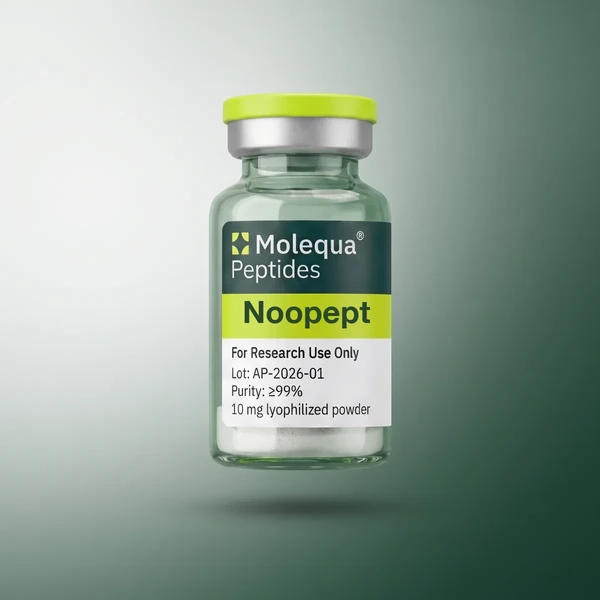
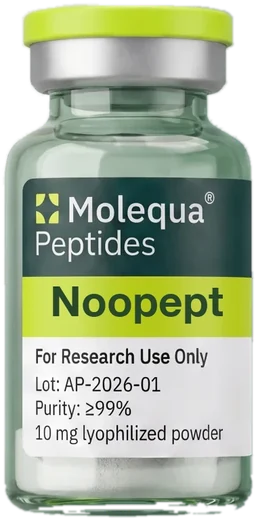
Noopept is the ethyl ester of N-phenylacetyl-L-prolylglycine, a dipeptide designed from piracetam. It was developed at the Zakusov Institute of Pharmacology in Moscow and the literature studies it mainly in the hippocampus.
- International non-proprietary name omberacetam, development code GVS-111
- Markers measured: NGF, BDNF and HIF-1 (Ostrovskaya et al., 2008)
- Described active metabolite cycloprolylglycine, an endogenous neuropeptide
- A medicine in Russia, no approval in the EU or the USA, for laboratory research only
Read more Close
Overview
Noopept, GVS-111, omberacetam: the same substance
| Name | Origin |
|---|---|
| Noopept | Common trade and research name |
| GVS-111 | Original development designation |
| Omberacetam | International non-proprietary name (INN) |
| N-Phenylacetyl-L-prolylglycine ethyl ester | Full chemical name |
All four refer to the same dipeptide. Throughout this text we use noopept.
Origin and why it was developed
Noopept came out of the Institute of Pharmacology of the Russian Academy of Medical Sciences in the 1990s. The starting point was a structural observation: piracetam, widely used at the time, contains a pyrrolidone ring that resembles proline. Ostrovskaya’s group asked whether the same effect could be achieved with a real peptide.
The result was a dipeptide of proline and glycine, fitted with a phenylacetyl group and an ethyl ester. Both modifications serve the same purpose: they raise lipophilicity and thereby improve uptake across the blood-brain barrier, a known problem with small peptides.
In the published animal models the effective concentrations were orders of magnitude lower than for piracetam. That gain in potency was the stated goal of the program.
Mechanism of action in the literature
Neurotrophic factors. The best documented finding is increased expression of NGF (nerve growth factor) and BDNF (brain-derived neurotrophic factor) in the rat hippocampus. Both factors are closely tied in the neuroscience literature to synaptic plasticity.
Active metabolite. In the organism noopept is converted to cycloprolylglycine, an endogenous dipeptide that is itself described as neuromodulatory. Part of the observed effects is attributed in the literature to this metabolite.
Antioxidant component. In cell models, protection against oxidative stress and against calcium overload has been described.
Research status 2026
The evidence base for noopept is asymmetric. In Russia there are clinical investigations and a marketing authorization as a medicine. In the Western research space the data are predominantly preclinical; large randomized trials to EMA or FDA standard are absent.
That asymmetry is why noopept is not authorized in the EU and is traded exclusively as research material.
The active metabolite: the genuinely interesting part
This is the pharmacologically most remarkable aspect of noopept, and it is missing from almost every account.
Noopept is metabolized to cycloprolylglycine, a cyclic dipeptide. Cycloprolylglycine is not a mere breakdown product, however, but an endogenous neuropeptide that occurs naturally in the brain and whose own activity has been described independently.
Gudasheva and colleagues published work on the anxiolytic activity of endogenous cycloprolylglycine as early as 2001, and in 2016 on its effect on BDNF levels in nerve cells. More recent work describes a dependence on AMPA and TrkB receptors.
Part of what noopept does may therefore be attributable to a substance the organism makes anyway. This hypothesis of a prodrug of an endogenous neuropeptide is what actually sets noopept apart within its substance class.
What the literature actually measures
The published work deals with defined biological markers, not with vague notions of cognitive performance.
| Marker | What the papers report |
|---|---|
| NGF (nerve growth factor) | Increased expression in the rat hippocampus |
| BDNF | Increased expression in the rat hippocampus |
| HIF-1 | Activation of the transcription factor described in vitro |
| Oxidative stress | Protective effect on human cortical neurons in culture |
The NGF and BDNF axis is the best documented. Both are neurotrophins, that is, survival and growth factors for nerve cells, and the hippocampus is a structure central to memory.
A limitation that belongs on the record
The great majority of the noopept literature is Russian, published in journals such as the Bulletin of Experimental Biology and Medicine, and frequently comes from the same research group.
That in itself is not a disqualifier, but it is a feature of the evidence base that it would be dishonest to conceal. Independent replication by outside groups is thin, and the journals concerned have limited international visibility.
One exception is the 2003 paper by Pelsman and colleagues, carried out on human cortical neurons and with a co-author from outside the originating group.
Regulatory position
Noopept is marketed as a medicine in Russia. There is no authorization in the European Union or the United States.
Buying Noopept: what to look for
When buying noopept it is not the price that decides but the verifiability of the quality. A research compound is only ever as good as its certificate of analysis. These five criteria separate serious suppliers from grey-market sellers, because from the outside lyophilized powder looks identical.
1. HPLC purity, documented rather than claimed
HPLC purity states what proportion of the powder is actually noopept and not a by-product of the synthesis. Serious suppliers document the value with a chromatogram. A purity figure without an attached chromatogram is a claim, not evidence.
2. Batch-specific certificate of analysis (CoA)
The most important document. A batch-specific CoA belongs to exactly the batch you receive: with batch number, date of analysis and purity value, issued by an independent laboratory. Rule of thumb: if a supplier cannot show you the CoA for the specific batch immediately, do not buy there.
3. LC-MS identity confirmation
Purity tells you how much of a substance is present. LC-MS tells you which substance it is. It confirms the correct identity via the molecular mass and rules out that a cheaper, mislabeled material has been shipped.
4. Origin and EU shipping with traceability
A supplier with a warehouse in the EU and full batch traceability has the advantage over grey imports: shorter transport routes, no customs risk, a documented path from synthesis to vial.
5. Correct delivery form: lyophilizate
High-quality material is delivered as a lyophilizate, freeze-dried powder, not as a premixed solution. In dry form the substance is stable for considerably longer and is reconstituted only immediately before use.
Legal notice: Noopept is a research material and not an approved medicine. It is supplied exclusively for scientific laboratory research and is not intended for human or animal consumption. It has no approved therapeutic use.
Science & studies
Key publications
Gudasheva T.A., Konstantinopolskii M.A., Ostrovskaya R.U., Seredenin S.B. (2001). Anxiolytic activity of endogenous nootropic dipeptide cycloprolylglycine in elevated plus-maze test. Bull Exp Biol Med. 131(5):464–466. PubMed 11550054 The paper on the endogenous metabolite, indispensable for understanding the prodrug hypothesis.
Pelsman A., Hoyo-Vadillo C., Gudasheva T.A., Seredenin S.B., Ostrovskaya R.U., Busciglio J. (2003). GVS-111 prevents oxidative damage and apoptosis in normal and Down’s syndrome human cortical neurons. Int J Dev Neurosci. 21(3):117–124. PubMed 12711349 One of the few papers on human cells, published under the development designation GVS-111.
Ostrovskaya R.U., Gudasheva T.A., Zaplina A.P. et al. (2008). Noopept stimulates the expression of NGF and BDNF in rat hippocampus. Bull Exp Biol Med. 146(3):334–337. PubMed 19240853 The most cited result: the effect on both neurotrophins in the hippocampus.
Vakhitova Y.V., Sadovnikov S.V., Borisevich S.S. et al. (2016). Molecular Mechanism Underlying the Action of Substituted Pro-Gly Dipeptide Noopept. Acta Naturae. 8(1):82–89. PubMed 27099787 The most complete mechanistic overview available in English.
Zainullina L.F., Ivanova T.V., Sadovnikov S.V. et al. (2020). Cognitive Enhancer Noopept Activates Transcription Factor HIF-1. Dokl Biochem Biophys. 494(1):256–260. PubMed 33119829 A newer mechanistic thread, independent of the neurotrophin axis.
Detailed studies
▸ Study 1: NGF and BDNF in the hippocampus
Citation: Ostrovskaya R.U. et al. Noopept stimulates the expression of NGF and BDNF in rat hippocampus. Bull Exp Biol Med, 2008. PubMed 19240853
What they did: administered noopept to rats and then measured the expression of NGF and BDNF in the hippocampus.
What they found: increased expression of both neurotrophins in that structure.
Why it counts: this is the result the most frequently cited mechanism rests on. NGF and BDNF are survival and plasticity factors for neurons, and the hippocampus is central to memory. It is at the same time the most widely repeated publication, usually without any note that this is a rodent model.
▸ Study 2: on human neurons
Citation: Pelsman A. et al. GVS-111 prevents oxidative damage and apoptosis in normal and Down’s syndrome human cortical neurons. Int J Dev Neurosci, 2003. PubMed 12711349
What they did: studied cultures of human cortical neurons, both of regular origin and from people with trisomy 21, under oxidative stress. Trisomy 21 is a sensible model here because it goes together with raised oxidative stress.
What they found: protection against oxidative damage and apoptosis in both culture types.
Why it counts: because it involves human tissue, which is rare in this evidence base. The other side of it: cell culture is a long way from an effect in a living organism.
▸ Study 3: the endogenous metabolite
Citation: Gudasheva T.A. et al. Anxiolytic activity of endogenous nootropic dipeptide cycloprolylglycine in elevated plus-maze test. Bull Exp Biol Med, 2001. PubMed 11550054
What they did: tested the activity of cycloprolylglycine itself, not of noopept, in the elevated plus-maze, a standard procedure for assessing anxiety in rodents.
What they found: an activity resembling anxiolysis for the endogenous cyclic dipeptide.
Why it counts: this is the core of the hypothesis that noopept acts at least partly as a prodrug of a neuropeptide the brain produces anyway. That shifts the question fundamentally.
▸ Study 4: the mechanistic overview
Citation: Vakhitova Y.V. et al. Molecular Mechanism Underlying the Action of Substituted Pro-Gly Dipeptide Noopept. Acta Naturae, 2016. PubMed 27099787
What they did: a summarizing, molecularly oriented paper on the signalling pathways described for the substituted dipeptide.
What they found: a bundle of converging mechanisms around neurotrophin expression and intracellular signalling.
Why it counts: it is the most useful reference for an overall picture in English, without having to reconstruct more than twenty years of scattered Russian publications yourself.
Storage
Store lyophilized powder at 2–8 °C protected from light; for long-term storage −20 °C. In dry form the substance is stable this way for years. After reconstitution the solution belongs in the fridge, protected from light, and according to the literature should be used within 28 days. Avoid repeated freezing and thawing, which degrades peptides measurably.
Reservation
Noopept is currently available for reservation. You reserve the quantity you want without obligation, and we confirm the batch and the delivery date by email. No payment is taken at reservation.
Stacking tips: substances frequently studied alongside
Piracetam and the racetam family
Historically this is the meaningful comparison, since noopept was designed starting from piracetam. The Russian literature reports activity at markedly lower doses, which was the stated goal of the program.
It is a comparison, not a combination. There are no published data on giving the two together.
Cycloprolylglycine
Not a combination but a metabolic relationship. Studying both in parallel is exactly what the literature itself does, in order to separate what is attributable to the administered substance from what belongs to its metabolite.
Choline and cholinergic precursors
This combination is widespread in informal use but rests on no publication dealing specifically with noopept. The mechanism described in the literature is neurotrophic, not cholinergic, which makes the argument from analogy questionable.
Key scientific figures and citations
“Noopept stimulates the expression of NGF and BDNF in rat hippocampus.” After Ostrovskaya R.U. et al. (2008), Bulletin of Experimental Biology and Medicine 146(3):334–337 PubMed 19240853
Key data from the literature
- Chemical name: N-phenylacetyl-L-prolylglycine ethyl ester
- Development designation: GVS-111, still in use in older publications
- International non-proprietary name: omberacetam
- Origin: Zakusov Institute of Pharmacology (V. V. Zakusov), Moscow, Russia
- Starting molecule of the design: piracetam
- Described active metabolite: cycloprolylglycine, an endogenous neuropeptide
- Markers measured: NGF, BDNF, HIF-1, markers of oxidative stress
- Brain structure studied first and foremost: the hippocampus
- First publication on the endogenous metabolite: 2001
- Status: a medicine in Russia, no authorization in the EU or the USA
- WADA prohibited list: not affected
Figures from the cited studies
- Neuroprotection in vitro (Pelsman 2003, Int J Dev Neurosci 21(3):117–124): exposure to 50 µM H₂O₂ for 1 hour destroyed more than 60 % of human cortical neurons in culture. GVS-111 was protective across 10 nM to 100 µM with an IC50 of 1.21 ± 0.07 µM
- In the same work GVS-111 outperformed piracetam, vitamin E, propyl gallate and s-PBN on neuroprotection. Cortical neurons from Down’s syndrome were also tested
- Selectivity at the level of transcription factors (Vakhitova 2016, Acta Naturae 8(1):82–89): out of nine factors tested (CREB, NFAT, NF-κB, p53, STAT1, GAS, VDR, HSF1, HIF-1), noopept at 10 µM increased DNA binding for HIF-1 only. Piracetam at 1 mM affected none of them
- Anxiolytic effect of the metabolite (Gudasheva 2001, Bull Exp Biol Med 131(5):464–466): cycloprolylglycine at 0.05 mg/kg i.p. prolonged time spent in the open arms of the elevated plus-maze nine-fold. The D-enantiomer was inactive at 0.05 and 0.1 mg/kg
- Neurotrophins (Ostrovskaya 2008, Bull Exp Biol Med 146(3):334–337): mRNA expression of both NGF and BDNF in rat hippocampus rose after a single dose, and after 28 days of dosing the effect did not weaken but was potentiated, meaning no tolerance developed
- Asymmetry of the evidence: Russia has a marketing authorisation as a medicine and clinical trials, the Western literature has essentially none. Authorisation in the EU or the USA: none
Reference sources (PubMed)
- Gudasheva T.A. et al. (2001). Anxiolytic activity of endogenous nootropic dipeptide cycloprolylglycine in elevated plus-maze test. Bull Exp Biol Med 131(5):464–466. PubMed 11550054
- Pelsman A. et al. (2003). GVS-111 prevents oxidative damage and apoptosis in normal and Down’s syndrome human cortical neurons. Int J Dev Neurosci 21(3):117–124. PubMed 12711349
- Ostrovskaya R.U. et al. (2008). Noopept stimulates the expression of NGF and BDNF in rat hippocampus. Bull Exp Biol Med 146(3):334–337. PubMed 19240853
- Ostrovskaya R.U. et al. (2014). Noopept normalizes parameters of the incretin system in rats with experimental diabetes. Bull Exp Biol Med 157(3):344–349. PubMed 25065315
- Vakhitova Y.V. et al. (2016). Molecular Mechanism Underlying the Action of Substituted Pro-Gly Dipeptide Noopept. Acta Naturae 8(1):82–89. PubMed 27099787
- Zainullina L.F. et al. (2020). Cognitive Enhancer Noopept Activates Transcription Factor HIF-1. Dokl Biochem Biophys 494(1):256–260. PubMed 33119829
Regulatory status: Noopept is marketed as a medicine in Russia. There is no authorization in the European Union or the United States. The product offered here is a reagent exclusively for scientific laboratory research (RUO).
Frequently asked questions about Noopept
What is noopept?
Noopept is a synthetic dipeptide, chemically N-phenylacetyl-L-prolylglycine ethyl ester. It was developed in the 1990s at the Russian Institute of Pharmacology as a peptide-analogue nootropic and carries the development designation GVS-111.
Is noopept a racetam?
No, although it is often classed as one. Noopept is a dipeptide and structurally not a racetam. The comparison comes from its being described in the Russian literature as a further development of the piracetam concept, with markedly lower effective concentrations in animal models.
What mechanisms are described in the literature?
Chiefly an increased expression of the neurotrophic factors NGF and BDNF in the hippocampus, together with an active metabolite, cycloprolylglycine. The evidence comes predominantly from rat models.
Is noopept authorized in the EU?
No. Noopept is not authorized as a medicine in the European Union. It is supplied exclusively as research material, not for use in humans.
What does GVS-111 mean?
It is the development designation of noopept. Older publications use that name, so you need to know it to find the complete literature.
Is noopept a peptide?
It is a substituted dipeptide of proline and glycine with a phenylacetyl group, present as an ethyl ester. Its size and behavior correspond more to a small molecule than to the lyophilized peptides of the range.
What is cycloprolylglycine?
The metabolite of noopept and at the same time a neuropeptide the brain produces naturally. Its own activity has been described independently, which gave rise to the hypothesis that noopept acts partly as a prodrug.
Why do you call the evidence base limited?
Because it is predominantly Russian, frequently from the same research group, and appeared in journals with low international visibility. Independent replication is thin. That does not make the results wrong, but it belongs to the assessment.
What do the studies actually measure?
Primarily the expression of NGF and BDNF in the rat hippocampus, markers of oxidative stress in neuronal cultures, and more recently the activation of the transcription factor HIF-1.